

Rwanda is set to rehabilitate cold-room facilities across key agricultural zones in a move expected to improve post-harvest handling, reduce losses, and expand market access for more than 400,000 smallholder farmers.
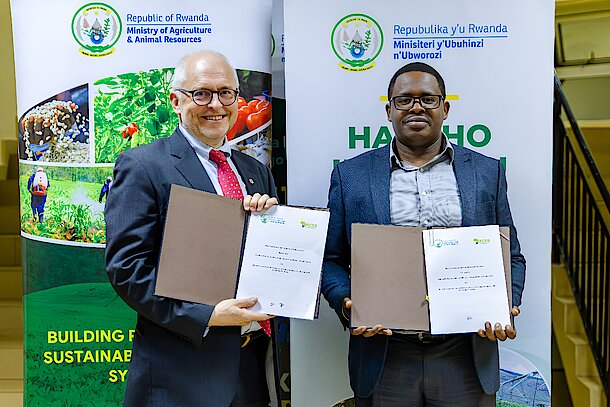
The initiative follows the signing of a strategic Memorandum of Understanding on March 25, 2026, between the Ministry of Agriculture and Animal Resources (MINAGRI) and the Africa Centre of Excellence for Sustainable Cooling and Cold-Chain (ACES).
The partnership marks a significant step toward modernizing Rwanda’s agricultural value chains through investment in cold-chain infrastructure.
At the heart of the collaboration is the technical rehabilitation and operationalization of 10 cold-room packhouse facilities that have remained underutilized. Once upgraded, these facilities will form a coordinated national network designed to support climate-resilient agriculture, enhance research, and improve market linkages.
The facilities are strategically located in key production districts, including Rulindo District, Rwamagana District, Gatsibo District, Ngoma District, Nyanza District, and Karongi District. Together, they are expected to serve hundreds of thousands of farmers across the country’s major horticultural zones.
Each packhouse will be equipped with modern infrastructure, including temperature-controlled storage systems, solar-powered energy solutions, and advanced post-harvest handling technologies. These upgrades will allow produce to move efficiently from farms to markets under controlled conditions, significantly extending shelf life and improving quality.
Beyond infrastructure, the initiative aims to transform the broader agricultural system by linking farmers more effectively to markets, enabling value addition, and supporting export growth. Technical assessments show that Rwanda’s fruit and vegetable cold-chain market spans more than 495,000 hectares across over 13,000 production sites.
The 10-packhouse network alone is projected to cover 36 percent of this market, serving more than 4,800 production sites and supporting an annual output exceeding 2.3 million metric tonnes of produce.
Even at minimal utilization levels, the facilities are expected to operate at full capacity, highlighting both the scalability and commercial viability of the investment.
The project will also establish integrated food corridors connecting farmers to premium domestic markets, as well as regional and international export destinations. To meet global standards, the facilities will operate under recognized food safety and quality frameworks such as HACCP and Rwanda GAP, with plans to advance toward Global G.A.P. certification.
Under the agreement, MINAGRI will provide policy direction and coordination, while ACES will oversee technical design, operationalization, training, and the development of sustainable business models. The packhouses will also serve as hubs for innovation, research, and skills development, guided by a joint steering committee tasked with implementation and scaling.
Speaking during the signing ceremony, MINAGRI Permanent Secretary Olivier Kamana described the partnership as a critical milestone in the country’s efforts to modernize agriculture. He noted that strengthening cold-chain systems would reduce post-harvest losses while unlocking new opportunities for value addition, exports, and increased rural incomes.
Professor Toby Peters, Executive Director of ACES, emphasized that the initiative addresses a long-standing gap in agricultural development—connecting production to markets. By integrating cooling, logistics, standards, skills, and market access into a unified system, he said, Rwanda is positioning itself as a leader in climate-smart agriculture.
Beyond its national impact, the initiative is expected to position Rwanda as a regional hub for sustainable cold-chain solutions. It opens new avenues for collaboration with investors, agribusinesses, logistics providers, and market off-takers, while contributing to food security, climate resilience, and green economic growth across Africa.