

Lei Gommers, Global Business Development Manager – Agriculture Drives, ABB
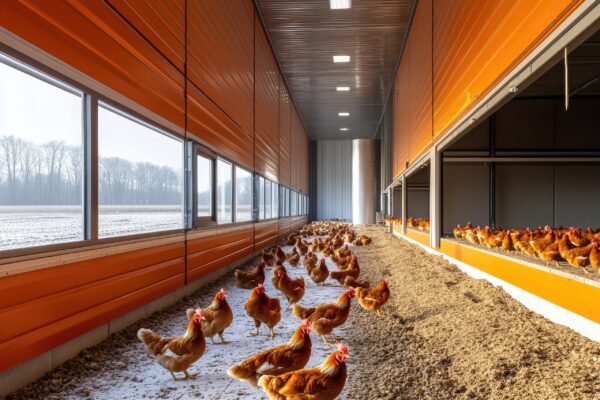
The way air moves through a poultry house can determine whether a farm thrives or merely survives. Yet even in buildings packed with fans, heaters and inlets, the climate inside often fails to match the scale and sensitivity of modern production.
On paper, ventilation is simple: move enough fresh air through the building to control temperature, humidity, and levels of ammonia and CO₂. In practice, it has become one of the most complex and risky processes in intensive agriculture — and one of the least controlled.
ABB’s recent whitepaper challenges how we think about air as a production factor. At the center of that rethink is a deceptively simple tool: the variable speed drive (VSD). This small electrical box has the power to turn ventilation from background noise into a steady and reliable input for the prosperity of your poultry farm.
On/off is no longer enough
The traditional approach to ventilation in poultry farming begins and ends with checking that the fans are turning. That mindset is increasingly out of step with the realities facing modern chicken farms.
The whitepaper draws a clear line between two worlds. On one side, there are traditional systems built on single‑speed fans, that are either on or off. On the other are setups where VSDs, sensors and controls work together to adjust airflow continuously in response to actual conditions.
The technical difference is straightforward. Fixed‑speed fans deliver one airflow at one energy cost; VSD‑controlled fans can deliver many combinations, matching speed to what the animals and the climate need.
The practical difference is bigger. For today’s poultry farmers, the ventilation challenge is getting much harder, not easier. Poultry houses are getting bigger, bird breeds are becoming more climate-sensitive, and weather isn’t as predictable anymore. With these challenges stacked on top of each other, “rough control” leads to familiar problems like hot spots, cold drafts, wet litter, ammonia spikes, higher mortality rates during heatwaves, and electricity bills that swing wildly with the seasons.
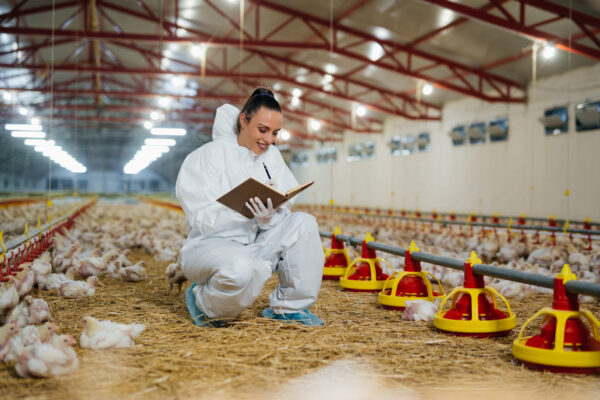
That’s why, in an industry that demands precision, ventilation can no longer rely on just the on-off switch. Air flow needs the same level of control as all your other processes.
What changes with precision fan control
When VSDs are applied as part of a well‑designed system, three effects stand out.
- First, climate stability improves. Instead of fans cycling harshly on and off, drives ramp speed up and down to hold setpoints for temperature and humidity. Minimum speeds can be defined so that incoming cold air is always mixed, not directed towards chicks or weaners. In hot conditions, those limits can be relaxed to prioritize energy savings without sacrificing comfort.
- Second, risk falls. Today’s drives are designed with livestock realities in mind. They can reduce speed instead of tripping during voltage dips, run in bypass if the drive itself fails, and even continue operating with a lost mains phase to give time for staff to intervene. On top of that, with built-in diagnostics, alarms, and logging, drives can flag issues early so ventilation becomes a monitored process rather than a blind spot.
- Third, the cost picture becomes more nuanced. For example, broiler and layer operations face very different economics: broiler farms start with negligible airflow needs and end with intense ventilation demand. That means most VSD savings — and most of the benefit in shaving electrical peaks — arrive in the second half of the cycle. But in the first half of the cycle, chicks are especially sensitive and need a very stable climate. Here, more accurate control still pays off by supporting better growth and improved feed conversion. However, layer farms run at a much steadier airflow baseline. Here, speed control tends to deliver more consistent savings and typical drive payback is shorter – often 12–24 months. This is because fans run at optimized, not maximum, speed for most of the year.
This nuance is important to note. Rather than a blanket solution, VSDs are a tool whose value varies according to production model, climate, and energy usage.
The future of air flow
This is not about swapping one type of controller for another, but changing the philosophy of how we manage air.
In a climate‑stressed agricultural economy with tightening margins, ventilation cannot be judged solely on whether it keeps livestock alive. It has to be measured like any other production system: stability of the climate, behavior under risk, energy used per kilogram of output, and uptime.
VSDs offer a route to treating air as a controllable, optimizable process rather than a stubborn cost and welfare risk. And with efficient drive technology, ABB is helping turn that idea into something practical that can be deployed at scale. For the industrial side of agriculture, that shift may prove as vital as any new technology on the horizon.
For a deeper dive into system design considerations, risk features, and farm-type comparisons, see ABB’s whitepaper From skepticism to strategy: Rethinking poultry ventilation