

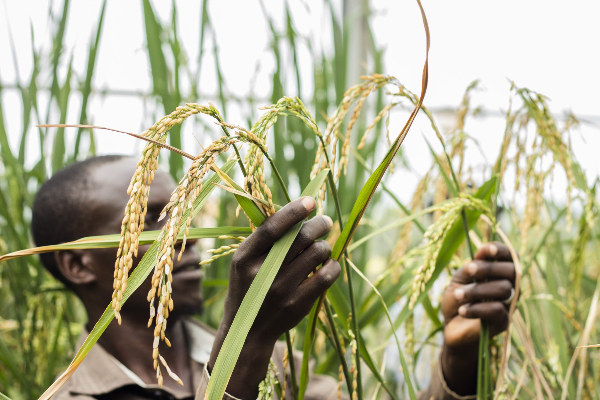
Scientists drawn from Uganda’s National Agricultural Research Organisation (NARO) are finalising advanced field and quality tests on new homegrown aromatic rice varieties poised to rival imported basmati and supa rice.
According to local media reports the initiative is being driven by steep domestic demand for aromatic rice and aimed at boosting farmer incomes, strengthening food security and cutting the country’s heavy rice import bill.
The new aromatic rice lines were developed under the Promotion of Sustainable Rice Development (ECO-PRiDe) Project funded by the Japan International Cooperation Agency (JICA) and implemented by NARO in partnership with national and local stakeholders.
Dr Jimmy Lamo, a rice breeder and Cereals Programme Leader at NARO, said current locally grown aromatic rice varieties suffer from low yields and high disease susceptibility, failing to meet market demand.
“These aromatic varieties dominate the market, but the ones currently grown in Uganda are highly susceptible to disease and give low yields,” Dr Lamo said, noting the improved lines were developed using disease-resistant parent seeds.
He said the new aromatic lines are undergoing performance testing across six locations, including the Doho Irrigation Scheme in Butaleja District, ahead of submission to the Ministry of Agriculture, Animal Industry and Fisheries and the National Variety Release Committee.
Dr Lamo told reporters on December 11, 2025, during the second Joint Technical Committee meeting of the ECO-PRiDe Project that farmers, millers and other value chain actors are participating in cooking and milling evaluations before approval.
He added that the involvement of these stakeholders is crucial to ensuring that the new varieties not only yield well but also meet consumer preferences for aroma and grain quality.
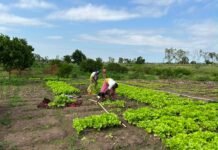
 Officials inspecting the new rice trial fields at Doho Irrigation Scheme in Butaleja District. Photo/NARO X
Dr Titus Alicai, Director of Research at the National Crops Resources Research Institute and National Project Coordinator for ECO-PRiDe, said the project goes beyond varietal development to promote sustainable and climate-resilient rice production.
“We want to increase rice production without harming the environment, while improving incomes for rural farmers,” Dr Alicai said, explaining that the approach includes producing high-quality seed and strengthening farmer knowledge on sustainable cultivation practices.
He added that ECO-PRiDe is developing an evidence-based blueprint to improve efficiency along the entire rice value chain and reduce the environmental footprint linked with rice farming.
Dr Kisho Miyamoto, Chief Advisor for the ECO-PRiDe Project, said the initiative is leveraging Japan’s long history in rice production to support Uganda’s agricultural transformation.
“More importantly, we are ensuring last-mile delivery, bringing quality seed, disease control knowledge and sustainable cultural practices directly to farmers,” Dr Miyamoto said, noting the project also supports capacity building for young Ugandan researchers.
At the Doho Rice Scheme in Butaleja, Dr Nasser Kasozi, Director of Research at BugiZARDI, said many farmers have already adopted improved production technologies introduced under the project.
He noted that the initiative is piloting rice–fish integration technologies, where nutrient-rich fish pond water is used to enhance rice productivity, providing additional food and income sources for rural households.
Dr Kasozi also revealed that a cropping calendar is being developed to improve water-use efficiency and stabilise rice yields throughout the year.
Officials who inspected the new rice trial fields observed promising performance of the aromatic lines alongside farmer-centred innovations, raising hopes of a more competitive and sustainable rice sector.
With the release of the locally developed aromatic varieties imminent, stakeholders believe Uganda is steadily positioning itself to reduce import dependence and meet growing consumer demand with homegrown solutions.