

The International Institute of Tropical Agriculture under the Consultative Group on International Agricultural Research (IITA–CGIAR), in partnership with the World Vegetable Center (WorldVeg) and AfricaRice, is deepening collaboration with The Gambia to strengthen national research capacity and advance food and nutrition security.
The effort is anchored in a Memorandum of Understanding between IITA and The Gambia’s Ministry of Agriculture, underscoring a shared commitment to country ownership and homegrown agricultural transformation, according to a recent repot by IITA.
The partnership is supported by Phase II of the Program to Strengthen Food and Nutrition Security in the Sahel (P2-P2RS), financed by the African Development Bank, through the Technologies for African Agricultural Transformation (TAAT) Program.
Its focus is to equip Gambian scientists with the skills to design, test, and scale innovations tailored to national priorities.
A flagship outcome of earlier collaboration is the biofortified maize variety PVA Syn13, bred by IITA and released in The Gambia in 2020. Rich in vitamin A, the variety has been prioritized by the government for maize production and is now used in school and hospital feeding programmes, as well as recommended for children under five years, pregnant women, and lactating mothers.
“In the past the government was spending a lot of money to import Vitamin A (for the hospitals) in the country for children under five and pregnant mothers; now with PVA Syn13 much of the efforts is focused on production and dissemination of this variety across the country to provide natural vitamin A,” said Modou Sabally who is one of the trainees.
“Now we have leant the skills of maize breeding, we hope to release more provitamin A maize varieties in our country,” he added.
To consolidate such gains, a cohort of Gambian researchers undertook two to three weeks of intensive, hands-on training across three leading research centers: IITA in Ibadan, led by Dr Silvestro Meseka; WorldVeg in Cotonou, led by Dr Mathieu Ayenan; and AfricaRice in Bouaké, led by Dr Sali Ndindeng.
The training covered priority value chains under P2-P2RS—maize, cowpea, tomato, cabbage, and rice—reflecting a multi-center approach to building strong, country-anchored research systems.
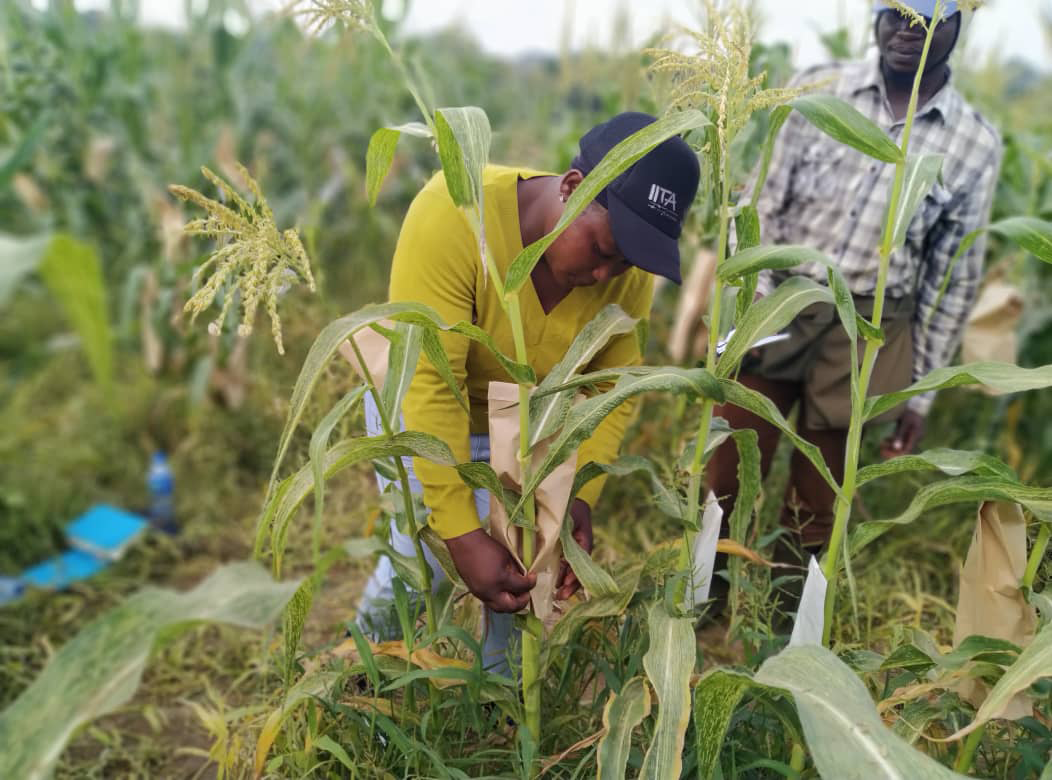
At IITA–CGIAR, participants strengthened their maize breeding skills, including trial design, nursery management, selection of promising lines, and hand-pollination for quality seed production. They also learned to use the statistical software R for data management and analysis—critical competencies for developing varieties suited to diverse Gambian environments.
Sabally, Sarjo Jarju, and Isatou Sillah noted that while they had benefited from IITA seed for decades, this was their first opportunity for deep, hands-on collaboration that enables them to breed and improve crops at home.
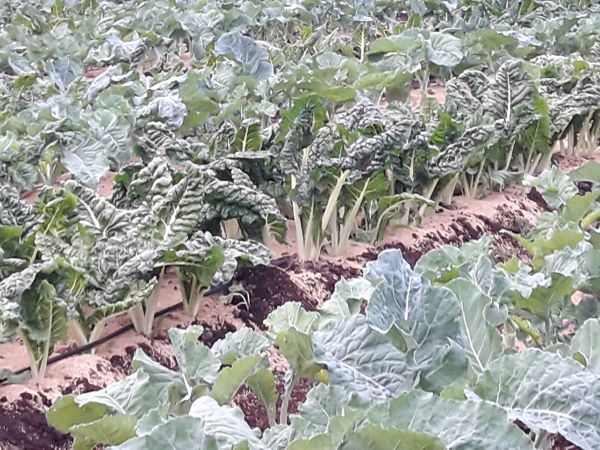
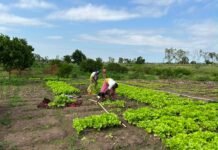
At WorldVeg, Alhagie Mboge, Ismaila Bah, and Sonko Ebou focused on vegetable breeding techniques such as controlled pollination, trait selection, purity maintenance, seed production, tomato grafting, and good agronomic and post-harvest practices.
Field visits with farmers and seed companies demonstrated how breeding advances translate into real-world production.
At AfricaRice, Hawa Manneh, Omar Kandeh, and Lamin Bayo explored rice breeding pipelines, selection methods, and seed systems designed for West African conditions.
The initiative aims to expand The Gambia’s pool of skilled researchers ready to apply new knowledge in farmers’ fields. In early 2026, IITA, WorldVeg, and AfricaRice will visit The Gambia during the planting season to continue field-level coaching and co-develop training materials for wide distribution.
Reflecting on the experience, a trainee said: “The training has been very effective, exposing me to new things, including flower emasculation, good agronomic practices, and, more importantly, vegetable seed production techniques. This training is very timely and the delivery of the modules has been highly interactive, and the trainers have been very resourceful. I am grateful to the trainers for their dedication.”
Through the successful delivery of this Memorandum of Understanding, the partners anticipate deeper collaboration to build resilient food systems in The Gambia, delivering tangible benefits to farmers and communities through strong national research capacity.