

- Agriculture and food systems produce nearly one-third of global GHG emissions, much of it at the farm and land-use level (Our World in Data, 2022).
- Around 75% of global deforestation is driven by agricultural expansion, prompting new expectations for transparent and climate-smart supply chains (org, 2024).
- Meanwhile, 82% of Net Zero commitments remain unverified due to missing Scope 3 and land-use data (PwC, 2025), a gap noted by industry leaders including CEO of Koltiva, Manfred Borer, underscoring the need for credible emissions data from agricultural producers to achieve climate strategies.
Agriculture and food systems are at the heart of the climate challenge, contributing nearly one-third of global greenhouse gas (GHG) emissions. Yet, despite their outsized impact, much of these emissions remain invisible at the farm and field level. Land-use change, livestock, and crop production drive the majority of emissions, far surpassing transport, which accounts for only 5% of the food sector’s footprint (Our World in Data, 2022).
Adding to the urgency, agriculture drives approximately 75% of global deforestation (Earth.org, 2024), contributing roughly 25–30% of global GHG emissions when land-use and cultivation impacts are included (Our World in Data, 2021). Yet most companies continue to rely on aggregated estimates, leaving critical blind spots in land-use emissions, farm practices, and carbon storage, and exposing businesses to regulatory, financial, and reputational risks.
A Gap in Verified Climate Action
Compounding the challenge, research shows that 82% of global Net Zero targets remain unverified, largely due to insufficient Scope 3 emissions data (PwC, 2025). This lack of verified farm-level information makes it nearly impossible for businesses to accurately measure, manage, and reduce their climate impact.
“From a technology and systems perspective, one of the biggest challenges we see is the fragmentation of farm-level data across supply chains. Critical information on fertilizer use, crop management, energy inputs, and land-use change is often collected inconsistently or not at all. Without reliable, interoperable data at the source, companies struggle to identify emissions hotspots, deploy targeted interventions, or confidently meet climate and regulatory commitments. Our focus has been on building scalable systems that integrate geospatial intelligence with verified field data, so emissions data is not only visible, but usable for real decision-making,” said Furqonuddin Ramdhani, Co-Chief Product Technology Officer at Koltiva.
Making Farm-Level Emissions Visible
Koltiva, a Swiss-AgriTech leader in digital agricultural, sustainability and traceability, provides an integrated suite of solutions designed to make previously invisible emissions visible, verifiable, and actionable. Through its KoltiTrace MIS platform, agribusinesses and food companies can now monitor farm-level emissions, identify hotspots, and develop climate-smart interventions aligned with international standards.
Accurately measuring emissions at the farm level remains a major challenge for food and agriculture companies. To address this, businesses are increasingly turning to a combination of geospatial monitoring, satellite imagery, and ground-level data collection to identify emissions hotspots, track land-use change, and verify carbon storage.
By integrating field-level information on farming practices, fertilizer use, energy consumption, and livestock management with global reporting standards such as the GHG Protocol, IPCC guidelines, and SBTi FLAG, companies can obtain credible, verifiable estimates of FLAG-relevant emissions and land-based carbon stock changes, forming a robust basis for compliant emissions accounting and target setting.
These insights enable agribusinesses to better understand their climate impact, support compliance with deforestation and supply chain regulations such as the EU Deforestation Regulation, and explore opportunities for regenerative agriculture and sustainable supply chain interventions. For example, some companies are leveraging platforms like Koltiva’s Land Use Tracker (GHG and EUDR modules) to map land-use change and monitor deforestation, the Cool Farm Tool integration to capture farm-level practices and calculate Scope 3 emissions, and the Agricarbon Tracker to estimate biomass and carbon stock at scale turning previously invisible data into actionable insights for climate-smart decision-making.
Ground Truthing for Credible Data
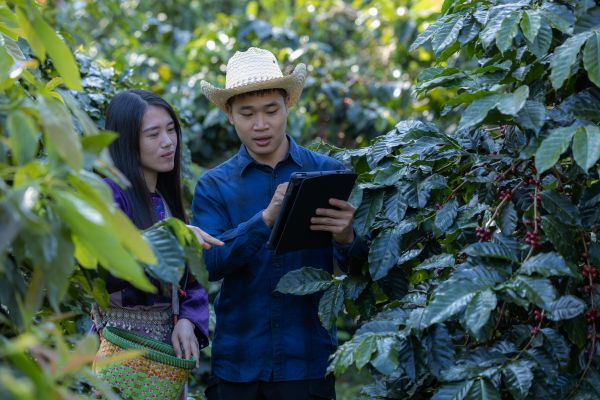
While satellites and sensors provide broad visibility across complex agricultural supply chains, they primarily capture patterns and anomalies rather than the underlying practices that drive emissions at the farm level. To translate remote observations into reliable climate data, companies must link geospatial signals with primary, on-the-ground information. This process typically involves structured data collection at the source — documenting land use, soil management, water inputs, fertilizer application, energy use, and crop practices — followed by systematic validation before the data is incorporated into emissions accounting and reporting frameworks.
“Advanced monitoring technologies are powerful, but from a technology standpoint, their value depends on the quality of the underlying data,” Furqonuddin added. “Ground-truthing is what connects digital signals with real-world conditions. By validating satellite and remote-sensing outputs with on-the-ground evidence, we ensure emissions data is robust enough to stand up to scrutiny from regulators, investors, and buyers. This combination of digital infrastructure and field verification is essential for building climate data systems that are credible, auditable, and scalable across global supply chains.”
Actionable Insights for Companies
By combining high-resolution monitoring with verified field-level data, companies are increasingly able to move from broad emissions estimates to targeted, actionable climate strategies. This integrated approach allows businesses to identify emissions hotspots within their supply chains and prioritize reduction efforts where they matter most, while also meeting growing regulatory and market expectations, including requirements under the EU Deforestation Regulation (EUDR), Corporate Sustainability Reporting Directive (CSRD), ISO 14068 for carbon claims, and the Science Based Targets initiative’s FLAG guidance. Beyond compliance, access to credible emissions data enables companies to support regenerative agriculture and carbon sequestration initiatives, while protecting market access and investor confidence through transparent, verifiable reporting.
Advances in digital monitoring and field-based data collection now make it possible for companies to track emissions and land-use change across thousands of farms and multiple regions. What was once largely invisible, — particularly at the farm level can now be translated into practical insights that inform procurement decisions, supplier engagement, and long-term sustainability investments. As environmental accountability becomes a defining factor of competitiveness, this data-driven approach is increasingly viewed not just as a compliance requirement, but as a strategic necessity for companies operating in global food and agricultural markets.
With nearly one-third of global greenhouse gas emissions linked to food systems and an estimated 82 percent of corporate Net Zero targets still lacking verification, pressure is mounting for companies to demonstrate credible progress. Leveraging a combination of digital monitoring and on-the-ground verification offers a clear pathway for businesses to take measurable action reducing emissions, strengthening resilience, and improving transparency across complex supply chains.
“With the right data and credible measurement systems in place, agribusinesses have an opportunity to lead the transition toward climate-smart agriculture,” said Manfred Borer, Chief Executive Officer and Co-Founder of Koltiva. “Companies that can accurately measure, manage, and reduce their emissions will set the benchmark for the industry, while those that fail to do so risk falling behind as expectations from regulators, investors, and markets continue to rise.”
Looking ahead, emissions monitoring across agricultural supply chains will require alignment with emerging standards such as SBTi FLAG and Scope 3 accounting. Integrating geospatial analysis, field activity data, and verified transactions will become critical for companies seeking to measure land-use emissions, assess carbon stock changes, and track progress against science-based climate targets.