



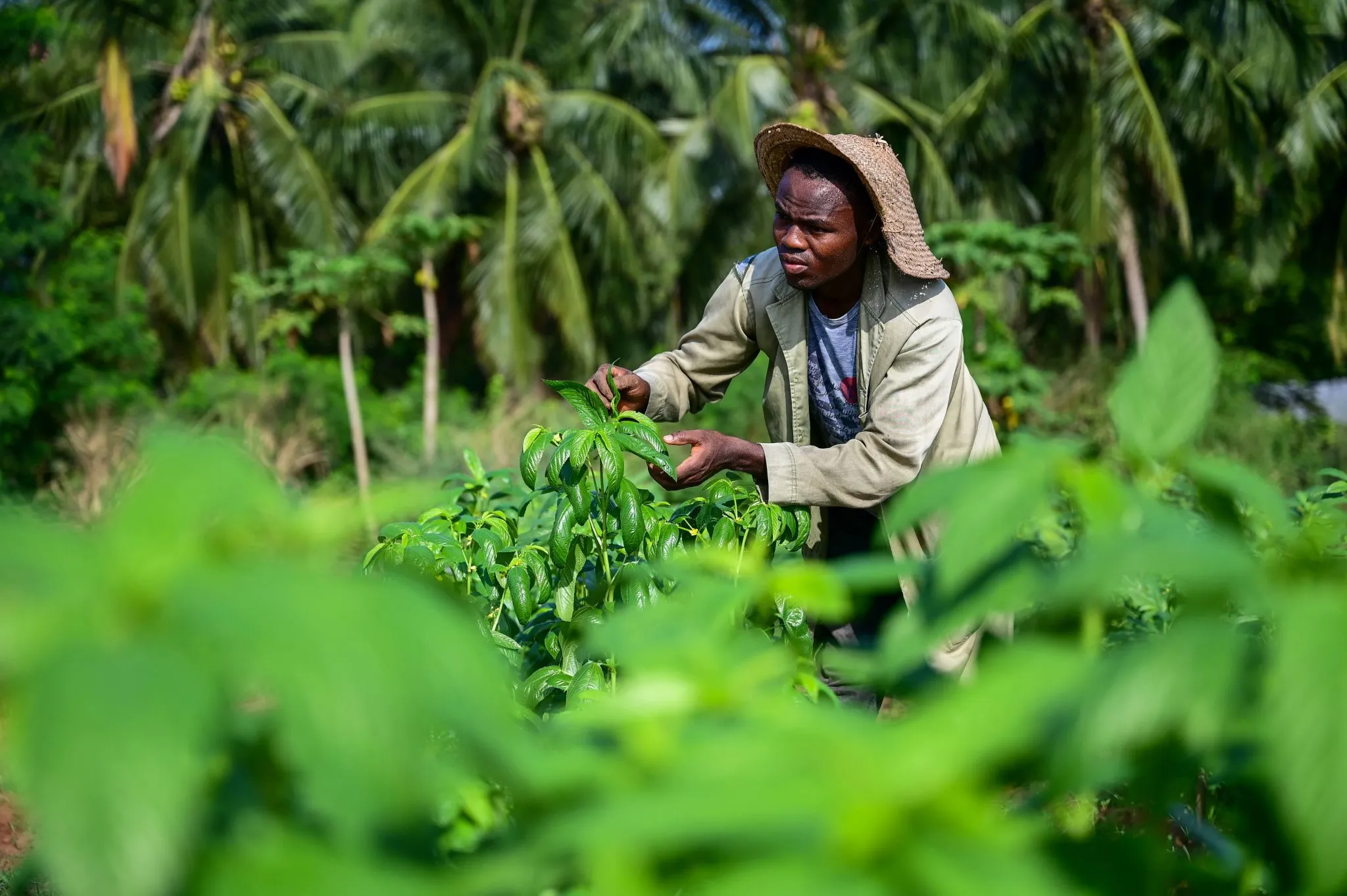
Jute mallow trials at WorldVeg in Benin. Pic by Neil Palmer (for the Crop Trust).
Smallholder farmers across West Africa are set to benefit from a major expansion in access to improved vegetable seeds following the release of dozens of new climate-smart vegetable varieties developed under the SafeVeg project.
The initiative, led by the World Vegetable Center (WorldVeg), has resulted in the release of 68 improved vegetable varieties in Benin, Mali and Burkina Faso, marking the largest increase in officially recognised vegetable crops in the region’s history.
The milestone will be celebrated this week in Cotonou, Benin, as researchers, policymakers and agricultural stakeholders gather to mark the conclusion of the five-year project.
The newly released varieties include chilli and habanero peppers, tomatoes, okra, amaranth, onions, roselle, jute mallow and African eggplant. Their introduction has nearly doubled the number of officially recognised vegetable varieties across the three countries, increasing the total from 70 to 138.
According to project partners, the development represents a significant breakthrough for West Africa’s vegetable sector, which has long struggled with limited access to improved seed varieties.
Before the SafeVeg project, many of the varieties listed in national seed catalogues were outdated and lacked the characteristics required by farmers and markets, limiting productivity and the growth of the sector.
The new varieties were bred to deliver higher yields while offering resistance to key pests and diseases. They also provide improved fruit and leaf quality, helping farmers meet market demands. Researchers say these traits could significantly increase production and incomes for hundreds of thousands of smallholder farmers across the region.
In addition, the varieties require fewer pesticide applications, contributing to safer food production systems while reducing risks to farmers, consumers and the environment.
Of the 68 newly released varieties, 60 were developed by WorldVeg, while the remainder came from regional partners, including Benin’s National Agricultural Research Institute (INRAB), Burkina Faso’s Institute of Environment and Agricultural Research (INERA), and the Faculty of Science and Technology at the University of Abomey-Calavi in Benin.
“This number of new vegetable variety releases is astounding,” said Dr Mathieu Ayenan, Associate Scientist and Vegetable Breeder at WorldVeg. He said the achievement demonstrates how strong scientific research, adequate funding and effective partnerships can create conditions for transformative growth in vegetable production.
SafeVeg project leader Dr Edmond Totin described the initiative as potentially transformative for the region, noting that it is helping unlock the benefits of productive, nutritious and safely produced vegetables for farmers, consumers and national economies.
The project has had a particularly strong impact on national seed catalogues. Since 2023, Benin has registered 50 new vegetable varieties, representing a six-fold increase in the country’s total.
Mali has released 15 varieties, bringing its total to 48, while Burkina Faso has registered nine new varieties, increasing its total to 36. A further 14 varieties already released in Benin and Mali have also been approved for local seed production.
The varieties are now being incorporated into the regional seed catalogue overseen by the Economic Community of West African States (ECOWAS), the Permanent Interstate Committee for Drought Control in the Sahel (CILSS) and the West African Economic and Monetary Union (UEMOA), enabling wider commercial production and trade across the region.
Researchers say the success of SafeVeg highlights the importance of collaboration between scientists, seed regulators, extension services, farmers, seed companies and traders.
As the project concludes, stakeholders expect its impact to continue expanding through stronger seed systems, improved farmer access to quality seed and increased competitiveness of vegetable production across West Africa.



[…] Source: Farmers Review Africa […]
Comments are closed.