

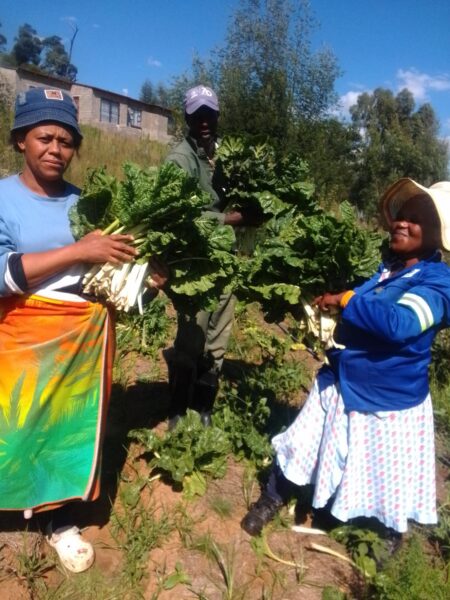
The Mofumahadi MaMontoeli Mota vegetable project of the Batlokoa Ba Mota cultural community in Tsheseng, Phuthaditjhaba, in the Free State has, over the past few weeks, succeeded not only in supplying sufficient vegetables to the local feeding scheme but has also produced a surplus that is being sold by the involved community members. This contributes to improving their socio-economic circumstances and enhances access to affordable, nutritious food in the area. Spinach, carrots, pumpkin and onions have been successfully produced. This success follows the training in vegetable production that community members received in December 2025, as well as the successful installation and commissioning of a solar-powered drip irrigation system in September 2025.
The vegetable project is a joint initiative of the executive committee of the National House of Traditional and Khoi-San Leaders (NHTKL), AfriForum, Saai and the office of Morena e Moholo (Principal Traditional Leader) Montoeli Mota, of the Batlokoa Ba Mota. This historic partnership was established as part of the very first annual Lenaka Memorial Lecture, which was held at the end of 2024 at Manthatisi High School. AfriForum and Saai support the project through their agricultural development incubator, the Resilient Regenerative Agricultural Initiative (RRAIN).
“I am very proud of our community members who, through their hard work and perseverance, are managing to produce more vegetables than the feeding scheme requires, enabling them to also earn an income. I am also proud that they are successfully applying the knowledge and skills transferred to them, as it serves as proof of the potential that can be unlocked in rural areas with the right kind of support. I hope this success motivates other stakeholders to join the project so that it can develop to its full potential,” says Morena e Moholo Montoeli Mota, Morena e Moholo of the Batlokoa Ba Mota cultural community.
“The annual Lenaka Memorial Lecture serves not only as a platform to celebrate our heritage and cultural identity but also focuses on promoting development within traditional communities. The success of this project confirms the positive role that traditional leaders and traditional leadership structures, such as the NHTKL and provincial houses, can play in the socio-economic development of grassroots communities when genuine partnerships based on a shared vision and values are established,” says Kgosi Thabo Seatlholo, Chairperson of the NHTKL.
Barend Uys, Head of Intercultural Relations and Cooperation at AfriForum, emphasises that good relations and cooperation between cultural communities – grounded in mutual recognition and respect – are essential building blocks for ensuring peaceful and prosperous coexistence in the country. “Communities face major challenges that can only be resolved through community building. It is encouraging to see how this project tangibly promotes community self-sufficiency and has a positive impact on people’s lives,” he says.
“Many of the rural, communal areas have good agricultural potential that can best be developed and utilised through the commercialisation of agricultural activities. Therefore, it is crucial to foster the growth of more commercial farmers in these areas where they are most required. Projects like this create development opportunities for small-scale farmers, which have the potential to evolve into commercial farmers. It is therefore a priority and privilege for Saai to also be involved in this initiative,” says Leon Lourens, Development Coordinator at Saai.
“This project is named after my mother, Mofumahadi MaMontoeli Mota, because good deeds like these, which make a future possible for our children, are the best way to honour our ancestors’ legacy,” concludes Morena e Moholo Mota.