

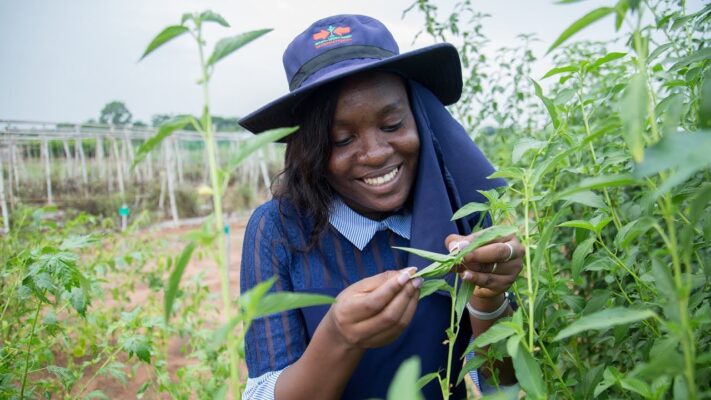
Meet Pamela Afokpe. As a plant breeder with East-West Seed, she’s spent her career creating better varieties of indigenous vegetables for the farmers who need them most. That work has now earned her the Borlaug Field Award from the World Food Prize Foundation — one of agriculture’s highest honours for field-level impact on food security and rural livelihoods.
Building from the ground up
Since 2017, Pamela has led East-West Seed’s research and development efforts in Benin, focusing on crops that the formal seed sector had largely overlooked. Indigenous vegetables like Gboma, Amaranthus, and Corchorus have fed West African families for generations, yet lacked improved genetics and commercial infrastructure. The prevailing industry view was that these crops were commercially unviable because smallholders traditionally saved their own seeds.
Pamela challenged that assumption. She argued that farmers were only recycling seeds because they lacked access to reliable, improved varieties. To test that logic, she spent years collecting more than 2,000 accessions across West Africa- from village markets in Togo to farming communities in Nigeria- gathering genetic material that had never been formally catalogued, held in the hands of farmers operating entirely outside the formal seed system.

Technical innovation and market application
Her breakthrough came through the development of the Sika variety, the first commercial Gboma bred for intermediate tolerance to bacterial wilt and extended shelf life. Bacterial wilt had historically caused field losses of 75% to 100% in the humid tropics, making commercial production prohibitive. Pamela’s variety addressed both the agronomic challenge and the practical barrier of post-harvest deterioration that had prevented these crops from reaching urban markets.
When Sika initially faced market resistance due to its pale green color, Pamela applied behavioral science to reframe the value proposition. She demonstrated that Sika’s superior leaf density allowed households to “make more soup with fewer leaves,” effectively doubling the nutritional return on investment. In the farm, she introduced precise nursery management practices that reduced farmer input costs by 40% while improving seedling survival.
Reaching the last mile
Critically, Pamela recognized that plant science is only effective if it reaches farmers and consumers. Rather than presenting research station data to wholesalers and market women, she conducted shelf-life demonstrations in open-air trading environments where female retailers could directly observe that Sika’s reduced spoilage translated into fewer daily losses and higher margins. Through her “10 Powerful Reasons to Consume Gboma” campaign, she reframed the crop from subsistence staple into one with a credible nutritional identity.
Measurable impact
The results speak plainly. Sika sold approximately 2,000 tons of produce equivalent in its first three years; a volume previously unprecedented for a non-global vegetable variety in the region. This translates to an estimated reach of 10,000 to 40,000 smallholder farmers depending on regional yield variations. Three farmer-adopted indigenous varieties have been released, and the pipeline supports testing of over seven global vegetable crops.
Her work has also influenced policy. East-West Seed’s success with these crops has fed into the Vision for Adapted Crops and Soils (VACS) initiative, a global partnership led by the U.S. State Department and the FAO that now recognizes these “opportunity crops” as critical to climate-resilient nutrition.
Leadership and legacy
Throughout this work, Pamela has managed a team of 30 while completing a sandwich PhD at Wageningen University. She has done this while navigating the structural barriers faced by women in African agricultural leadership, and while balancing new motherhood.
As a One Planet fellow, she has strengthened her leadership capacity to address climate challenges in agriculture. Her journey mirrors the early persistence of Dr. Norman Borlaug: she did not wait for perfect laboratory conditions; she built research infrastructure in a rented field with manual irrigation, stayed in the field until the data was irrefutable, and created a legacy that is currently improving the livelihoods of thousands of families across West Africa.
The Borlaug Field Award recognizes exactly this kind of work—persistence in the field, scientific rigor applied to the crops that matter most to vulnerable communities, and a refusal to accept that certain crops are too difficult or too unmarketable to deserve investment.
Congratulations, Pamela. This is well earned!