

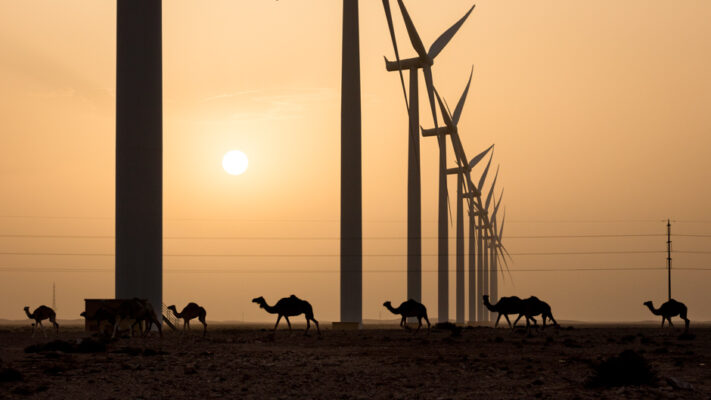
Towering over the Atlantic coast, the 131 wind turbines of the Tarfaya Wind Farm dramatically rise from the Moroccan desert. Tarfaya—a nearby port city and namesake of the megaproject—boasts only 8,000 residents. Despite its unassuming size, Tarfaya has always punched above its weight historically. Juggled between the colonial empires, the city is most remembered for the Green March—a mass demonstration forcing Spain’s capitulation in the Western Sahara territorial dispute, one of the last examples of African decolonization.
Today, Tarfaya is the site of the once-largest wind farm in Africa (only recently eclipsed by the Kenyan Lake Turkana Wind Power Station in 2018). Its staggering size is equaled only by the staggering investment its construction required—the development cost investors around 5 billion MAD, or around 620 thousand MAD per resident of Tarfaya. In comparison, the average salary in Morocco is 72 thousand MAD per resident.
The Tarfaya Wind Farm is just one of several Moroccan mega-energy projects launched in recent years. Some 800 kilometers away sprawls the Ouarzazate Solar Power Station (OSPS), previously the world’s largest concentrated solar power plant. At 243 meters tall, OSPS’ central tower shoots skyward amongst the field of solar panels and looms over nearby Ouarzazate. A bright light atop the tower may be mistaken for a beacon—instead, it is stored thermal energy in the form of molten salt used to generate electricity well into the night. Costing developers upwards of 84 billion MAD (or 9 billion USD), OSPS is the centerpiece of Morocco’s march towards energy independence.
The Moroccan government launched its national plan for renewable energies in 2008, seeing its own dependence on fossil fuel imports—earning it the title of largest energy importer in Africa—as vulnerable for an emerging economy. As of 2025, Morocco has improved is energy efficiency and continued to transition from dependence on imports and fossil fuels to more renewable sources—namely solar, wind, and hydropower. With renewables currently accounting for 46% of the national electricity mix and with a target of a 52% renewable energy share by 2030, Morocco seems poised to accomplish, if not very nearly fall short of, its aggressive renewable goals.
Egypt and South Africa have seen a similar transition to renewables in their national energy mix. Mirroring Morocco, both countries have issued national directives encouraging decreased reliance on fossil fuels in exchange for renewables; both have expanded investment into wind, solar, and hydropower projects; and both have increased regulations on less sustainable energy sources to spur private investment in renewables. The three countries routinely lead the African continent in more sustainable energy consumption:
- South Africa leads the continent in installed wind capacity at 3,442 MW, with Morocco placing second (1,788 MW) and Egypt a near third (1,702 MW).
- South Africa again leads Africa in total installed solar capacity with 6,164 MW, where Egypt places second (1,856 MW) and Morocco takes third (934 MW).
- Hydropower is the only renewable where these three don’t dominate the podium—South Africa ranks third in total installed hydropower capacity at 3,605 MW, with Egypt coming in seventh (2,832 MW) and Morocco a close ninth (2,585 MW) among the 54 African countries.
Despite these similarities, one thing stands out about Morocco amongst the rest—the fact that it stands out at all. Moroccan renewable energy projects are often in the form megaprojects—flashy and audacious spectacles. From a UAE-backed green hydrogen and ammonia project costing 319 billion MAD to the OSPS molten salt tower, from Xlinks’ undersea cable connecting the United Kingdom and Morocco to the massive Tarfaya Wind Farm, Moroccan energy projects are nothing if not attention grabbing.
Morocco is far from the only country to possess a concentrated solar power plant. Khi Solar One in South Africa enjoys a beacon tower much like Morocco’s OSPS, albeit 38 meters shorter and without government branding as leading the “avante-garde of solar” (a term levied by the Moroccan Agency for Sustainable Energy). Morocco’s national renewable investment firm states that, while the short-term objective of the Moroccan energy program is supplying solar power to Morocco, the “[ultimate] objective given by his majesty the king is Mecca.”
While Morocco revels in its recent energy-related accomplishments, I wonder whether Morocco has strayed from its more neatly principled original intentions. In 1996, the Moroccan government launched the Global Rural Electrification Program (PERG). As its namesake suggested, PERG’s primary aim was “achieving a rural electrification rate of 80% by 2010,” specifically with a least-cost approach. This focus on cost-efficiency proved incredibly successful and progress was faster than expected—soon after the original PERG declaration was made, the original goal was revised to a rural electrification rate of 98% by 2007.
Costing 25 billion MAD, the massive undertaking of PERG was carried out by a single state-owned utility: ONE. With only a handful of initial staff and not willing to replicate the unsatisfactory results of rural electrification efforts in the 1970s and 1980s, PERG favored an explicitly “participatory approach.” As opposed to spending a vast majority of PERG’s budget on megaprojects or exponential increases in transmission line lengths, ONE allocated funds only where they were most impactful. These small-dollar investments mainly went to infrastructure repairs by locality—for example, lowering the height of telegraph poles or, in cases where connection to the larger grid was untenable financially, doling out individual solar home systems.
While systems integration and intra-national coordination was facilitated by ONE, “significant role…[was] given to local municipalities in terms of approval of zones, identification of households and more generally providing access to local information.” Morocco’s most significant rural electrification program—which achieved 99.89% rural coverage by 2024—relied purely on participatory involvement in planning, decision-making and implementation.
I invoke participatory development purposefully to contrast its methods to the current focus on energy megaprojects. While the previously listed megaprojects have been largely successful and have generated ample amounts of energy, they originate from a centralized perspective of Moroccan development that restricts rural communities to the edges of generated benefits. Instead of putting those with the most need at the forefront of development, megaprojects serve to supplement those attached to the developed national power grid, open possibility for Morocco to become a net energy exporter, and “prove the extent of Morocco’s technical abilities.”
Let’s return to PERG, where a hallmark of their investment strategy was the implementation of individual solar home systems where connection to the larger grid was financially lackluster. This strategy enjoyed widespread popular support and high efficacy rates. Not only was energy supplied to rural communities—through the participatory approach, communities saw higher usage of electricity for income-generating activities along with more general adoption of electricity for efficient utility use.
A similar approach may be applied today as an alternative to further megaprojects such that focus may be returned to the rural Moroccan communities where energy inequality is most felt. Continued allotment of solar home systems or rooftop photovoltaic panels to farms and businesses without electricity—or homesteads where connection to the national grid is financially costly—will serve not only to make energy use more equitable but also build the capacity for rural communities to capitalize on electricity for their own entrepreneurial and socioeconomic endeavors. Through use of the participatory approach and a preference for a similar least-cost methodology to PERG’s, state actors and facilitators may be able to meet Morocco’s 52% renewable energy share by 2030 without a 90 billion MAD price tag.
Megaprojects must not be the only path forward as Morocco seeks to appease international sustainable development goals. Similarly, holistic adoption of solar home systems will not increase Morocco’s stature as North Africa’s largest clean energy exporter. Instead, a balanced approach is necessary to ensure Morocco’s equitable fulfillment of its many objectives—a balanced approach which holds the third of its population living in rural conditions with continued diligence.
Griffin Franzese is a systems engineering student at the University of Virginia conducting research regarding the voluntary carbon market while living in Marrakesh, Morocco.