

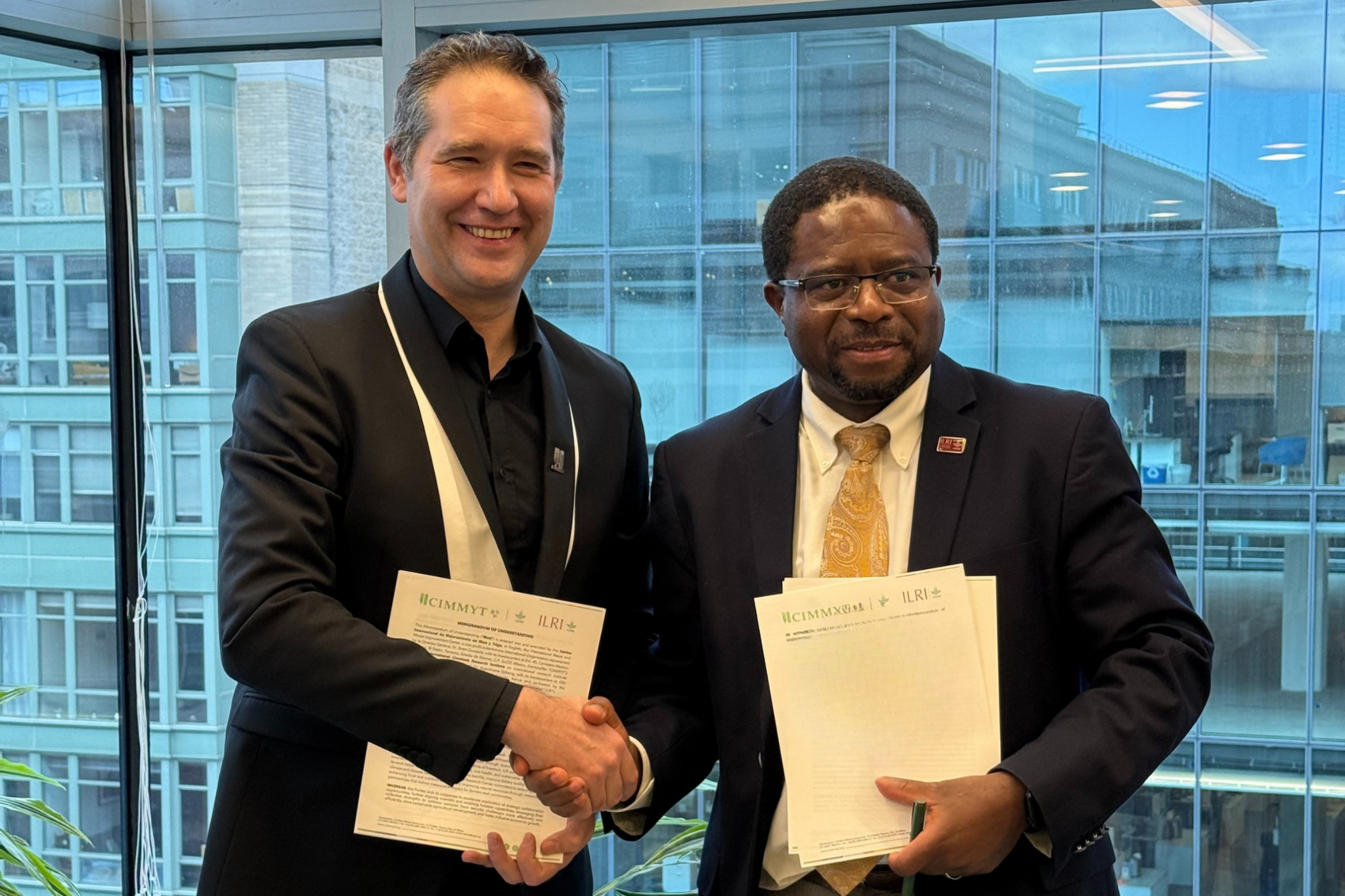
The International Livestock Research Institute (ILRI) and the International Maize and Wheat Improvement Center (CIMMYT) have signed a new Memorandum of Understanding (MoU) aimed at strengthening and expanding their long-standing collaboration to address some of the most pressing challenges facing global food systems and to support countries in achieving their food security objectives.
The agreement builds on a strong track record of joint project delivery and formalizes a strategic commitment by the two CGIAR centers to deepen research collaboration across crop and livestock systems.
ILRI and CIMMYT are both part of the CGIAR research system, which works globally to drive food systems transformation in pursuit of a food-secure world.
Together, the two institutions bring more than 50 years of experience working to improve food security, livelihoods and resilience for smallholder farmers, particularly in low- and middle-income countries.
Their partnership has been especially significant in regions where mixed crop–livestock systems underpin rural livelihoods, including sub-Saharan Africa and Latin America.
Mixed crop–livestock systems support the majority of smallholder farmers in these regions, providing food and income while also supplying manure for soil fertility and strengthening resilience to economic and climate shocks.
ILRI and CIMMYT have previously collaborated in countries such as Zimbabwe and Sudan on initiatives aimed at improving these systems through better technologies, drought-tolerant fodder species and enhanced market access.
Signed by ILRI Director General Appolinaire Djikeng and CIMMYT Director General Bram Govaerts, the new MoU seeks to harness the complementary scientific strengths of both institutions to deliver greater value for smallholder farmers, investors and national partners.
It also recognizes the extensive partnerships each center has built over decades, which are expected to amplify the impact of joint research and innovation.
“Our shared research legacy has already delivered important innovations in food security and sustainable agriculture,” Djikeng said. “This new phase focuses on leveraging that synergy for co-creating with our partners in our targeted countries for more integrated solutions that address today’s challenges.”
“ILRI and CIMMYT bring distinct but highly complementary scientific capabilities. Together, we can co-develop transformative innovations and attract coordinated investments that achieve greater impact at scale,” said Govaerts while emphasising the strategic importance of the collaboration and noting that the two organizations bring distinct but highly complementary capabilities.
As part of the new partnership, research leaders from both institutes are expected to convene early in 2026 to advance high-potential, demand-driven concepts into investor-ready collaborative programs. Priority areas identified under the MoU include dual-purpose food and feed production, climate change mitigation, and building resilience across key regions such as the Sahel, the Horn of Africa and parts of Asia.
Beyond joint research, the agreement also lays the groundwork for more coordinated country-level and investor engagement.
It envisages closer alignment of complementary research assets, exploration of opportunities to improve efficiency and cost-effectiveness, and the joint development of large, integrated investment propositions.
By formalizing and expanding their collaboration, ILRI and CIMMYT aim to accelerate the delivery of integrated crop–livestock solutions that respond to climate, productivity and market challenges, while supporting national efforts to strengthen food security and rural livelihoods in vulnerable regions worldwide.