

During the three-day event in New Delhi, a large audience -made up of business operators and entrepreneurs as well as many smallholder farmers – was introduced to technological innovations for the agricultural sector, supported also by specific government programmes.
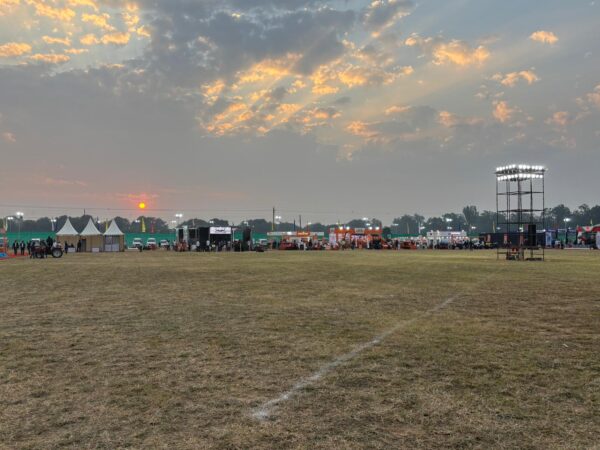
The third and final day of EIMA Agrimach India, the international exhibition of agricultural machinery organized by FICCI and FederUnacoma and held on the IARI PUSA University Campus in New Delhi, opened with a large turnout.
Unlike the first two days, which mainly saw the participation of economic operators, dealers, importers, and representatives of agricultural cooperatives and institutions, today’s attendance consists largely of farmers.
They represent a significant share of the population, given that in India 46% of the total workforce is employed in agriculture. Smallholder farming dominates the country, with farms averaging no more than 2 hectares, most of which are dedicated to arable crops (approximately 140 million hectares out of a total of 200 million agricultural hectares). Around 40 million hectares are devoted to rice, about 25 million to oilseeds, and another 20 million to fruit and vegetable crops.
Farming operations are still largely performed manually, since the machinery fleet used in the country’s agricultural areas consists almost exclusively of tractors (86% traditional tractors also used for transport, and a further 8% other types of tractors). Machinery for mechanized crop operations – such as plant protection treatments and harvesting – is almost entirely lacking (currently only 1% of the market concerns these types of equipment).
To ensure that farmers remain in rural areas and to foster the growth of the agricultural economy, the Indian Government has launched the PM-Kisan programme, which provides financial support to small farmers. Meanwhile, to improve production quality, the National Programme for Organic Production (NPOP) and the public digital agriculture infrastructure known as Krishi DSS have been active for several years. These tools guide agriculture toward innovation and promote the spread of an increasingly wide range of technologies.