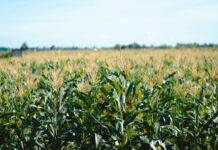


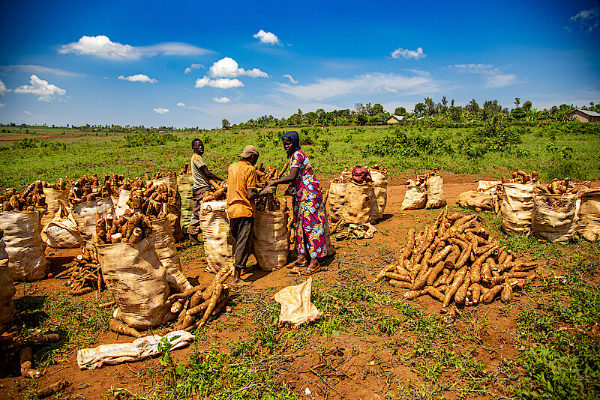
Drought-resistant cassava is transforming livelihoods for farmers in Rwanda’s dry eastern regions, with growers in Nyawera Cell of Mwiri Sector, Kayonza District, recording improved harvests despite harsh climatic conditions.
Through the Kayonza Irrigation and Integrated Watershed Management Project Phase II (KIIWP2), once-parched hillsides are now producing healthy cassava crops, demonstrating the power of climate-smart agriculture.
The project is funded by the International Fund for Agricultural Development (IFAD) and implemented by the Rwanda Agriculture and Animal Resources Development Board (RAB).
KIIWP2 aims to lift 40,000 rural households out of poverty by supporting climate change adaptation, boosting food production, and increasing household incomes. It operates in nine drought-affected sectors of Kayonza District, including Mwiri, where prolonged dry seasons have frequently resulted in food shortages.
By promoting drought-resistant crops, soil protection measures, irrigation infrastructure, and climate-smart farming practices, the project is helping farmers build lasting resilience to climate shocks.
A key intervention under the project is the 17-hectare cassava multiplication field in Nyawera, where four cassava varieties—Buryohe, Tebuka, Nsizebashonje, and NAM130—are being tested and multiplied. Researchers from RAB first assess whether each variety can withstand the area’s harsh climate and adapt well to local soil conditions before approval.
Once certified, high-quality planting materials are distributed to farmers. The Nyawera site is expected to produce 26 tonnes of improved cassava cuttings, which will be shared with households across Mwiri and neighboring sectors. Women and youth, who make up the majority of KIIWP2 beneficiaries, are actively involved in the work, from field management to harvesting.
A Mother’s Journey from Struggle to Stability
Among those benefiting is Alphonsine Mukamugema, a mother of two children in secondary school and others in primary school. Through her work with KIIWP2 and RAB at the Nyawera cassava site, she has earned an income that has brought new stability to her household.
“Before, we struggled to pay school fees and health insurance,” she says. “But now I can help my husband. I even bought a goat, it reproduced, and we sold one to help us build part of our house.”
Today, Alphonsine owns four goats and has set her sights on buying a cow in the future. She says the project has restored her confidence and given her family hope for sustained progress.
Farmers involved in the project are paid according to the kilograms they harvest. During peak harvesting periods, cassava production is so high that residents who are not part of KIIWP2 are also hired as casual laborers. Each kilogram harvested earns 10 Rwandan francs, with many workers making up to 5,000 RWF per day—an important contribution to meeting daily household needs.
Building Resilience, One Field at a Time
The Nyawera cassava site is more than just a farm; it is a clear example of how climate-smart agriculture can change lives. By combining drought-resistant crops, job creation, and improved farming skills, KIIWP2 is enabling families that once relied on food aid to grow their own food and earn reliable incomes.
With productivity already reaching 25.91 tonnes per hectare, the site is delivering strong results. As KIIWP2 continues to expand climate-smart interventions across Kayonza District, thousands more households are expected to gain the tools and confidence needed to confront climate change and secure their livelihoods.