

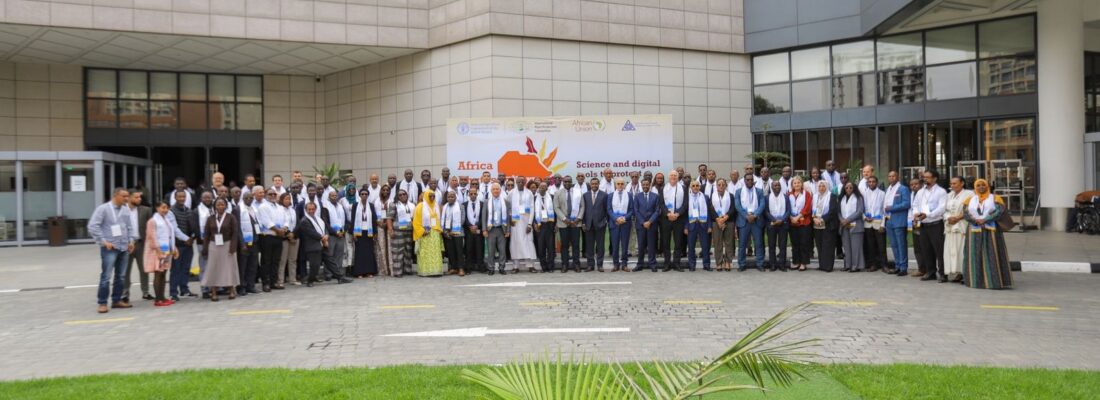
Addis Ababa – The Food and Agriculture Organization of the United Nations (FAO), the International Plant Protection Convention (IPPC) and partners launched the third phase of the Africa Phytosanitary Programme (APP) today – representing a major effort to stop the spread of plant pests and diseases in Africa using cutting-edge digital tools.
The launch is hosted by the Government of Ethiopia, through the Ethiopian Agricultural Authority (EAA) and brings together about 100 phytosanitary specialists from 18 countries, joining APP Phase 3: Botswana, Burkina Faso, Central African Republic, Comoros, Cote d’Ivoire, Djibouti, Libya, Eswatini, Ethiopia, Gabon, Mauritania, Mozambique, Niger, Nigeria, Namibia, Sao Tome and Principe, Sudan, Togo. Also attending are observers from Yemen, phytosanitary officers from four countries across the two previous phases: Egypt, Mali, South Africa and Uganda, and FAO plant health officers in Africa.
They will participate in a weeklong Train-the-Trainer (ToT) workshop in advanced pest surveillance techniques, including the use of customized digital tools and applications for monitoring, detecting and reporting major pests of economic, regulatory and environmental importance in Africa. Participants will receive state-of-the-art tablets for geospatial pest surveillance, use field survey protocols developed by technical experts, and undertake practical sessions using the pest survey tools.
The pilot and second phases of APP started in 2023 and 2025, respectively, engaging phytosanitary specialists from Cameroon, Democratic Republic of Congo, Egypt, Guinea-Bissau, Kenya, Mali, Morocco, Sierra Leone, Uganda, Zambia and Zimbabwe, and then Algeria, Cape Verde, Chad, the Republic of Congo, Liberia, Malawi, Senegal, South Africa and Tunisia. Phase 3, which represents the largest expansion of APP, builds on achievements so far and aims to train plant health officers, who, upon their return to their countries, will train their peers in the national plant protection organisations (NPPOs) and other government stakeholders on the use of the APP suite of digital tools.
“This workshop will build the critical human capacity necessary to eliminate trade disruptions and expand global market access”, said Ambassador Diriba Kuma, Director General, Ethiopian Agricultural Authority (EAA). “Pests do not respect geographical boundaries or geopolitical borders. Therefore, a fragmented approach is no longer an option. To secure our food supply and fortify our economies, we require a unified, data-driven and highly coordinated front. The Africa Phytosanitary Programme presents precisely the strategy, continent-wide framework we need to shield our plant resources and agricultural trade from devastating pests” he added.
Ambassador Diriba also highlighted Ethiopia’s efforts to strengthen its phytosanitary systems, including through the ongoing rollout of the IPPC ePhyto Solution and an evaluation using the IPPC Phytosanitary Capacity Evaluation (PCE) tool to guide development of Ethiopia’s five-year Strategic Plan.
Enrico Perotti, Secretary of the International Plant Protection Convention (IPPC), reminded participants about not becoming complacent in the fight against plant pests and diseases as the pressures are growing, exacerbated by a changing climate, global travel and trade.
“We have to amplify all the lessons we learn here so that the price we pay is not too heavy in the future”, he said.
“While some countries have waived import tariffs for agricultural produce from Africa, non-compliance with sanitary and phytosanitary (SPS) could still disrupt Africa’s access to international markets, affecting economic growth. Compliance with international standards will therefore boost Africa’s efforts to trade better, feed its growing population and ensure food security. The APP is helping”, he added.
Reports indicate that Africa’s agricultural exports face up to 30 percent rejection rates due to sanitary and phytosanitary (SPS) non-compliance.
In NPPO of Egypt reports that harmonized surveillance data and better technical proposals, with reliable data on pest-free production of key commodities such as citrus, mango and grapes, have supported new market openings in the Dominican Republic and Peru. Some countries have also integrated the APP digital tools into their national surveillance systems to improve their data collection and storage and also enhance pest detection. Kenya and Uganda, for instance, can keep pests such as Xylella fastidiosa and banana bunchy top at bay through regular monitoring. In other countries, such as Mali, the governments have made firm commitments and investments in scaling APP training and access to digital tools nationwide.
“The Africa Phytosanitary Programme is not simply introducing new tools or new technologies. It is helping build a community of professionals who can learn from one another, support one another, and work together to strengthen plant health systems across the continent,” said Orlando Sosa, Representative ad interim, Food and Agriculture Organization of the United Nations (FAO), Ethiopia.
“The Africa Phytosanitary Programme represents one of the continent’s most ambitious efforts to build a functional, harmonized and digitally connected phytosanitary network. What is so valuable about the programme is that for the first time, plant health experts across Africa have access to the same information platforms”, said Saliou Niassy, Coordinator of the African Union Inter-African Phytosanitary Council (AU-IAPSC).
“Plant health is no longer simply an agricultural construct. Investing in plant health is investing in food security, economic resilience and peace. We want to make sure that all our member states have strong, modern phytosanitary systems to respond rapidly to emerging pests”, he added.
“We note the need for the private sector to contribute to enhancing access to innovative technologies and smart pest management tools. We need to increase public-private partnerships or forums – bringing together innovators, regulators, farmers, donors, importers, exporters, and policymakers”, said Mohamed Habib Ben Jamaa, Executive Director of the Near East and North Africa Plant Protection organizations (NEPPO).
Funded through generous contributions from the European Union and the United Kingdom of Great Britain and Northern Ireland, APP phase three builds on support from the United States Department of Agriculture (USDA), Animal and Plant Health Inspection Service (APHIS), which funded the pilot in 2023. Ongoing efforts now are focused on scaling the benefits from APP to more African countries and other regions. The workshop recognised the importance of scaling what works. And with the impact already being created by APP, plans are underway to scale the programme to more African countries and other regions in the world.
In this next phase, AU-IAPSC and NEPPO, the two regional plant protection organizations in Africa, will guide the transition to enhance regional leadership and national ownership of the programme.