

The Seville-based technology company and CSIC spin-off presents three key outcomes of the EU-funded NOVASOIL project in Dublin, highlighting how digital innovation, sustainable business models and financial incentives can help accelerate investment in healthier soils across Europe.
Seville, Spain– EVENOR-TECH, a Spanish technology company specialising in sustainable soil management and environmental innovation, is participating in European Mission Soil Week 2026, held on 17–18 November in Dublin, Ireland. As coordinator of the Horizon Europe project NOVASOIL (Innovative Business Models for Soil Health), the company is bringing forward practical solutions designed to make investment in soil health both environmentally beneficial and economically viable.
European Mission Soil Week is the flagship annual event of the EU Mission “A Soil Deal for Europe”, bringing together policymakers, researchers, farmers, land managers, businesses and financial institutions to exchange knowledge and accelerate the implementation of sustainable soil management solutions.
During the event, EVENOR-TECH is showcasing three major outcomes of NOVASOIL: an integrated Digital Toolbox for decision-making, a portfolio of business models and sustainable soil management practices examined through 13 European case studies, and a Policy and Innovation Roadmap providing evidence-based recommendations to encourage investment and support the wider adoption of sustainable practices.
Together, these results address one of the main challenges facing European agriculture: how to translate the environmental benefits of healthy soils into viable economic opportunities for farmers, businesses and other land managers.
Digital innovation to support investment in soil health
One of the central outcomes presented at European Mission Soil Week is the NOVASOIL Digital Toolbox, an integrated digital environment designed to support stakeholders in identifying, evaluating and developing business models that promote soil health.
The Toolbox combines a Digital Knowledge Hub, analytical resources and a Decision Support Tool, bringing together scientific knowledge, practical experiences and economic considerations to facilitate informed decision-making.
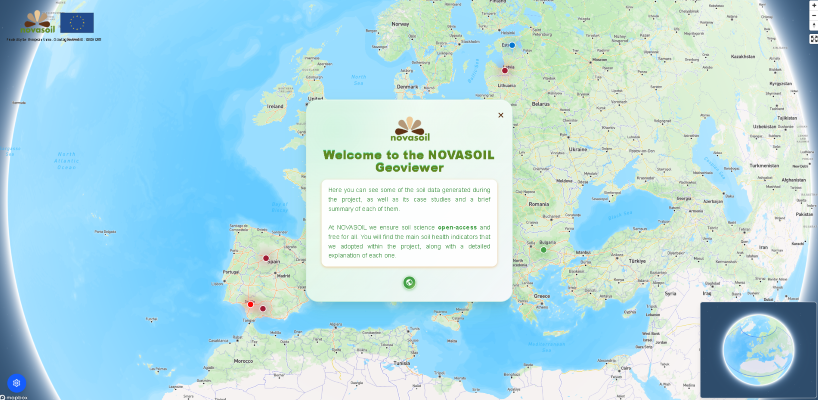
Its objective is to help farmers, agricultural advisers, companies, investors and policymakers explore sustainable soil management opportunities and better understand the conditions required for their successful implementation.
The platform addresses different dimensions of soil health investment, including sustainable agricultural practices, ecosystem service provision, certification schemes, value-chain approaches and innovative financial mechanisms.
By making this information more accessible, the Toolbox seeks to reduce the gap between scientific research and practical implementation, helping stakeholders move from identifying environmental challenges to evaluating feasible responses.
Francisco José Blanco-Velázquez, representing EVENOR-TECH and the NOVASOIL coordination team, is presenting the Toolbox as part of the project’s contribution to the European Mission Soil Week.
Business models tested across 13 European case studies
A second major outcome is NOVASOIL’s portfolio of sustainable soil health business models, developed and assessed through 13 case studies covering different European agricultural systems, environmental conditions and socioeconomic contexts.
The project examines how sustainable soil management practices can be integrated into economically viable business arrangements that deliver benefits for both land managers and society.
These business models explore several approaches, including the remuneration of ecosystem services, the development of sustainable agricultural value chains, certification mechanisms and market opportunities associated with environmentally responsible land management.
The case studies also investigate barriers that may limit adoption, such as high initial investment costs, uncertainty over financial returns, administrative complexity, limited technical support and the difficulties of measuring and demonstrating environmental benefits.
Beyond identifying these challenges, NOVASOIL examines the incentives, partnerships and enabling conditions needed to overcome them.
An important contribution of the project is its focus on the replicability and scalability of successful approaches. Rather than proposing a single solution for all agricultural systems, NOVASOIL recognises that soil management strategies must respond to local environmental, economic and institutional conditions.
The project’s findings are also being disseminated through the EU CAP Network’s EIP-AGRI Practice Abstracts, supporting knowledge transfer to farmers, advisers and other agricultural stakeholders across Europe.
Policy and financial incentives: creating the conditions for sustainable investment
Alongside technological innovation and business model development, NOVASOIL has addressed the policy and financial barriers that can prevent farmers and other land managers from adopting practices that improve soil health.
The project’s third major outcome, the NOVASOIL Policy and Innovation Roadmap, brings together evidence-based recommendations aimed at strengthening the institutional, financial and regulatory conditions for sustainable soil management.
The Roadmap builds on project research, case-study experiences and stakeholder engagement to identify opportunities for improving existing policy frameworks and developing more effective incentives.
A central issue is the need to better recognise the economic value of the ecosystem services provided by healthy soils, including carbon storage, water regulation, biodiversity support and improved agricultural resilience.
Although these benefits extend to society as a whole, the costs of implementing sustainable practices often fall directly on farmers and land managers. This imbalance can discourage investment, particularly when environmental improvements require several years to generate measurable returns.
NOVASOIL therefore examines a range of policy and economic instruments that could help address these challenges, including:
- Payments for ecosystem services and result-based incentives, designed to reward land managers for the environmental benefits associated with sustainable practices.
- Financial support and risk-sharing mechanisms, aimed at reducing investment barriers and facilitating the transition towards more sustainable production systems.
- Certification and market-based approaches, which may create additional value for agricultural products and services associated with improved soil management.
- Cooperation across agricultural value chains, encouraging stronger partnerships between producers, businesses, investors and public institutions.
- Long-term policy frameworks and improved access to technical advice, helping create more predictable conditions for investment and encouraging wider adoption.
The Roadmap also considers the importance of aligning these approaches with existing European agricultural and environmental policy instruments, while recognising the differences between national and regional contexts.
Through these recommendations, NOVASOIL seeks to contribute to a policy environment in which soil conservation is not perceived solely as an environmental obligation, but also as an opportunity for sustainable economic development.
Connecting research, technology and environmental policy
The three outcomes presented by NOVASOIL are closely interconnected.
The case studies provide practical evidence about sustainable management practices and business models. The Digital Toolbox translates this knowledge into accessible resources for decision-making. The Policy and Innovation Roadmap identifies the conditions and incentives needed to facilitate their implementation and wider adoption.
This integrated approach reflects the project’s broader ambition to connect scientific innovation with the economic and institutional realities faced by farmers, businesses and public authorities.
It also highlights the importance of collaboration between research organisations, technology developers, policymakers, financial institutions and land managers.
Through its Community of Practice and stakeholder engagement activities, NOVASOIL has encouraged dialogue among these groups, helping to identify practical needs, economic barriers and potential opportunities for cooperation.
The project’s findings are particularly relevant in the context of Europe’s efforts to strengthen agricultural resilience, improve resource efficiency and support the transition towards more sustainable land management.
EVENOR-TECH strengthens its contribution to European soil innovation
As a Seville-based technology company and spin-off of the Spanish National Research Council (CSIC), EVENOR-TECH works at the intersection of environmental research, digital technologies and sustainable land management.
Its role as coordinator of NOVASOIL reflects its involvement in European research and innovation initiatives aimed at developing practical solutions for environmental challenges.
By participating in European Mission Soil Week 2026, EVENOR-TECH is contributing to discussions on how emerging technologies, effective business models and supportive policies can work together to promote healthier soils across Europe.
The event also provides an opportunity to connect NOVASOIL’s outcomes with other European initiatives, share experiences with key stakeholders and explore pathways for the future uptake of the project’s results.
Ultimately, NOVASOIL demonstrates that advancing soil health requires more than identifying appropriate environmental practices. It also depends on creating the economic, technological and institutional conditions that enable those practices to become viable, accessible and sustainable over the long term.
About NOVASOIL
NOVASOIL (Innovative Business Models for Soil Health) is a European research and innovation project funded under the Horizon Europe programme and coordinated by EVENOR-TECH.
The project brings together a multidisciplinary European consortium working to identify and promote innovative business models that encourage investment in soil health.
Its activities include the analysis of business models, the assessment of sustainable soil management practices, the development of digital decision-support tools, stakeholder engagement and the formulation of policy and innovation recommendations.
Through 13 European case studies, NOVASOIL has generated practical knowledge on the opportunities, barriers and incentives associated with more sustainable land management.
The project contributes to the objectives of the EU Mission “A Soil Deal for Europe” by supporting solutions that combine environmental improvements with economic viability.
- NOVASOIL project: https://novasoil-project.eu/
- European Mission Soil Week 2026: https://missionsoilweek.eu/
- European Commission – NOVASOIL project: https://cordis.europa.eu/project/id/101091268