

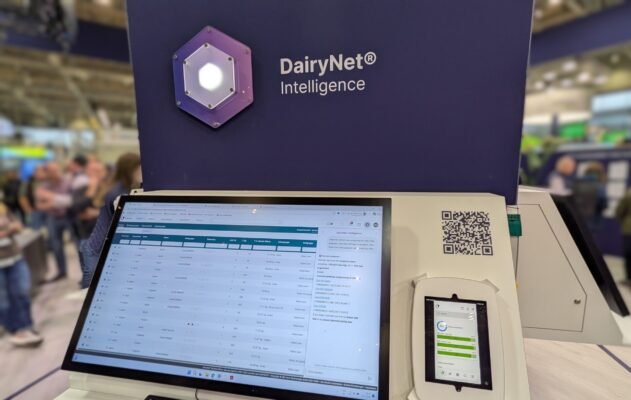
Effective herd management requires farmers to quickly assess the health status of individual cows and identify animals that need closer attention. This means reviewing and evaluating a wide range of information every day. With DairyNet Intelligence, GEA is expanding its DairyNet herd management system into a digital assistant designed to support dairy farmers with these tasks. GEA will offer an initial look at the solution at EuroTier 2026.
DairyNet already brings together information from a range of applications and systems. DairyNet Intelligence adds a new layer: artificial intelligence processes the available data to help farmers assess the current condition of individual cows more quickly. Rather than opening multiple screens and reviewing metrics one by one, users can access a concise summary directly on the animal details page.
To create this summary, the assistant uses AI to analyze the health-related data available in DairyNet. This includes information on milk yield, animal actions, somatic cell count and conductivity, as well as integrated data from CattleEye and CowScout. Based on this information, the system generates a brief summary of the cow’s current health status, making it easier to identify abnormal readings. The system does not yet recommend specific actions. At this stage, it helps users review and interpret the available information more quickly.
GEA is also testing a conversational interface for accessing herd information. Users can select predefined questions to identify, for example, which cows currently require special attention. In the future, the assistant could also generate analyses and visualizations and provide the specific information needed to support a pending decision.
From herd overview to digital assistant for daily farm operations
DairyNet is gradually evolving from a central information platform into a digital assistant for day-to-day herd management. Over time, the assistant could also remind users of upcoming tasks and help prepare the necessary work. For example, it could alert users when an AutoDry program is about to begin to prepare cows for the dry period, or initiate an appointment request with a veterinarian when a cow’s data indicate a potential health issue.
The interaction of different systems and data sources also opens up new possibilities. In the future, existing data could be used to better coordinate and automate farm processes: a manure scraper cleans the walkways before the cows arrive for milking; the feeding robot delivers fresh feed as soon as the first cows leave the milking parlor; and weather data helps adjust feed quantities and feeding times on hot days.
These examples show how individual data points can be connected to support coordinated processes. GEA brings together solutions for milking, feeding, manure management and herd management. DairyNet provides the common data foundation for DairyNet Intelligence.
As DairyNet Intelligence evolves, it is expected to provide dairy farmers with greater support in their daily operations. The assistant is intended to prioritize tasks, flag required actions and facilitate collaboration among farm managers, employees, veterinarians and advisors. Information and operational knowledge will remain accessible in the system, enabling everyone involved to work from the same data and track changes over time. This is particularly useful on farms where several people share responsibility for the herd.
Security as part of the system architecture
As DairyNet brings together more information and applications become increasingly interconnected, the security of the underlying infrastructure becomes even more important. Data security has therefore been an integral part of GEA’s herd management system development for many years. The DairyNet Box plays a central role. Installed on the dairy farm, this industrial PC serves as the local technical platform for DairyNet and connects to the DairyNet Cloud.
The system architecture restricts internet access, thereby reducing the potential attack surface. GEA has systematically assessed the risks associated with its software products and machines and developed appropriate safeguards. The security assessment also covers the risk of physical access to the on-site hardware.
The DairyNet Box processes and stores all key farm data locally. As a result, essential herd management functions remain available even if the internet connection is temporarily limited or unavailable. Once the connection is restored, the necessary data is synchronized automatically. DairyNet thus combines cloud-based applications with the reliable on-farm availability required for agricultural operations.
This proven technical infrastructure already provides the foundation for additional AI features. GEA continues to develop the infrastructure to meet future requirements, including those of the European Cyber Resilience Act.
The AI functions presented at EuroTier are currently in the testing phase. GEA plans to make them available initially on selected farms in late 2026 or early 2027. Insights from these initial deployments and feedback from dealers will guide further development