

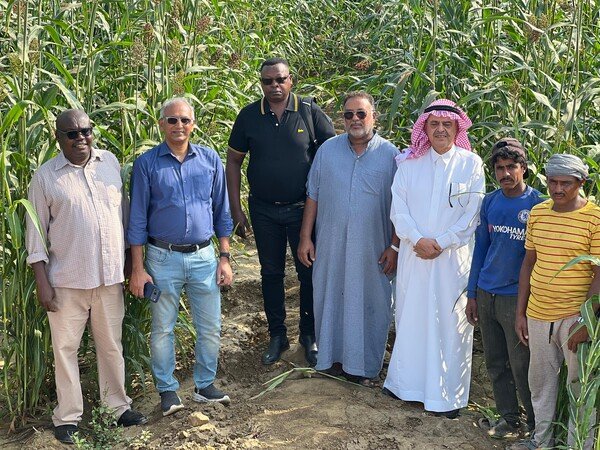
The International Crops Research Institute for the Semi-Arid Tropics (ICRISAT) and the Food and Agriculture Organization of the United Nations (FAO) research partnership identifies five promising crop candidates that could help farmers in Saudi Arabia produce both food grain and livestock fodder in water-scarce environments.
The new research has identified promising sorghum and pearl millet candidates that could strengthen food security and livestock feed production in Saudi Arabia, offering farmers in water-scarce regions opportunities to produce both grain and fodder from the same crops.
The findings, published on 10 August 2026 in Frontiers in Plant Science, highlight the potential of improved dryland cereals to support more productive and climate-resilient agricultural systems.
The study was undertaken through a partnership involving ICRISAT, FAO, and Saudi Arabia’s Sustainable Agricultural Rural Development Programme (Saudi REEF), under the Ministry of Environment, Water and Agriculture (MEWA).
Researchers evaluated 27 sorghum and 15 pearl millet entries across four growing environments in Jazan and Abha, representing contrasting lowland and highland conditions. The objective was to identify crop candidates combining good grain yields with reliable green fodder production under challenging growing conditions.
The research identified three promising sorghum candidates – SSV 74, WM 89/90#1615 and 89WM 5003 – with favourable combinations of grain and fresh biomass production. The best-performing entry exceeded the leading check variety by 9.3% in grain yield and 41.3% in fresh biomass.
For pearl millet, LCICMV-1 (SOSAT-C-88) and ICMV 91450 demonstrated promising dual-purpose performance. ICMV 221 recorded the highest average grain yield, while LCICMV-4 (Jirani) showed potential under conditions associated with Jazan.
ICSV 15021 also emerged as a particularly promising sorghum candidate for fodder production, recording the highest average fresh biomass and strong performance stability across the tested environments.
Commenting on the research partnership, ICRISAT Director General Dr Himanshu Pathak emphasized the global importance of strengthening agricultural production in water-scarce regions.
“Saudi Arabia’s commitment to strengthening food security in one of the world’s most water-scarce environments speaks to a challenge of global significance,” he said.
He added that collaboration with FAO and the Saudi Government was helping unlock the potential of dryland agriculture, strengthen domestic food and livestock feed security, and create economic opportunities for farmers.
Dr Kakoli Ghosh, Chief Technical Adviser of FAO’s Sustainable Rural Agricultural Development Programme in Saudi Arabia, noted that sorghum and pearl millet are valuable because they can provide both grain and livestock feed.
Identifying cultivars suited to local conditions, she said, was an important step towards strengthening domestic production and supporting farmers. She described the partnership as an effort to translate research into practical options for the Kingdom’s agrifood systems.
Dr Raman Babu, ICRISAT’s Global Research Program Director for Accelerated Crop Improvement, highlighted the importance of selecting crops based on multiple production objectives rather than focusing on a single characteristic.
“Multi-trait selection helps breeders identify crop candidates that balance different priorities,” he said, referring to grain production and biomass for livestock feed.
The research used statistical approaches, including multi-trait selection indices and Pareto-frontier analysis, to assess the balance between grain and fodder production and identify promising candidates across different environments.
The next phase will focus on farmer-managed trials, fodder-quality assessments, water-productivity evaluations, seed multiplication and national registration. Farmers and livestock keepers will also play an important role in assessing the crops’ performance and suitability under real farming conditions.
Beyond Saudi Arabia, the findings offer useful lessons for dryland farming systems across Africa and other regions where farmers depend on cereal crops for both household food supplies and livestock production.
By advancing dual-purpose sorghum and pearl millet, the partnership is laying the groundwork for more resilient crop-livestock systems, improved domestic food and feed production, and stronger livelihoods for farmers in water-scarce environments.