

By Dr Siphesihle Qange Agricultural Programme Lead, Seriti Institute
Between 2022 and 2026, 697 people were employed and trained, and 171 farmers were engaged through training, mentoring, technical assistance and access to production resources at the Inchanga Agroecology Hub in eThekwini Municipality.
Three youth-led cooperatives were registered, while the Hub recorded a 71% adoption rate of agroecological practices.
These are important numbers. But behind every number is a person.
Someone who gained practical experience. A farmer who learned a different way of managing soil. A young person who began thinking about agriculture not simply as subsistence, but as an economic opportunity. A community member who had the chance to earn an income while contributing to something that could benefit the wider community.
Community development is often measured in numbers. How many people were
trained? How many farmers were supported? How many jobs were created? How much money was invested?
Do not get me wrong; these numbers are important.
But after spending time working with communities, farmers and partners, I have come to believe that there is another question that matters just as much:
What remains when the project ends?
The Inchanga Agroecology Hub in eThekwini has given us a valuable opportunity to consider this question.
Over the past few years, Inchanga Agroecology Hub has brought together the eThekwini Municipality, the Southern Africa Food Lab (SAFL), the Seriti Institute, farmers, community members, government departments, researchers, development organisations and private-sector partners.
Each brought something different to the table.
The Municipality provided the land, infrastructure and institutional support. SAFL brought technical knowledge and experience in agroecology. Seriti helped turn ideas into on-the-ground activities, working with communities and farmers and coordinating implementation and partnerships.
What makes this experience interesting is not simply what each organisation did on its own. It is what became possible because they worked together.
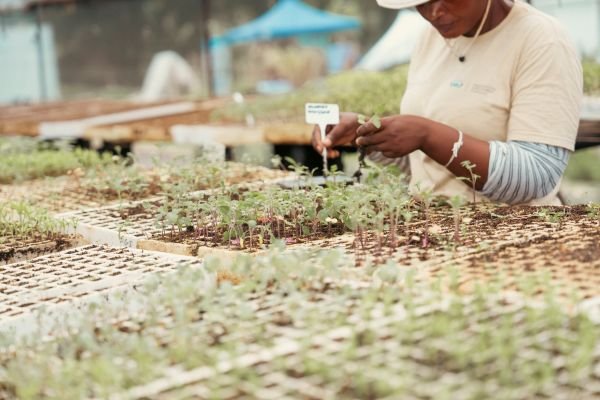
Over time, Inchanga became more than a place where vegetables were grown. It became a place where people could learn, work, experiment, share ideas and see agriculture differently.
And this is where agroecology becomes particularly interesting.
Agroecology is sometimes presented as a set of farming techniques: composting, soil management, biodiversity, water conservation and regenerative production.
These practices are important, but agroecology is also about how people interact with their land, their communities and their food systems.
At Inchanga, farmers had the opportunity to see these ideas in practice. They could observe composting, regenerative production, biodiversity conservation and water-efficient farming rather than simply hearing about them in a training room.
That matters because farmers are not empty vessels waiting for technical knowledge to be delivered to them.
They already have knowledge. They understand their land, their crops, their weather and their communities. Good development does not replace that knowledge. It creates spaces where different forms of knowledge can meet, where farmers can experiment, ask questions and decide what works for them.
Scott Drimie, co-director of the Southern Africa Food Lab, has worked on the partnership from the Food Lab side. He argues that the reason the site can be read this way is largely down to “John Nzira of Ukuvuna, who has worked with the hub for several years, and his contribution was to get people to design the site as one thing rather than a collection of separate activities on the same piece of land.”
The chicken run, the compost, the beds, the trees and the wetland were laid out so that each one feeds something else.
Seed is saved on site rather than bought in. Feed is grown rather than purchased.
That is why a farmer gets something from walking through Inchanga that no training room can give them. They can see how the parts connect.
“The full permaculture design is being completed as we hand the site over, and it is the part of this work most likely to outlast all of us,” Drimie added.
Drimie is also clear about what agroecology means and about what it does not.
“Agroecology has a clear meaning. It is farming that works with ecological processes rather than against them, and it is equally about who holds the knowledge and who controls seed, land and markets. Ecology and social arrangements are part of the same definition, not two options to choose between.”
He argues that simply replacing purchased fertiliser with compost does not necessarily constitute agroecology if the wider systems remain unchanged.
“What matters is how far a site has truly progressed. At Inchanga, we aimed to move decisively towards genuine agroecology, not simply claim the term, and to be honest about what that claim means.”
This is one of the reasons partnerships matter. No single organisation has all the answers.
A municipality may have land and infrastructure but not the capacity to run every agricultural programme. A technical organisation may understand agroecology but lack the relationships needed to work effectively with communities. An implementing organisation may be good at programme management but depend on others for specialist knowledge.
Farmers themselves hold knowledge that none of these organisations can replicate. Partnerships work when these differences become strengths rather than obstacles. At Inchanga, the network eventually grew beyond the original three partners.
Organisations working in natural resource management, research, markets, certification, farmer development and government agricultural services became connected to the Hub.
And this is perhaps one of the most valuable things ever built… Relationships.
Relationships are often difficult to capture in a monitoring framework. They do not always appear in a budget or a log frame. Yet they can determine whether something survives after funding ends.
The Hub’s relationship with PGS 1,000 Hills is a good example.
The organisation continues to support farmer certification, consignments, off-take arrangements and the weekly market.
These are not simply activities attached to a project; they are relationships and systems that can continue beyond individual funding cycles.
Drimie puts it more strongly:
“If you asked me which part of Inchanga is most likely to still be running in five years, I would say PGS 1,000 Hills. It is farmers certifying each other’s produce and running a weekly market, and none of that depends on our funding cycles. Projects pay for things. Structures like that one keep them going.”
This brings us back to the difficult question of sustainability.
Development projects have beginnings and endings. Funders eventually move on. Contracts expire. Staff leave. Programmes close.
That is not necessarily a problem.
The problem is when everything built during a project disappears with it.
The Inchanga experience has shown both the possibilities and the challenges.
There is now infrastructure, a network of farmers, practical knowledge, partnerships and systems that did not exist in the same form before. At the same time, questions remain around funding, infrastructure maintenance, markets and the transition towards stronger local ownership.
This is why sustainability cannot be something we discuss in the final month of a project.
It needs to be part of the design from the beginning.
When we enter a community, we should be asking: Who will own this? Who will maintain it? Who will use it? Who will make decisions when we are gone? Which
relationships need to exist for this work to continue? And, importantly, what does the community itself want to carry forward?
These questions may not always have easy answers.
But asking them early changes the way we approach development. It shifts the focus from delivering a project to building something that can last.
For me, this is one of the strongest lessons from Inchanga.
The legacy of a community development programme should not be limited to the infrastructure built or the number of people who participated.
It should be the confidence, knowledge, relationships, institutions and opportunities that remain in the community.
The goal should never be to make communities permanently dependent on development organisations.
The goal should be to make ourselves less necessary over time.
That does not mean walking away from communities. It means changing our role: from implementer to partner, from delivering solutions to strengthening local capacity, and from creating projects to helping build systems that communities and institutions can own.
Agroecology offers a powerful space for this kind of development because it brings together people, land, knowledge, livelihoods and the environment.
But agroecology will not succeed simply because farmers are taught how to make compost or conserve water.
It will succeed when farmers have the knowledge to make informed decisions, when young people can see viable opportunities in agriculture, when markets recognise the value of what farmers produce, when institutions work together, and when communities have a meaningful stake in the systems being built around them.
That is the bigger lesson from Inchanga.
Good partnerships should leave more behind than they take with them.
They should leave stronger farmers, stronger relationships, stronger local institutions, better knowledge and greater confidence that the work can continue.
Ultimately, the success of a partnership is not measured by how long the partners remain.
It is measured by what the community can do after they leave.