

Plastic waste is one of the world’s fastest-growing environmental problems. According to the OECD’s Global Plastics Outlook: Policy Scenarios to 2060 report, global plastic use is projected to nearly triple from 460 million metric tons in 2019 to 1.2 billion metric tons by 2060, if current trends continue.
Today, reducing plastic use, recycling, and waste-to-energy processes are among the main approaches for managing plastic waste. However, these approaches are struggling to keep pace with the growing volume of plastic waste.
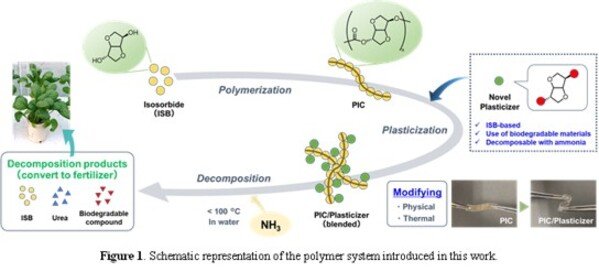
Addressing this challenge, a research team led by Associate Professor Daisuke Aoki from the Graduate School of Engineering, Chiba University, Japan, developed abio-based plastic,poly (isosorbidecarbonate)(PIC),thatcanbeconvertedintofertilizerafteruse.
The basic building block of the polymer, isosorbide (ISB), is a bio-based monomer synthesized from glucose.
When treated with aqueous ammonia, PIC can be chemically converted into ISB and urea, and the resulting products can be used to support plant growth. However, its inherent hardness and brittleness limited its range of potential applications.
In a study that was published in Volume 16 of the journal Scientific Reports on August 18, 2026, the team overcame this limitation by developing a dual-functional, isosorbide-based plasticizer that, when added to PIC, makes the plastic softer and more flexible while preserving its ability to be converted into fertilizer after use.
Importantly, not only the polymer but also the plasticizer can be converted into fertilizer components through ammonia treatment.
Unlike biodegradable plastics that gradually break down, this material functions as a conventional plastic during use and is chemically converted into fertilizer only after its service life, through ammonia treatment.
The research team included Mr. Shunsuke Fujimata and Dr. Tatsuo Taniguchi from the Graduate School of Science and Engineering at Chiba University; Dr. Takehiro Kamiya from the Graduate School of Agricultural and Life Sciences at The University of Tokyo; and Dr. Mizuhiko Nishida from the Graduate School of Agricultural Science at Tohoku University, Japan.
“We are at a critical turning point in the history of plastics. While current strategies like reduction and traditional recycling are important, they are inherently ‘passive’ and do not offer active environmental benefits. We wanted to move toward an ‘active’ environmental contribution by designing materials that solve the plastic waste problem while simultaneously addressing resource depletion and supporting sustainable agriculture,” says Dr. Aoki.
The plasticizer consists of an isosorbide unit at its center, connected to triethylene glycol units on both sides through carbonate linkages. Adding the plasticizer made the plastic much softer and flexible.
The elongation at break increased from 4.3% to 45.2%, indicating that the material became over ten times more stretchable.
While further improvement of the mechanical properties will be important for expanding the range of potential applications, the researchers believe that these properties could be further tailored by designing related polymers and plasticizers.
This could allow the material to be used in flexible products such as agricultural mulch films, seedling pots, plastic bags, and packaging materials.