

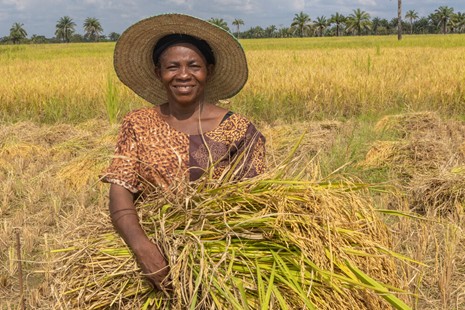
For millions of rice farmers worldwide, access to the latest agricultural research remains limited, making it difficult to turn information about soil, weather, crops, pests and water into practical advice for their own fields.
However, the International Rice Research Institute (IRRI) and the International Food Policy Research Institute (IFPRI) suggest that generative artificial intelligence (GenAI) and large language models (LLMs) which could help close that gap by creating a new interface between agricultural research and farmers.
The idea is not simply to give farmers another chatbot. Instead, GenAI could provide a conversational gateway to data, crop models and scientific knowledge, allowing farmers to ask questions in ordinary language and receive advice tailored to their particular field and growing conditions.
Recent work by IRRI and IFPRI explores how this approach could bridge the long-standing gap between sophisticated agronomic research and farm-level decision-making.
Turning agricultural data into practical advice
Modern rice research increasingly draws on diverse sources, including field experiments, soil information, weather data, remote sensing and crop simulation models. The challenge is converting these complex datasets into recommendations that farmers can understand and act upon.
GenAI could provide the missing interface. Rather than requiring farmers to interpret technical datasets or navigate specialist software, an AI system could translate scientific outputs into natural-language recommendations while incorporating information about local conditions.
For smallholder farmers in Africa and Asia, where extension services may struggle to reach every field regularly, such systems could potentially make specialised agronomic knowledge available at much greater scale.
The technology could support decisions ranging from nutrient management and irrigation to pest control, planting dates and climate-related risks. IRRI’s recent work on AI-enabled rice advisory systems demonstrates how field-level information can be combined with agronomic knowledge to produce more targeted recommendations.
From generic chatbots to science-backed AI
The biggest challenge is ensuring that an AI system provides reliable agricultural advice rather than plausible-sounding but incorrect answers.
IFPRI research highlights the importance of grounding GenAI systems in verified agricultural knowledge. Its Generative AI for Agriculture project has explored retrieval-augmented generation, in which AI responses are linked to curated research and extension materials rather than relying solely on the information contained in a general-purpose language model.
This distinction is critical because agricultural decisions can have immediate consequences for farmer incomes and food production. An incorrect recommendation on fertiliser application, pesticide use or disease management could cause substantial losses.
Context is equally important. A recommendation suitable for a rice farmer in Southeast Asia may not work in a rainfed field in East Africa. Soil characteristics, climate, varieties, water availability, farming practices and access to inputs can all change the appropriate response.
A global opportunity with significant challenges
For GenAI to become a genuinely useful agricultural extension tool, researchers say technology alone will not be enough.
Farmers need reliable connectivity, appropriate local-language interfaces and systems designed around their actual needs. Trust, data governance, privacy, equity and human oversight will also be essential.
The potential, however, is significant. Instead of concentrating agricultural intelligence in research stations and extension offices, GenAI could help distribute it directly to farmers, potentially reaching remote communities that conventional advisory systems struggle to serve.
For the world’s most vulnerable rice-growing areas, the promise is therefore not AI for its own sake. It is the possibility of turning decades of agricultural research and increasingly sophisticated farm data into timely, understandable and field-specific decisions.
If researchers can overcome the challenges of accuracy, infrastructure, inclusion and responsible data use, GenAI and LLMs could become a powerful bridge between global rice science and the farmers who need it most.