

South Africa isn’t for the faint-hearted
I really hope this isn’t a tedious read. The ideas being shared here are far too important to be bungled by my incompetent writing, so bear with me please.
To get you going, let me start off with a feeling.
It’s a feeling you’re familiar with. It crops up at the family braai. It surfaces when chatting to friends. At every election cycle, it rears its head. You see it when bathing in our sunny beaches, trekking our green mountains, and experience it when belting out Nkosi sikelel’ at a match.
This beautiful country of ours could be so much more. If only, if only.
But we have somehow mastered the art of contradiction. This is a country capable of astonishing resilience and shocking dysfunction. We produce world-class businesses and record unemployment. We are endlessly hopeful and perpetually frustrated. South Africa is a tough place to love.
The events of this past week have highlighted all of this. A young democracy, born in inclusivity, has vigorously debated who belongs, who should stay, who should work. Employment has once again become the focal point of our national anxiety. And it’s around the edges of employment that I’d like to engage you on. Specifically because of how we view employment. I often think we misunderstand unemployment and fixate on statistics. Or employment as a means to an end. But this masks the real dread. The real crisis isn’t that so many of our people are without work.
It is that they do not belong.
A man without a country
There’s a busy intersection which runs under the N1 in Sunninghill, Johannesburg. Here you’ll find a series of robots that work erratically and give the homeless gents a chance to direct traffic for a few bucks. Turns out that these gents generally short the electrical wiring of these traffic lights. On a walk one day, I saw one of the guys fiddling around with a fuse box and so I approached him. When I asked if he knew how much of chaos he was causing during rush hour he huffed: “Bossa – at least I’m busy today.”
This little interaction turned on the lightbulb. Beyond a stable income, work is everything else. Somewhere to contribute, somewhere to matter. When people are locked out of meaningful participation for long enough, the consequences extend far beyond income. Confidence erodes. Hope retreats. Citizenry is killed.
But lest we despair, let’s focus on the possible. I recently had the good fortune of seeing something remarkable. In this little experiment, tucked away in the North West province, you’ll find the local economy is kicking along, jobs are being created, crime has reduced, people are coming together.
Come take a walk with me
Deelpan sits in the middle of nowhere. I’m certain you’ve never heard the name before. I had never. Located 4 hours west of Johannesburg, Deelpan is a place you drive past but not to.
It’s an uneventful drive through the countryside – dorpies, townships and many commercial farms. This mixture of development sets the scene. It’s a long drive.
Most of the 5,000-odd residents of Deelpan are a legacy of displacement. During the apartheid era, families were forced off their fertile land located near the current N14. Woe be told, in the intervening years, there’s been no significant development. You’ll find a primary school with more holes in the windows than classrooms, a few mazy streets, rudimentary dwellings and open land. Most of the residents find seasonal employment in the surrounding farms – but this, like the seasons, come and go. There’s a single spaza shop that’s more closed than open.
I don’t want to romanticize the simple, yet tough conditions. I am sure the residents do find a certain peace living out here. But basic conditions should be better. Deelpan just feels like a place frozen in time.
Along came a Multi-Functional Agri-Node
In and around 2023, our Social Employment Fund (SEF) partner, Seriti Institute (NPC), decided to take on the challenge of working in Deelpan. If you ask them why, you’d get the type of answer only a battle-hardened South African non-profit would give – ‘why not?’
The challenge that was faced was finding appropriate work for the residents – work that would create a ‘common good’ for the community, whilst providing necessary skills and experience for a life beyond. At face value, the answer should seem relatively straightforward, after all, you have land, water and abundant sunshine. Naturally, the solution should be some sort of agricultural-type project. But getting folk to embrace community farming, deciding what to plant, where to sell, how to extract value and above all, turn work into something that was meaningful – herein lies the craft. And after 3 years of hard work and experimentation, what stands here today, isn’t just a farm, it is a pretty sophisticated ‘Multi-functional Agri-Node’ (MFAN).
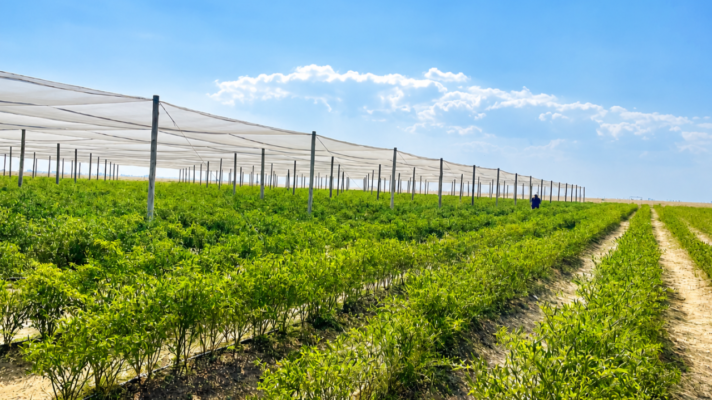
I walked the five hectares with its bright red chillis and dry winter sun, trying to make sense of it all. A greenhouse, shade netting, drying area, borehole, inverter-container and so on make up the MFAN. At face value, it looks well coordinated – like each of these pieces were intentionally set out. But a conversation with our Seriti colleagues reveals the trial and error (and prayer) that patched it all together.
Starting from nothing, today, this MFAN, with its 150 Social Employment Fund employees, yields around 40 tonnes of produce – predominantly chillies and a good mix of spinach, onion, cabbage and beetroot. Workers work for a period in the MFAN and are then trained to exit into livelihoods. The high-quality yield has ensured a lucrative commercial agreement with a national buyer, with the profits being pumped back into the MFAN. As the employee’s work improves so to do the yields, output is increased and better earnings are made – these earnings are used to purchase equipment, expand production and improve technical inputs. In addition to the sales, the MFAN donates produce to needy households and the local school.
And the results speak for themselves
The local economy of Deelpan is now bustling – whereas you would struggle to find a single shop open past midday, there are now over a dozen shops – supermarkets, spaza shops – all operating. Money is circulating in and around the town. Crime has reduced significantly. People are eating nutritious food. Around town, you see mud-roofs being replaced with steel and tile. Most importantly, at least 70% of participating households are now engaged in some enterprise to reduce stipend dependency.
There is something in the air.
This is something to be excited about. In a relatively short space of time, with hard diligent work together with the care and attentiveness of an experienced development practitioner, it is very possible to change the fortunes of an out-of-luck place.
See content credentials
Rhythm in the soul
The above socio-economic indicators are indeed heartwarming. But this isn’t the story. The magic of all of this lies with the transformation of people.
Oliver Molete is the seedling man of the Deelpan MFAN. When you walk into his office – a wooden 4×2 structure at the entrance of the farm, you are struck by the perfection of it all. Oliver has files and files of hand-written records – meticulously capturing daily, weekly and monthly data of inputs, harvests and sales. When you walk into Oliver’s office, he will let you know that you are in his office. Before this work, Oliver had no real interest in farming. However, when the opportunity arose, his natural inclination for detail and order came to the fore and he found some natural love for cultivating seedlings. Today his not-so-little greenhouse generates 86,400 seedlings monthly, which are highly coveted by farmers. He tends them as if they are his offspring. Oliver has found his purpose. He now belongs.
And then there’s the MFAN’s Project Leader, Tiro Ramudie. Tiro recalls his family being displaced under the apartheid regime and ‘just being stuck here’. This doesn’t hold him back though. Today Tiro manages the MFAN with a quiet authority that commands respect. When he moves about the 5-hectare farm, Tiro gives directions to the 150 workers. He listens to them – considering their input for what else to plant and when. They engage in discussion on fertiliser mixtures and different planting methods. Tiro is a man possessed. He ‘owns’ the MFAN. He has found his place.
But nothing speaks progress like that of Itu. Itumeleng Khoza is a product of the MFAN. In the 2-years that Itu worked in the Deelpan MFAN he picked up a significant set of technical skills which he then blended with his natural inclination for business. And when Itu left the MFAN, he was allocated a small parcel of land. His latest yield was 10,500 cabbages and over 6,000 chillies. More impressively, Itu employs 20 of his fellow residents. “The MFAN is Deelpan’s largest employer,” beams Itu, “and I am the second largest.” Itu now belongs. And is bringing others along with him.
Itumeleng Khoza in front of his small farm. “The MFAN is Deelpan’s largest employer,” beams Itu, “and I am the second largest.”
Maybe the real product of this farm isn’t chillis?
There is an Indian maxim that reads: “All the wealth of the world cannot help one Indian village, if the people are not taught to help themselves,” (Vivekananda, 1863-1902). I found myself thinking about this when I met Oliver, Tiro and Itu.
Their talents were not created by the Deelpan MFAN. Oliver’s discipline already existed. Tiro’s leadership already existed. Itu’s entrepreneurial instinct already existed. What the MFAN did was create the conditions under which those qualities could finally emerge.
Touch. Pause. Reflect.
The drive back to Johannesburg offered plenty of time to think. What is it about this MFAN that’s worth talking about? For the South African, hoping for a better tomorrow, but frustrated at our own inertia, how should they process all of this.
Let me try.
Programmes like the Social Employment Fund, with worksites like this Deelpan MFAN, are indeed wonderful. But they are not panaceas. Gaps, such as policy uncertainty and uneven funding cycles persist. Yet in just four years, more than 180,000 individuals around the country have been put to meaningful work. Among them are thousands like Oliver, Itu and Tiru, for whom a certain spark has been ignited. With this spark, what changes could they make in their communities?
It is tempting to dismiss these stories as drops in the ocean. But every ocean is made of drops. The mistake we make is asking whether projects like these can solve South Africa’s problems. That completely misses the point. The real question is whether these projects show us what is possible when people are trusted, equipped and given meaningful work.
That great South African, Alan Paton, captured this beautifully, so I’ll let him wrap things up. In his seminal work Cry the Beloved Country, Paton, through the thoughtful Reverend Msimangu, writes: “The tragedy is not that things are broken. The tragedy is that things are not mended again.”
Four hours west of Johannesburg, there is a development project which is allowing people to quietly mend what is broken. Oliver is tending seedlings, Tiro is planning the next planting cycle, and Itu is employing 20 people who might otherwise have been without work. None of them are waiting for perfect conditions.
And perhaps that is where hope is found. Not in ignoring our problems, but putting aside the “if-onlys”, rolling up our sleeves and building anyway.