


By Steven Lumley, technical manager, WearCheck
Oxidation – the focus of part 2 of WearCheck’s “When Good Oils Go Bad” series – is one of the most common chemical reactions we encounter in everyday life. It occurs when fuel burns, when steel rusts, when wounds are cleaned with hydrogen peroxide and even when a cut apple turns brown. In lubricating oils, oxidation is no less familiar and no less damaging.
Put simply, oxidation is the chemical reaction between a lubricant and oxygen. Over time, this reaction alters the oil’s chemistry, leading to degradation of both the base oil and its additives. While oxidation occurs at all temperatures, it accelerates dramatically as operating conditions become more severe, making it one of the primary causes of lubricant failure in service.
In lubricating oils, oxidation involves the sequential addition of oxygen to the base-oil molecules, producing a range of reactive – and often harmful – by-products, including aldehydes, ketones, hydroperoxides and carboxylic acids.
As these oxidation by-products accumulate, the lubricant’s physical and chemical properties begin to change. The oil thickens, acids form, additives are depleted and insoluble materials can precipitate out as sludge or varnish. Left unchecked, oxidation compromises the lubricant’s ability to protect equipment, increasing wear, corrosion and the risk of deposits.
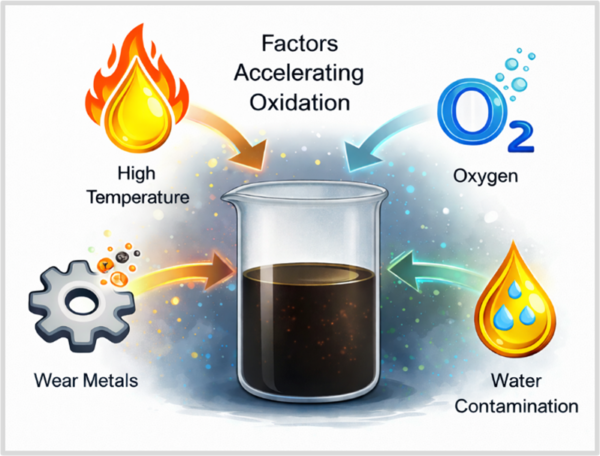
Oxidation is unavoidable, but its rate is highly dependent on operating conditions such as temperature, oxygen exposure, catalytic metals and contaminants. Let’s take a closer look at these factors:
Temperature
The oxidation rates increase exponentially, with temperature following the Arrhenius rate rule. As a rule of thumb for mineral oils, the rate of oxidation roughly doubles for every 10°C increase in temperature above ±75 °C. This is why oils in hot-running systems age far faster than those operating under cooler conditions.
Oxygen Exposure
Poorly sealed systems, aeration and excessive air entrainment increase the availability of oxygen accelerating oxidative reactions.
Catalytic Metals
Wear metals such as iron and copper act as powerful oxidation catalysts, and even small concentrations can significantly speed up oil degradation.
Water Contamination
Water not only promotes corrosion but also accelerates oxidation reactions and additive breakdown, particularly at elevated temperatures.
The Oxidation Chain Reaction
Oxidation in lubricants takes place through a complex series of chain reactions that consists of three key stages: initiation, propagation and termination.
Initiation
In the initiation stage, external stress factors like heat, wear metals or contamination break a chemical bond within the lubricant, generating a free radical – a highly reactive molecule with an unpaired electron.
Propagation
The free radical quickly reacts with oxygen to form peroxide radicals, which in turn attack other lubricant molecules. This creates additional free radicals, a process known as branching, which allows the reaction to spread and accelerate throughout the oil.
Termination
Oxidation slows only when free radicals are neutralised. This occurs when either two radicals combine to form a stable compound, or when antioxidant additives in the oil sacrifice themselves to interrupt the chain reaction. Once antioxidants are depleted, oxidation can proceed rapidly and uncontrollably. Remember, antioxidants delay oxidation, but they do not prevent it indefinitely.
The Consequences of Oxidation
As oxidation progresses, its effects become increasingly damaging. Viscosity increases due to the polymerisation of oxidised molecules, while acid formation leads to corrosion of metal surfaces. Sludge and varnish deposits impair oil flow and heat transfer, and additive depletion reduces anti-wear, anti-foam and corrosion protection. Together, these changes lead to a progressive loss of lubricant performance, ultimately leading to higher friction and increased wear.
In severe cases, oxidation-related deposits, particularly varnish, can cause sticking valves, blocked filters and overheating – often long before the oil appears visibly degraded.
Detecting Oxidation Through Oil Analysis
Oxidation is one of the most closely monitored degradation mechanisms in oil analysis and is assessed using a range of application-specific laboratory tests.
Used together, these techniques provide early warning of accelerated oxidation – often long before catastrophic lubricant failure occurs. The key tests used to assess oxidation are summarised below.
Final Thought
The reality is, oxidation is the inevitable ageing process of lubricating oils. While it cannot be eliminated, it can be managed effectively through correct lubricant selection, contamination control, temperature management and a well-designed oil analysis programme. Understanding how oxidation occurs and recognising its early warning signs allows operators to intervene early, extend oil life and ultimately protect critical equipment from avoidable damage.
After all, oils don’t fail simply because they age, they fail when the effects of ageing are left unchecked.
The next instalment of this WearCheck series moves from oxidation to nitration – a different pathway, but one that can be just as damaging.
Please visit www.wearcheck.co.za or contact WearCheck on marketing@wearcheck.co.za or +27 (31) 700-5460.