

The Europe seed treatment market, while representing a niche segment within the region’s broader crop protection industry, has witnessed considerable growth due to the increasing emphasis on sustainable agriculture, precision farming, and efficient seed management practices. Newer seed treatment options are now being used to help guard seeds against soil-borne troubles, to raise germination results, and to support better crop stand-up when the weather patterns are unpredictable. Also, there is a noticeable pull toward biological seed treatments and low-impact crop protection products, and that push is helped along by the strict European regulatory scenario. Acorrding to MarketsandMarkets, the European seed treatment market is expected to be worth about USD 1.90 billion in 2025, and to climb to USD 2.81 billion by 2030. That would mean a CAGR of 8.1% throughout the forecast period, 2026-31.
The European seed treatment market has shown strong growth as there is increased focus on sustainable agriculture, precision farming, and better seed handling routines. Farmers throughout Europe are using seed treatment technologies to boost germination, stabilize crop establishment, and shield seeds from soil-borne illnesses and pests. The market is further getting a push from the demand for higher-quality agricultural output, along with the steady shift toward biological and low-residue crop protection options that match stringent European environmental conditions. Also, major players in the industry are putting effort into research and development to introduce biological formulations, polymer coating methods and combined, end-to-end seed treatment solutions. These upgrades, along with Europe’s strict regulatory stance toward sustainable farming inputs and less reliance on chemicals are likely to back the long-term momentum of the European seed treatment market.
Stringent Environmental Regulations Accelerating Demand for Sustainable Seed Treatment Solutions in Europe Market
The stringent environmental and pesticide regulations in Europe are significantly driving the demand for advanced, sustainable seed treatment technologies. In many cases, the regulatory rules are built around reducing extra chemical application and also encouraging farmers toward more responsible, low-tendency farming methods. Farmers are increasingly looking at targeted seed treatment solutions that help minimize the environmental impact while still maintaining crop performance. Seed treatment technologies help deliver active ingredients in a precise way, right onto the seeds, which can reduce the total pesticide usage and fit well with integrated pest management strategies. Further, growers’ awareness and shift towards biological seed treatments and low-residue crop protection products are supporting the market growth. As European agriculture is shifting toward sustainable farming systems, the need for fresh, eco-friendly seed treatment solutions will grow steadily throughout the region.
Precision Polymer Coating Technologies Enhancing Seed Treatment Performance in Europe
The adoption of advanced precision polymer coating technologies is significantly improving the effectiveness of seed treatment solutions across the European agricultural sector. It enables manufacturers to apply active substances, biological agents, micronutrients, and protective compounds in a uniform and controlled manner onto the seed surface. Precision coating also improves seed flowability, planting accuracy, and shelf stability, which are critical for high-performance commercial agriculture. The integration of biological microorganisms inside polymer-based coatings as the region is moving toward sustainable farming practices. Hence, seed treatment applications are supporting better germination outcomes, stronger crop establishment, and a more efficient early-stage protection strategy.
Limited Awareness Regarding Biological Seed Treatment Benefits Restricts Wider Adoption in Europe
Limited awareness among small- and medium-scale farmers regarding the long-term agronomic and economic benefits of advanced seed treatment technologies continues to pose a significant challenge to wider market adoption across Europe. While sustainable and biological seed treatment solutions are getting more regulatory backing and industry momentum, many growers stay cautious—mostly due to low technical knowledge. There is few on-farm demonstrations at the field level, that makes growers worry about the product performance, especially in the shifting weather conditions. In practice,e this knowledge gap becomes especially visible in areas where traditional crop protection practices continue to be preferred.
Biological Seed Treatment Segment Poised for Strong Growth Across Europe Due to Sustainability Focus
The biological seed treatment segment is expected to witness robust growth in the European seed treatment market owing to the region’s increasing emphasis on sustainable agriculture and environmentally responsible crop protection practices. The farmers are moving toward biological seed treatments that include beneficial microorganisms and naturally derived actives to help with seed vigour, better nutrient uptake, and resistance to soil-borne diseases. Also, supportive regulatory measures for low-residue agricultural inputs are helping, along with the growing restrictions on conventional chemical pesticides. Further, the increasing need for organic farming and integrated pest management strategies is motivating manufacturers to invest in newer biological seed treatment technologies across Europe.
Seed Dressing Segment Set to Grow at the Highest Rate Due to Cost-Effective Early-Stage Crop Protection
The seed dressing segment is anticipated to witness strong growth in the European seed treatment market due to its cost-effective and efficient approach toward protecting crops during the critical germination and early growth stages. With seed dressing, farmers can put fungicides, insecticides, and even biological agents straight onto the seeds, which makes it easier to cut down total chemical input, while still boosting resilience against disease and pests. It further gains traction among European farmers as it supports sustainable farming approaches, while being relevant as per the stringent regional regulatory scenario on crop protection. Also, the continued uptake of higher-quality commercial seeds, along with the growing focus on better crop establishment, is expanding the seed dressing segment demand across Europe.
Oilseeds & Pulses Segment Slated for Strong Growth Owing to Rising Demand for High-Value Crops
The oilseeds and pulses segment is expected to witness significant growth in the European seed treatment market owing to the increasing cultivation of high-value crops such as soybean, sunflower, rapeseed, peas, and lentils. The crops are prone to seed- and soil-borne diseases, especially in the early stages of development. Hence, there is a real push for good seed treatment approaches to boost germination and help crops establish more smoothly. Also, consumer demand keeps rising for plant-based proteins, edible oils, and more sustainable food components, which is driving growers to improve productivity and overall crop quality with better seed protection technologies. Further, biological seed treatments are being adopted more often in pulse and oilseed farming, supporting the regional growth.
France Exhibits the Highest Demand in the Europe Seed Treatment Market
France represents one of the largest and most influential markets for seed treatment in Europe due to its extensive agricultural production, advanced farming practices, and strong focus on crop quality enhancement. The country possesses a strong cultivation base in cereals, oilseeds, and pulses, so demand stays high for seed treatment solutions that help with fast germination, guard against soil-borne illnesses, and support crop establishment. The rising adoption of precision agriculture and more sustainable crop protection approaches are helping the market further. The presence of major agricultural input providers, strong investments in biologicals, and environmentally friendly seed treatment technologies helps in reinforcing France’s competitiveness in the overall European seed treatment market.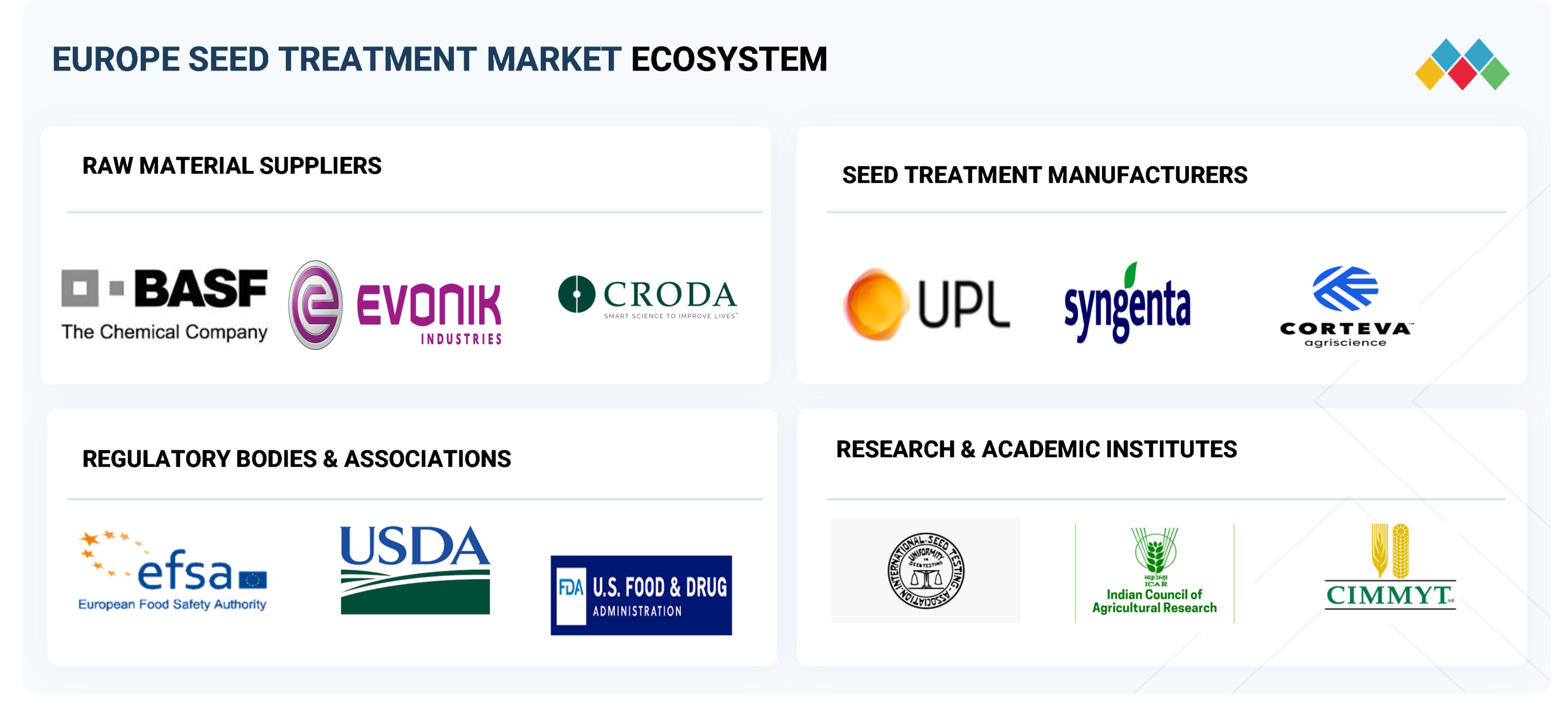
The European seed treatment market ecosystem possesses a well-established network of raw material suppliers, seed treatment manufacturers, regulatory authorities, and agricultural research institutions. Major raw material suppliers like BASF SE, Evonik Industries AG, and Croda International Plc bring essential formulation ingredients, specialty additives, polymers, and biological components used in newer seed treatment methods. Major manufacturers, such as Syngenta AG, Corteva Agriscience, and UPL Limited, are investing in “greener” seed protection approaches, biological seed treatments, and precision coating technologies to maintain their competitive positioning in the market. The whole ecosystem is further backed by regulatory organisations; for instance, the European Food Safety Authority, along with international agricultural authorities and research institutions like the International Seed Testing Association and CIMMYT, help with product safety benchmarks, improvements in seed technology, and sustainable agricultural innovation across Europe.
Conclusion
The European seed treatment market is witnessing steady expansion, supported by the region’s strong focus on sustainable agriculture, precision farming, and environmentally responsible crop protection practices. Increasing concerns regarding soil-borne diseases, fluctuating climatic conditions, and the need to improve crop productivity are encouraging farmers to adopt advanced seed treatment solutions across major agricultural economies. The growing shift toward biological seed treatments, polymer coating technologies, and integrated seed protection systems is further transforming the regional market landscape. In addition, stringent European regulations promoting reduced chemical usage and sustainable agricultural inputs are accelerating innovation among leading market participants. Continuous investments in research and development activities are expected to strengthen the adoption of high-performance seed treatment technologies throughout the region.
France continues to play a dominant role in the European seed treatment market due to its extensive agricultural production and strong adoption of modern crop management practices. The market is also benefiting from increasing demand for high-quality cereals, oilseeds, and pulse crops, alongside rising awareness regarding seed health and early-stage crop protection. Major industry participants are actively expanding their biological and sustainable product portfolios to align with evolving regulatory standards and farmer preferences. Furthermore, collaboration among manufacturers, research institutions, and regulatory authorities is supporting technological advancements and product innovation across Europe. As the region continues transitioning toward sustainable and high-efficiency farming systems, the European seed treatment market is expected to witness long-term growth driven by innovation, environmental compliance, and increasing agricultural productivity requirements.