

When Timing Goes Wrong
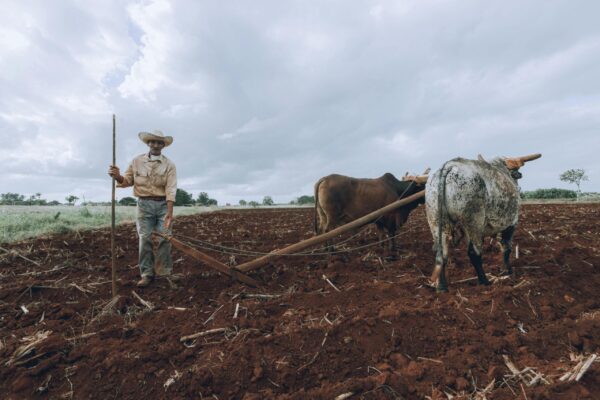
It is early morning in Douala, Cameroon. A smallholder farmer looks up at a sky that offers no clear answer. He planted three days ago. The soil felt right, the air felt humid, and the season said it was time. But the rains that were supposed to follow never came. Now, a week later, a sudden downpour floods his field before his seedlings have taken root. The season is lost before it even begins.
This is not a rare story. Across West Africa, millions of farmers make critical decisions about when to plant, irrigate, and harvest, based on weather patterns that were once reliable but are now increasingly unpredictable. When those decisions are wrong, the consequences are not just inconvenient. They are financially devastating.
The question researchers and technologists are now asking is simple: can artificial intelligence do better than the sky?
The Rainfall Problem Is Getting Harder, Not Easier
West Africa’s rainfall has always been highly seasonal and variable. But climate change has accelerated that variability, outpacing traditional forecasting methods. The Sahel region in particular has seen erratic shifts in the timing, intensity, and distribution of rainfall over the past two decades, disrupting planting calendars that farming communities have used for generations.
The bigger problem is that existing weather services were not built with smallholder farmers in mind. National meteorological services offer broad, city-level forecasts that lack the local resolution a farmer actually needs. A three-day general forecast for a region the size of Nigeria tells a farmer in a rural village very little. By the time that information reaches them, often via radio or word of mouth, the window to act has already closed.
Agriculture in Cameroon, Nigeria, and Ghana collectively supports tens of millions of livelihoods. The forecasting gap these farmers face is not a minor inconvenience. It is a structural barrier between them and better outcomes each season.
How the AI Model Works
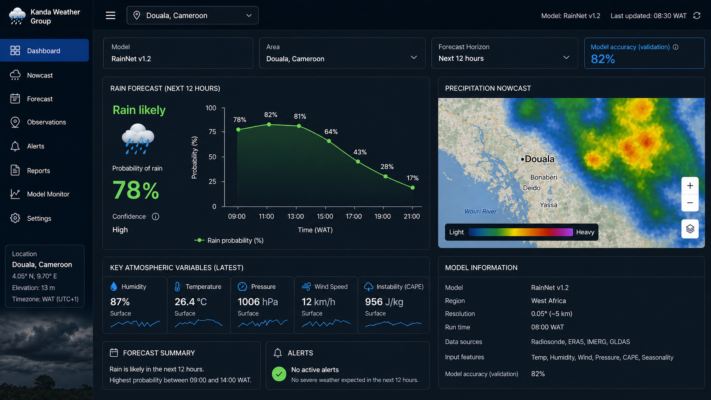
The model forecasts rainfall 12 hours in advance using atmospheric data collected at multiple altitude levels. Weather balloons, also called radiosondes, collect measurements of temperature, humidity, wind speed, and pressure. These signals help the model detect patterns like seasonality, atmospheric instability, and moisture levels, which are key drivers of rainfall.
Conceptual dashboard illustrating how localized rainfall forecasts can be presented to support farm-level decision-making over a 12-hour window.
The model was trained on over 1,000 weather balloon launches pulled from the Integrated Global Radiosonde Archive (IGRA2), spanning the years 2008 to 2020. Each launch covers approximately 500 square kilometers, making it far more locally precise than satellite-based estimates alone.
To build this system, Omdena partnered with Kanda Weather Group in late 2021. Over 10 weeks, a team of data scientists and engineers developed the model for the West African region, starting with Douala, Cameroon.
The result is a simple forecast: rain or no rain in the next 12 hours, with a model accuracy of approximately 82%. In practical terms, the AI is reading the sky in ways the human eye cannot.
How It Changes What Farmers Can Do
Twelve hours may not sound like much. But for a farmer, it is exactly the decision window that matters. Knowing rain is coming in the next half-day means a farmer can delay pesticide or fertilizer application, which would otherwise lose effectiveness when washed away by rain. It means holding off on irrigation and saving water costs. It means timing a harvest before waterlogging damages a standing crop.
Equally valuable is the no-rain forecast. A dry 12-hour window is a green light to plant, to spray, to move produce to market without risk of spoilage. These are small decisions made dozens of times each season, and getting more of them right translates into better yields and fewer losses over time. These kinds of micro-decisions are part of a broader shift, where AI-driven climate risk analysis is increasingly shaping how decisions are made in agribusiness.
The team also built the model as a portable, deployable tool that can run on any internet-connected device, without requiring technical expertise from the end user. A farmer, an extension worker, or an NGO field officer can access it directly from a phone.
Where It Still Falls Short
The project achieved strong results, but the team was clear-eyed about its limitations, and those limitations matter if this technology is to serve farmers rather than just impress researchers genuinely.
The first challenge is data. The model was built primarily on data from Douala, Cameroon. Extending it accurately to other regions of West Africa requires local weather balloon launches and historical rainfall records that simply do not yet exist at the necessary scale. Forecasting accuracy in locations without sufficient data will be lower.
The second challenge is connectivity. The tool assumes reliable internet access. In many rural farming communities across West Africa, that assumption does not hold. A forecast sitting on a server that a farmer cannot reach is no forecast at all. There is also a trust gap that technology alone cannot shortcut. Farmers who have been let down before will not immediately adopt a new one, however accurate it may be.
Finally, even an 82% accurate model means roughly 1 in 5 forecasts will be wrong. In high-stakes decisions like planting timing, a confident wrong forecast can sometimes be worse than no forecast at all. The next version of this work needs to go beyond a simple yes-or-no prediction and communicate how confident that forecast actually is.
What Needs to Happen Next
The path forward is clear, even if it requires effort from multiple directions. More weather balloon launches across Nigeria, Ghana, and other West African countries would expand the training data and improve regional accuracy. This is achievable. Kanda Weather’s approach uses low-cost, community-powered balloon launches that cost less than half as much as traditional radiosondes and reward residents for participating in data collection.
Delivery mechanisms also need to be rethought for low-connectivity environments. SMS-based forecast alerts, integration with existing agricultural extension services, and partnerships with NGOs that already have farmer networks could bridge the last mile more effectively than a smartphone app alone. Local language interfaces are equally important. A forecast in English is not useful to a farmer whose primary language is Hausa or Twi.
The technology exists. What is needed now is the infrastructure, the partnerships, and the sustained investment to move it from a research result into a tool farmers can actually rely on.
Back to the Farmer
That farmer in Douala, the one staring at an uncertain sky, is still out there. The rains are still unpredictable. But the picture is changing. With a 12-hour AI forecast available on a basic phone, that same morning decision looks different. It is still a judgment call, but it is no longer a guess made alone.
What Omdena and Kanda Weather Group demonstrated is that high-quality, locally relevant rainfall forecasting is technically achievable for West Africa, at low cost, using community-gathered data. The science works. Now the harder work begins: getting it into the hands of the people who need it most, in a form they can trust and use.
Farming has always required reading nature carefully. AI does not replace that skill. It sharpens it.
This article is based on the Omdena and Kanda Weather Group project: Building a 12-Hour Rainfall Forecasting AI Model to Mitigate Climate Change Variability in West Africa (2021). Learn more at omdena.com/projects/rainfall-forecasting.
Author Bio: Somesh Utkar works on applied AI projects at Omdena, focusing on real-world agricultural deployments. He writes about practical lessons and insights from AI systems used in farming environments.