



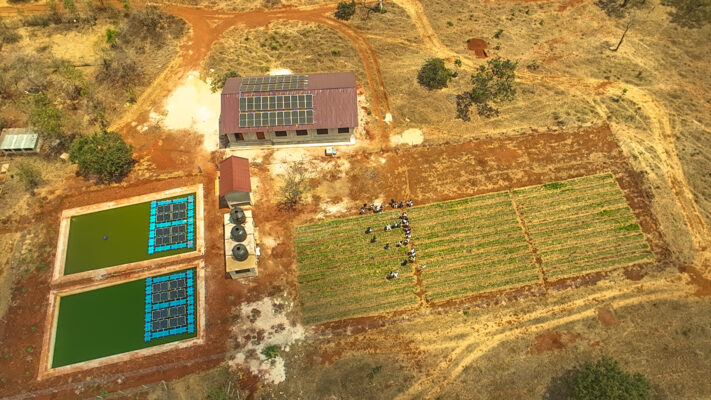
Land ownership, climate change and socio-economic conditions threaten livelihoods and farmers across East Africa, who rely on their crops for their survival. Water conservation efforts should focus on improving irrigation techniques and strategically adopting the “more crops per drop” approach to increase crop yields, especially in areas with limited water resources. The PrAEctiCe project, funded by the EU Horizon-program, enhances food production through Integrated Aqua-Agriculture (IAA) systems to support smallholder farmers with sustainable farming techniques. The project also supports the development of tools for advisors and farmers, to choose the most appropriate IAA farming methods.
The Living Labs and the decision support tool
Three different living labs were designed and built in East Africa to facilitate the project’s purposes. These systems optimize water, energy, and nutrients use:
- Aquaculture and intercropping in Kisumu/Kenya, using filtered (with a Membrane BioReactor) water, from the city’s wastewater treatment plant. The wastewater from the fish tanks is then used to irrigate crops, while Black Soldier Fly larvae is produced from domestic wastes and used as fish-feed.
- An aquaponics facility in Kajjansi/Uganda, where wastewater from fish tanks containing tilapias and African catfish is used to irrigate tomatoes, strawberries, lettuce etc. The media bed on which the plants grow, removes the solids. The plants themselves absorb the nutrients, providing clean water, which is then pumped back to the fish-tanks.
- A fish-poultry integrated system in Morogoro/Tanzania, with the chicken manure being used in the adjacent fishponds, to produce small organisms that the fish will eat. These plants are irrigated with water pumped from the fishponds as well.
Power for all operations in these three systems, is supplied by photovoltaics, reducing the dependence on the usually unreliable electric grid. Additional floating panels were installed in the fishponds in Morogoro, for the first time in Africa, as they are more efficient than the normal panels, operating in a lower temperature (due to the water) without any land occupied.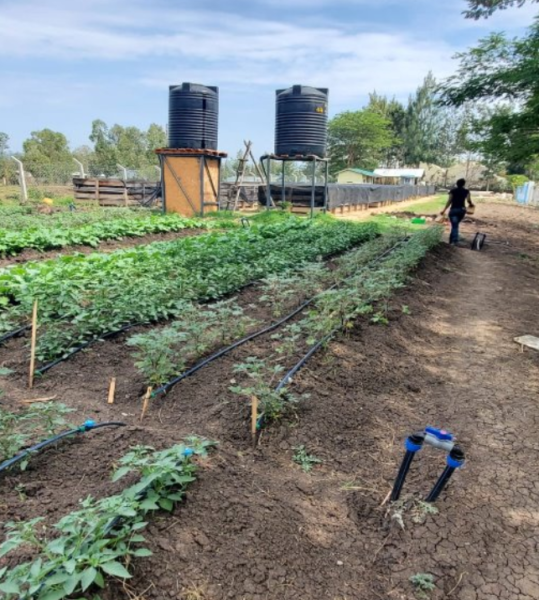
In all three labs, small weather stations, and water and soil sensors were installed. Real-time data are provided, enabling close monitoring of parameters that can affect the production of both fish and plants. These data are then combined with measurements from the crops, the soil, the fish stock, the harvests, and any other activities, in a Decision Support Tool (DST). The DST is coming in the form of a mobile application or a desktop interface, providing recommendations and advices to the farmers and any other users.
The interactive map
An interactive map of 210 IAA systems in these countries was also prepared. This output presents real locations and features of IAA practices that can function as models for local governments, international NGOs, research institutes, funding bodies, private companies, and farmers, promoting the adoption of sustainable and productive farming systems. Users can access and navigate in the map, from the project’s website under the “Living Labs” tab (https://praectice.eu/integrated-agriculture-aquaculture-map/).
Capacity building
The partners operating the Living Labs were trained on the use of all the equipment and the use of the DST, from the providers of these technologies. The living labs are supposed to continue acting as demonstration farms beyond the end of the project, and training ensured that the staff will be able to operate them without further outside support.
On-line training modules for agroecology and IAA, to empower farmers, advisors, investors and students on their transition to such systems, were also created (https://smartstep-community.com/en/agroecology/). These modules cover agroecological methods and utilize a train-the-trainer approach to facilitate adoption.
Policy recommendations were composed to highlight the technology, financials and regulatory environment needed from the governments, to engage all actors in a mutually beneficial way. The workshops performed, assisted all partners to understand intellectual property and the best paths for the exploitation of the innovative results of the project. All the solutions proposed, can be easily replicated or downscaled, and adopted in the rest of the Sub-Saharan Africa, assisting people to improve their lives.
The role of AquaBioTech
AquaBioTech was selected to assist and support the development of all operations in the three demo farms, along with designing and installing the water quality monitoring system. The company has also led the efforts of mapping the IAA practices in East Africa and produced the on-line interactive map. The experience from previous agro-ecological projects in the African region, allowed the company to provide consultancy on all aspects of aquaculture production. As part of the commitments, AquaBioTech produced material for the on-line training of students and farmers, policy briefs for various stakeholders, and finally abstracts and posters for the scientific community. The Business Department, with its good knowledge of the region and the connections to funding and governmental bodies, has contributed significantly to the discussions, during the exploitation workshops and the international meetings organised by organisations like FAO



… [Trackback]
[…] Read More: farmersreviewafrica.com/integrated-aqua-agriculture-growth-in-east-africa-from-theory-to-praectice/ […]
Comments are closed.