

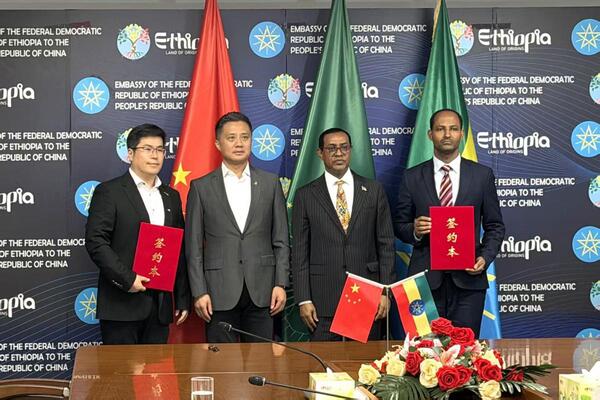
Ethiopia has signed a strategic agreement with Chinese company Aladdin Holdings Group to establish an integrated agriculture and renewable energy hub, marking a significant step in the country’s push to modernise its economy and strengthen food security.
The deal, formalized through a memorandum of understanding with the Ethiopian Embassy in Beijing, will see the creation of a China–East Africa Modern Agriculture and Cultural Tourism Industry Innovation Center.
The project aims to combine renewable energy, advanced farming systems, equipment manufacturing and tourism into a unified industrial cluster.
Under the agreement, both parties will focus on key areas including solar power development, industrial energy storage, cold-chain logistics and agricultural robotics. The initiative is designed to create a scalable development model that can be replicated across Ethiopia, the wider East African region and eventually the continent.
Chairman of Aladdin Holdings Group, Yang Renqiang, said the company views Ethiopia as a high-potential market, citing its abundant renewable energy resources and increasing demand for agricultural modernization.
He noted that the project will help address critical issues such as food security, job creation and industrial development.
Ethiopia’s Ambassador to China, Tefera Derbew Yimam, welcomed the partnership, emphasizing that agriculture remains the backbone of the country’s economy, employing around 70 percent of the population.
He said the initiative aligns with national priorities to modernize agriculture and boost productivity through technology-driven solutions.
The agreement reflects Ethiopia’s broader economic reform agenda, including efforts to diversify energy sources and promote sustainable development.
The country has been expanding its renewable energy portfolio—particularly solar, wind and geothermal—to complement its heavy reliance on hydropower and reduce vulnerability to climate-related shocks.
The project also highlights deepening cooperation between Ethiopia and China under frameworks such as the Forum on China-Africa Cooperation (FOCAC) and the Belt and Road Initiative. The two countries have a long history of collaboration in infrastructure, manufacturing, agriculture and energy development.
Analysts say the integration of renewable energy with modern agriculture could be transformative for Ethiopia’s rural economy, particularly through improved cold-chain systems and mechanization, which are critical for reducing post-harvest losses and increasing market access.
If successfully implemented, the hub is expected to serve as a model for green, technology-driven agricultural development in Africa, while positioning Ethiopia as a regional leader in sustainable agri-industrial innovation.