

Kick-off workshop and inaugural meeting of the Project Steering Group in Chișinău (Moldova) – Priorities for 2026 defined: alignment of Ukrainian institutions with EU standards, inclusive regional development, export orientation – synergies with APD Moldova to be strengthened
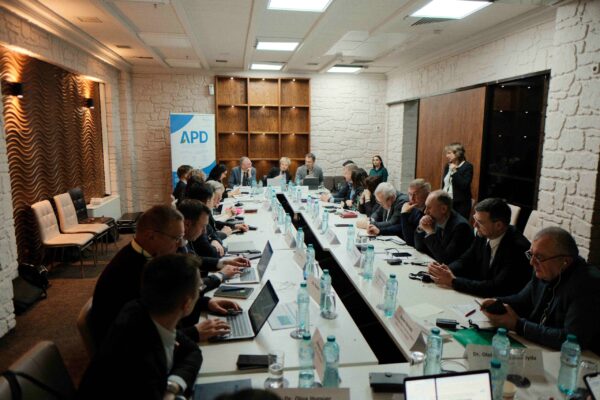
The priorities for the next project phase of the German Ukrainian Agricultural Policy Dialogue (APD Ukraine) have been set. The priorities were developed and adopted during a kick off workshop at the first meeting of the Project Steering Group of APD Ukraine on 3–4 March in Chișinău, Moldova. Consisting of representatives from politics and industry from both countries, the project will focus on the following areas: alignment of Ukraine’s agricultural policy with Common Agricultural Policy (CAP) standards, integrated rural development, and the strengthening of the agribusiness dialogue between both countries. APD Ukraine is implemented on behalf of the German Federal Ministry of Agriculture, Food and Regional Identity (BMLEH) by GFA Consulting Group GmbH. The implementing consortium consists of DLG Markets GmbH and Berlin Economics GmbH. The operational project partner in Ukraine is the National Association of Agricultural Advisory Services “Dorada”. The beneficiary institution is the Ministry of Economy, Environment and Agriculture of Ukraine.
The in-depth working meetings in the Moldovan capital underlined the continued importance of APD Ukraine in the 20th year of its existence. This was emphazised by the participants from the Ministry of Economy, Environment and Agriculture of Ukraine, the Committee on Agrarian and Land Policy of the Ukrainian Parliament (Verkhovna Rada), BMLEH, as well as representatives of Ukrainian sector associations.
Ukrainian participants pointed to the “historic dual challenge” facing the country’s agricultural and food sector in view of the Russian war of aggression and the concurrent EU integration process. This historic test is characterized by difficult framework conditions for agricultural and food production under wartime conditions, including contaminated agricultural land or labor shortages. In addition, extensive operational tasks arise in connection with institutional adjustments required for EU accession. Against this backdrop, close technical cooperation between the two countries remains crucial to effectively shape reforms and strengthen rural areas, participants agreed.
Three priority result areas defined
The priorities for 2026 set at the inaugural meeting comprise three core thematic areas that will be addressed as cross cutting tasks:
1. Alignment of Ukrainian agricultural policy with the EU’s Common Agricultural Policy (CAP)
- Harmonization of political processes, standards and institutions
- Strengthening analytical and implementation capacities for future CAP instruments
- Technical support and guidance for Ukrainian institutions in developing and reinforcing institutional and administrative structures for the implementation of CAP instruments in line with EU standards
- Establishment of a high level working group with thematic task forces for priority reform processes to prepare concrete institutional adjustments for a potential EU accession
- Integrated rural development and strengthening of local stakeholdersAPD will continue to support Ukraine in developing an integrated national strategy for rural development. The focus includes:
- Supporting municipalities and hromadas in strengthening local governance and institutional capacities in the context of EU integration reforms and alignment with CAP related rural development instruments
- Further development of LEADER, the community led EU rural development method, approaches for autonomous regional development in rural areas, including the strengthening of local action groups as standard CAP instruments
- Promoting the participation of women’s organizations, young farmers and war veterans in local governance structures and EU integration processes in the agricultural and rural development sector
The Project Steering Group further decided: Cooperation with German-Moldovan Agricultural Policy Dialogue (APD Moldova) will be further developed, against the background that Moldova has already set up several adaptation and integration steps within the EU accession process.
3. Agribusiness dialogue and export orientation
Another project milestone for the current year is to further integrate Ukraine into Europe’s agri food value chains. Priority areas include:
- Crop breeding and crop protection
- Implementation of animal welfare concepts
- Decentralized water and energy supply and renewable energies
- Processing and marketing
- Export strategy and preparation for the EU Single Market
To further strengthen the bilateral agribusiness dialogue, a German Ukrainian Agribusiness Forum is planned for May 2026, along with agricultural study tours in June and November 2026.
Strengthening cooperation within a resilient network
“The in-depth work in the Moldovan capital has shown how crucial professional and personal connections are for our common path. Exchange, mutual learning and building new synergies were clearly at the centre of the meetings. Especially now, as Ukraine is taking important EU integration steps under challenging conditions, the Agricultural Policy Dialogue is indispensable,”
said Dr Olga Trofimtseva, Project Director of APD Ukraine, former Minister of Agriculture of Ukraine and internationally recognized expert on agricultural policy and EU integration.
“The discussions in Chișinău clearly demonstrated the importance of the German Ukrainian Agricultural Policy Dialogue for the further development of Ukraine’s agricultural sector and for strengthening the German and European agricultural markets. APD Ukraine strengthens bilateral exchange, supports reform processes and contributes significantly to bringing Ukraine closer to European agricultural and policy standards,” emphasized Stephan Framke, Advisor for Technical Cooperation/International Bioeconomy at the German Federal Ministry of Agriculture, Food and Regional Identity (BMLEH).
“In the context of EU accession, there is strong interest in economically viable solutions for Ukraine’s agriculture. Issues such as animal welfare, crop protection, energy and water supply, and the expansion of processing capacities were clearly the focus, always linked to practical implementation on farms. As APD Ukraine, we see ourselves not only as a platform for agricultural policy dialogue but also as a driver of economic cooperation between Ukraine and its European partners. Our task is to strengthen exchange in a targeted manner and jointly develop viable perspectives for a modern, more resilient agricultural and food sector,” underlined Dr Olga Hunger, Key Expert for Economic Cooperation and EU Agricultural Markets at APD Ukraine.
About the German Ukrainian Agricultural Policy Dialogue
The German Ukrainian Agricultural Policy Dialogue (APD Ukraine) has been supporting Ukraine since 2006 in modernizing its agricultural sector and preparing for EU accession. The project strengthens governmental, economic and civil society stakeholders in shaping the EU approximation process in an evidence based and effective manner. Key areas include the alignment of agricultural policy with EU standards and the Common Agricultural Policy (CAP), the development of institutional capacities at all levels, and integrated rural development. In addition, APD promotes transparency, knowledge transfer and public acceptance of the EU integration process.