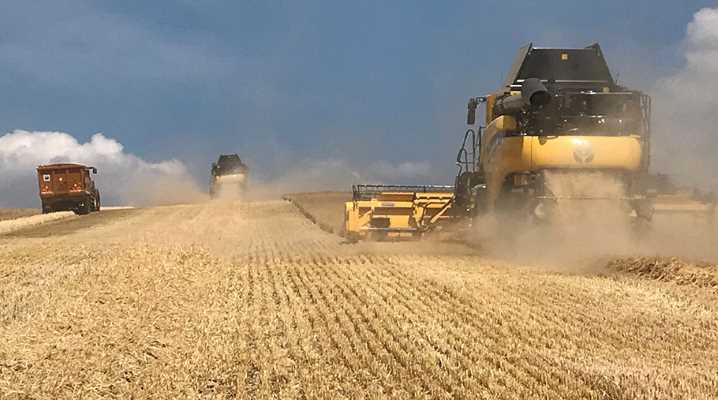
Grain SA, the South Africa’s grain producers organisation has strongly rejected the final outcome of the wheat tariff amendment investigation following confirmation in the Government Gazette that the Dollar-Based Reference Price (DBRP) for wheat will remain unchanged at US$279 per ton and that no automatic trigger mechanism will be introduced.
The application, submitted jointly by Grain SA and the South African Cereals and Oilseeds Trade Association (SACOTA), had requested an increase in the wheat reference price from US$279 per ton to US$289 per ton, alongside the introduction of a more efficient system to address delays between tariff triggers and their implementation. However, none of the core requests from the industry were approved.
Grain SA described the decision as a severe blow to wheat producers and to the long-term sustainability of South Africa’s domestic wheat sector.
“We are not satisfied with this outcome, and we do not accept the reasoning on which it is based,” said Dr Tobias Doyer, CEO of Grain SA. “The decision fails to reflect the reality on wheat farms across South Africa. Producers are under pressure from rising input costs, volatile markets, high financing costs, logistics challenges and unfair international competition. To suggest that the current framework provides adequate protection is simply not aligned with what producers are experiencing.”
South African wheat producers, he noted, operate in a global market where competitors often benefit from substantial government support, subsidies, and more favourable policy environments, while local farmers receive no comparable assistance yet are expected to absorb production risks and rising costs.
“This decision effectively tells producers that they must continue producing under increasingly difficult conditions while receiving insufficient policy support,” said Doyer. “That is not sustainable. If South Africa wants local wheat production, then policy must recognise the realities of producing wheat in this country.”
Grain SA also raised concerns about the impact of current policy on the country’s wheat quality strategy. South African wheat is widely regarded by millers and processors as high quality, but producers argue they are not adequately rewarded for the additional costs and risks associated with maintaining that standard.
Disappointment was also expressed that the application was opposed by the National Chamber of Milling, representing a sector that directly benefits from locally produced wheat.
“It is deeply disappointing that the very value chain that benefits from local wheat quality would oppose a measure aimed at keeping that production viable,” said Richard Krige, Chairperson of Grain SA. “Millers value South African wheat quality, but producers cannot continue carrying the cost and risk of that quality if the market and policy environment refuse to reward them for it.”
Krige warned that continued policy and market signals could force producers to reconsider their production strategies.
“If quality is not valued and paid for, producers will increasingly be forced to reconsider their production strategies,” said Richard Krige, Chairperson of Grain SA. “South African wheat producers have been encouraged to produce quality wheat, but the market and policy environment are not rewarding them for it. If producers cannot be paid for quality, they will have no choice but to focus on yield and quantity simply to survive. These are basic business principles, not threats. You cannot continue producing quality if there is no market for quality.”
He further cautioned that declining planted wheat hectares already signal weakening confidence in the sector, as farmers reassess the crop’s viability within their production systems.
“The real test of policy is not what it looks like on paper,” said Krige. “The real test is whether producers are confident enough to keep planting. At the moment, that confidence is being eroded.”
The Government Gazette maintained that the current DBRP framework continues to provide effective support and that the domestic wheat industry remains profitable. Grain SA strongly disputes this conclusion, arguing that rising input costs—fertiliser, fuel, chemicals, labour, financing, mechanisation and logistics—have consistently outpaced producer prices over time.
The organisation is also frustrated that while the Gazette acknowledges delays between tariff triggers and implementation, it fails to provide an immediate solution or approve an automatic mechanism, instead referring the matter for further interdepartmental engagement after 19 months of deliberation.
“This is one of the most frustrating aspects of the decision,” said Doyer. “Government acknowledges that the system is inefficient, but producers are once again left without certainty, without timelines and without a working solution. Wheat producers cannot make planting and investment decisions based on endless future consultations.”
Grain SA warned that the weakening of the domestic wheat industry would have ripple effects across input suppliers, transporters, storage facilities, millers, rural economies and consumers, while increasing South Africa’s exposure to global price shocks and supply disruptions.
“The question is not whether South Africa can afford to support its wheat producers,” said Krige. “The question is whether South Africa can afford to lose them.”
Despite its rejection of the outcome, Grain SA said it remains committed to engagement but will pursue all available avenues to challenge the decision and push for a more responsive and economically realistic wheat tariff framework.
“Wheat producers are not asking for special treatment,” said Doyer. “They are asking for a fair chance to survive, compete and continue producing food for South Africa. Wheat farmers collectively, as Grain SA, will continue this fight for survival.”