

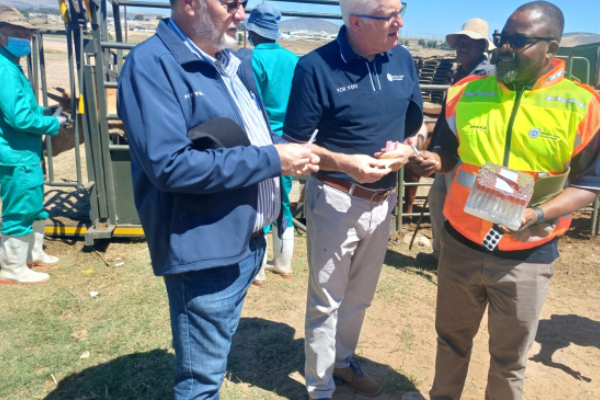
The South African government will fully cover the cost of vaccinating the national livestock herd against Foot-and-Mouth Disease (FMD), Agriculture Minister John Steenhuisen confirmed in a media statement issued on 5 March 2026.
According to the statement, the decision means farmers will not pay for vaccines administered as part of the country’s response to recent outbreaks of the highly contagious animal disease. The vaccination campaign is already underway across provinces as authorities intensify efforts to control the spread of FMD and protect the agricultural economy.
Steenhuisen said vaccine supplies have been distributed nationwide and that hundreds of thousands of animals are currently being vaccinated each week. The government aims to immunise 80 percent of South Africa’s national herd by December 2026 as part of its broader disease containment strategy.
South Africa has secured vaccine supplies from international manufacturers to support the programme. So far, the country has received one million doses from Argentina-based animal health company Biogénesis Bagó and 1.5 million doses from Turkish manufacturer Dollvet. Additional shipments are expected to arrive in the coming weeks to maintain the pace of vaccinations.
The minister praised veterinary professionals and industry organisations for supporting the national rollout.
“We would like to thank the state and private veterinarians who are on the frontline of the vaccination campaign, as well as industry organisations, particularly the Milk Producers’ Organisation, for their cooperation and support in helping to protect South Africa’s livestock sector,” Steenhuisen said.
FMD remains a major threat to livestock industries globally due to its rapid transmission among cloven-hoofed animals such as cattle, sheep and pigs. Outbreaks can disrupt domestic production, halt exports and cause major economic losses in countries reliant on livestock farming.
Against this backdrop, the minister warned stakeholders to be cautious about misinformation circulating on social media and other platforms regarding the vaccination programme and its costs.
“FMD is everyone’s responsibility. It is critical that farmers and stakeholders verify information before sharing it. Misinformation during a biosecurity crisis can cause real damage to the sector,” Steenhuisen said.
The Department of Agriculture addressed recent rumours that misrepresented the cost of vaccines supplied by Dollvet. Some claims circulating online have focused on R45 per dose, describing it as the full price of the vaccine and suggesting the government was inflating costs.
However, the department clarified that the R45 figure represents only the supplier’s bulk delivery price to a cold-storage facility in South Africa. It covers production and international transport under strict cold-chain conditions but does not include the additional operational requirements needed to distribute vaccines nationwide.
Once the vaccines arrive in the country, they must undergo quality checks and be stored under regulated temperature conditions before being entered into national veterinary inventory systems. From there, they are distributed through a network of provincial depots and veterinary teams responsible for administering the vaccines in the field.
Maintaining the cold chain, managing secure storage, coordinating logistics and transporting doses to farms across several provinces are all essential steps required to ensure the vaccines remain effective.
The department said these logistical processes form part of the total procurement cost and are standard for large-scale animal health programmes.
Steenhuisen also rejected claims that the government was profiting from the vaccination campaign.
“The vaccines are being procured and paid for by the state and administered free of charge to farmers,” he said. “No farmer is paying for these vaccines, and government is certainly not selling them.”
Authorities further dismissed allegations that the state lacks the resources to fund the programme. The Department of Agriculture confirmed that funding has already been allocated specifically for vaccine procurement and that additional supplies will be secured to sustain the campaign.
The urgency of the vaccination drive follows a declaration by President Cyril Ramaphosa during the 2026 State of the Nation Address, in which FMD was officially classified as a national disaster. The designation highlights the seriousness of the outbreak and allows the government to mobilise resources to contain the disease more effectively.
Steenhuisen emphasised that controlling FMD requires cooperation across the livestock sector, warning that division and misinformation could undermine response efforts.
“The only way we will defeat this disease is through cooperation, science-based decision-making and a united effort across the sector,” he said.
Farmers and industry stakeholders have been encouraged to follow the Department of Agriculture’s official FMD updates channel on WhatsApp for accurate information on vaccination schedules and disease control measures.
“Reliable information saves livestock, livelihoods and markets,” the minister said.