


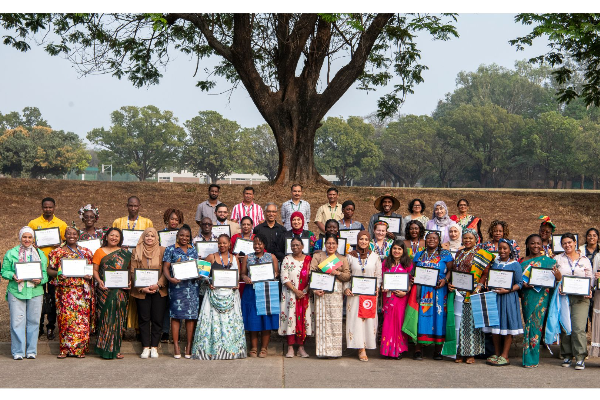
An international training program held in India this January spotlighted how farmers—particularly women and youth—can move beyond primary production to capture a greater share of the value of their produce through small-scale food processing and market-led agripreneurship.
The International Training on Agri-Entrepreneurship for Women and Youth – Small-Scale Food Processing Enterprises, organized by International Crops Research Institute for the Semi-Arid Tropics (ICRISAT), ran from January 19 to 30, 2026 under the Indian Technical and Economic Cooperation Programme of the Ministry of External Affairs, Government of India.
The course brought together 35 participants from 22 countries across the Global South, including farmers, entrepreneurs, policymakers, and educators, united by a shared goal of transforming agricultural produce into higher-value, market-ready products.
Opening the program, Himanshu Pathak, Director General of ICRISAT, emphasized the importance of South–South collaboration in strengthening agri-entrepreneurship. He highlighted the role of the ICRISAT Center of Excellence for South–South Cooperation in Agriculture (ISSCA) in enabling knowledge exchange and enterprise development across developing regions.
“When women and youth from the Global South unite to pursue agripreneurship, they become key drivers who turn crops into safe, nutritious, and affordable foods,” Dr Pathak said. “This training demonstrates how local challenges can be transformed into scalable enterprise opportunities that strengthen rural economies while building resilient, market-ready food systems.”
The program focused on the growing importance of small-scale food processing enterprises in reducing postharvest losses, meeting rising demand for safe and nutritious foods, and creating employment close to farming communities. Participants were equipped with practical technical skills alongside entrepreneurial and business planning capabilities needed to establish and manage viable food enterprises.
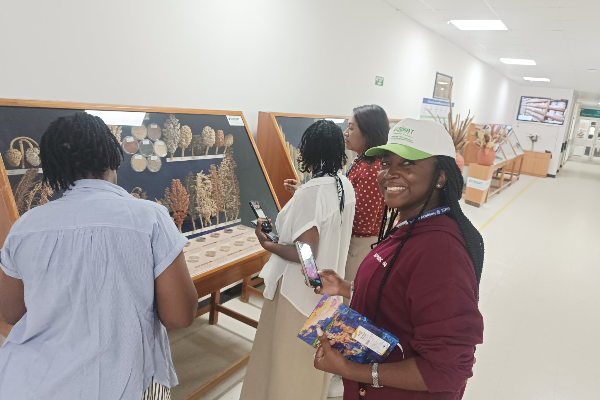
The curriculum combined hands-on learning in processing technologies with training in quality control, packaging, branding, marketing, financial literacy, and enterprise management. Participants also visited ICRISAT’s Agribusiness Innovation and Nutrition platform and its Product Development and Pilot Processing Unit, gaining exposure to how research innovations are translated into commercial products.
Additional learning visits included ICRISAT’s Genebank, the Charles Renard Analytical Laboratory, and genomics and insect research laboratories. Beyond ICRISAT, participants toured national innovation hubs such as NutriHub at the Indian Institute of Millet Research, AgriGhar, and the Rural Technology Park at the National Institute of Rural Development and Panchayati Raj, observing pathways from research to market.
Reflecting on the need for integrated skill development, Stanford Blade, Deputy Director General for Research and Innovation at ICRISAT, said the program reinforced the link between science, entrepreneurship, and markets. “When these elements align, innovation moves beyond laboratories and becomes a driver of real economic change,” he noted.
A team-based business pitching exercise formed the backbone of the training, challenging participants to develop and present enterprise ideas grounded in real market opportunities. The cohort also attended the National IP Yatra 2026 hosted by ICRISAT, gaining exposure to intellectual property rights and strategies for commercializing innovations.
For many participants, the training reframed how they view everyday agricultural challenges. “This training changed how I look at everyday challenges,” said Ms Essia Maghrebi of the National Agronomic Institute of Tunisia. “What I will take back to my country is this: where there is a gap, there is business.”
Course directors Dr Padmaja Ravula, Principal Scientist in Gender and Nutrition Research, and Mr Purushotham Rudraraju, Manager for Agribusiness Relations, said the program went beyond technical instruction to build entrepreneurial confidence and market awareness.
They noted that empowering women and youth with both skills and business acumen is essential for creating inclusive, resilient food systems across the Global South.