


EBC Financial Group highlights how Kenya’s diesel import costs rose 6.7% despite falling global prices, while KES 4.6 billion in government support prevented a pump-price increase ahead of the Central Bank of Kenya’s (CBK) December interest-rate decision and fuel-price review.
NAIROBI, – EBC Financial Group (EBC) notes that Kenya’s cost of importing diesel rose while the world price fell, and government support is stopping that rise from reaching the pump, so cheaper world diesel may take time to reach drivers. Normally, a lower world price means cheaper diesel. But in October, diesel cost 6.7% more to bring into Kenya. Consequently, the Energy and Petroleum Regulatory Authority (EPRA) kept the highest price pumps may charge unchanged until 14 December, using KES 4.6 billion from the Petroleum Development Levy Fund. Diesel runs the lorries that bring Kenya’s food and the matatus that carry its commuters. For Kenyans, that means no new rise at the pump now, but it does not undo earlier increases in fares and food.
David Precious, Senior Market Analyst at EBC Financial Group, said, “A fall in the world price does not mean Kenya’s diesel costs fall at the same time. Kenya pays for the diesel that actually arrives, and that diesel was bought earlier. Cargo timing, shipping and insurance can all widen the gap between the world price and what Kenya pays.”
What could Explain Kenya’s Rising Diesel Import Cost
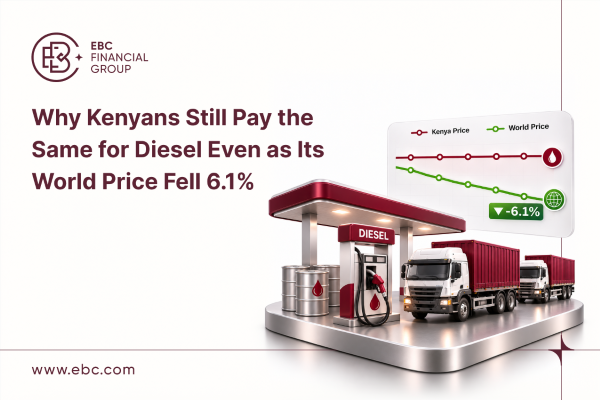
EPRA’s report shows two different measures. The world diesel price fell 6.1%, but the cost of bringing diesel into Kenya, called the landed cost, rose to USD1,137.09 per cubic metre (1,000 litres) in October from USD1,065.38 in September. EPRA’s formulae for setting pump prices average the cargoes unloaded at Mombasa port in the month up to the 9th, so cargoes bought earlier at higher prices may still be counted. Shipping and insurance may also play a part. The figures do not show how much each contributes. The exchange rate explains little of the rise, because the Kenyan shilling lost only about 0.2%, moving from KES 129.91 to KES 130.17 per US dollar.
The International Energy Agency (IEA) said on 13 November 2026 that global oil supply is recovering and is expected to exceed demand in the fourth quarter. Diesel is different. European diesel prices fell 11% from their early-October peak but remain 77% above pre-war levels, and the IEA said in October that diesel can stay in short supply into 2027. A recovery in crude oil supply does not automatically make imported diesel much cheaper.
How Two Supports Hold Kenya’s Pump Price Steady
The Petroleum Development Levy Fund, built from a charge of about KES 5.40 on every litre of petrol and diesel, can work like a shock absorber, softening a price jump at the pump. It is reported to collect about KES 2.4 billion a month, while this month’s payment alone is KES 4.6 billion. Treasury Cabinet Secretary John Mbadi said on 3 November that the fund was held back in October because energy demand was expected to rise as Europe enters winter. This month, the fund stopped a KES 10.54 per litre rise, so diesel stays at KES 227.76 in Nairobi.
The second support is a lower rate of value added tax (VAT). The Tax Laws (Amendment) Act, 2026, signed into law on 16 October 2026, keeps VAT on fuel at 8% instead of 16%, for a new 90 days from 14 October 2026, extendable by another 90. The Central Bank of Kenya (CBK) said at its 7 October 2026 meeting that subsidies and the lower VAT were easing price pressures.
According to the Kenya National Bureau of Statistics (KNBS), annual inflation rose to 7.3% in October 2026 from 6.8% in September 2026. Over the year, diesel prices rose 32.5%, transport prices 17.1% and food prices 10.2%. In May 2026, diesel rose KES 46.29 per litre in one review to KES 242.92 in Nairobi, above today’s KES 227.76. Matatu owners announced a 50% fare increase, a sign of how quickly a jump at the pump can reach fares.
The CBK’s upper limit for inflation is 7.5%, so inflation sits just below it. The CBK meets again on 9 December. EPRA’s current price period ends on 14 December, which means the CBK decides before EPRA’s next report shows whether import costs are easing.
“Holding the pump price steady has a cost of its own: KES 4.6 billion this month, against the roughly KES 2.4 billion a month that the fund is reported to collect,” Precious added. “If support at this scale continues, the fund may need topping up. And if import costs stay high while support is reduced, the pump price may rise in one larger step instead of gradually.”
To learn more, please visit: www.ebc.com.
Disclaimer: The views expressed are for general information only and do not constitute investment advice or recommendations by EBC Financial Group (“EBC”). Trading carries risks, including potential losses. Past performance is not indicative of future results.