

Solidaridad (Southern Africa) will join partners at the UN climate summit to put farmers’ priorities at the centre of a discussion on who can access adaptation finance, who decides how it is spent and how soon it reaches communities.
At COP31 in Antalya, Türkiye, Solidaridad (Southern Africa) will bring a question from the farm to the climate finance debate. When farmers know what could save their next harvest, can they get it funded before the season turns?
The 31ˢᵗ United Nations Climate Change Conference, framed as an implementation COP, running from 9 to 20 November, brings governments together to advance international action on climate change. For smallholder farmers in Southern Africa, the debate over adaptation finance comes down to decisions they make every season. Do they spend scarce cash on seed when the rains are late? Will there be water to keep the crops alive if the rains stop again?
“For Solidaridad Southern Africa, there is a prioritization to translate climate advocacy and awareness into implementable and pragmatic climate adaptation and mitigation solutions for the most severely vulnerable farmers in Africa. There is little doubt that the challenge is no longer the absence of solutions to climate adaptation and mitigation, but rather the inability to make existing solutions and opportunities accessible, affordable and applicable to those who need them most. Solidaridad Southern Africa will shift its strategic focus from simply identifying and promoting solutions to actively enabling their implementation, accessibility and adoption,” says Dr Jonathan Atkinson, Managing Director, Solidaridad Southern Africa.
Solidaridad (Southern Africa) will contribute to that debate alongside research and policy partners at the Financing Locally Led Climate Adaptation side event on Wednesday, 18 November, from 15:30 to 16:30 local time at the CGIAR-FAO Pavilion.
Nonsikelelo Nkomo-Mabobe, Business Development Manager at Solidaridad (Southern Africa), will attend COP31 in person and represent the region as a panellist. Jon Hellin, Principal Scientist at the International Rice International Institute for Environment and DevelopmentResearch Institute (IRRI), will moderate the wider discussion on the challenges farmers face in accessing adaptation finance across regions.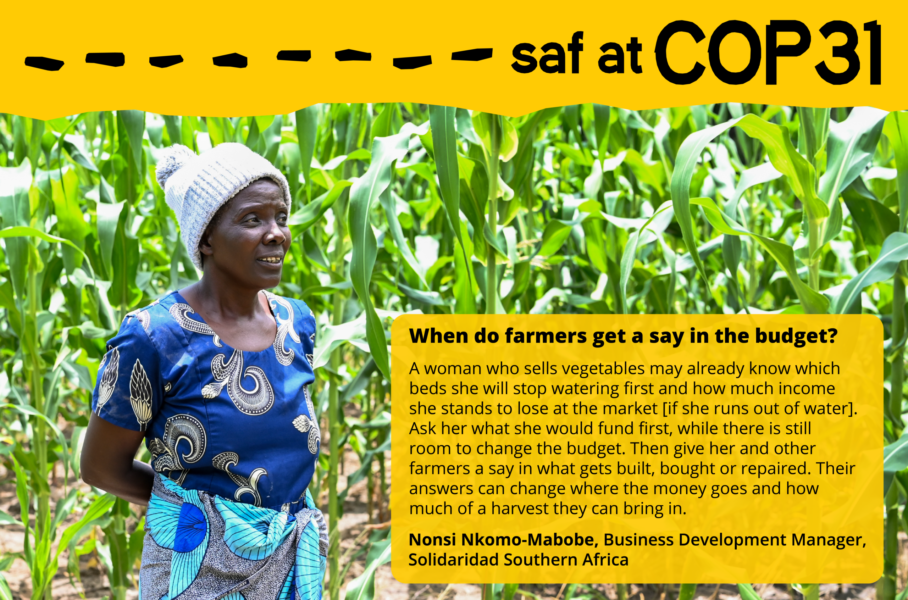
The side event will explore how farmers’ priorities are better addressed in adaptation decision-making, and how those same farmers have access to climate finance to implement chosen adaptation pathways supported by policies from the micro to national and international scales. Through its participation, Solidaridad (Southern Africa) aims to amplify the priorities farmers and local organisations bring to decisions about how their communities adapt.
1.62 million litres. One example of what is at stake.
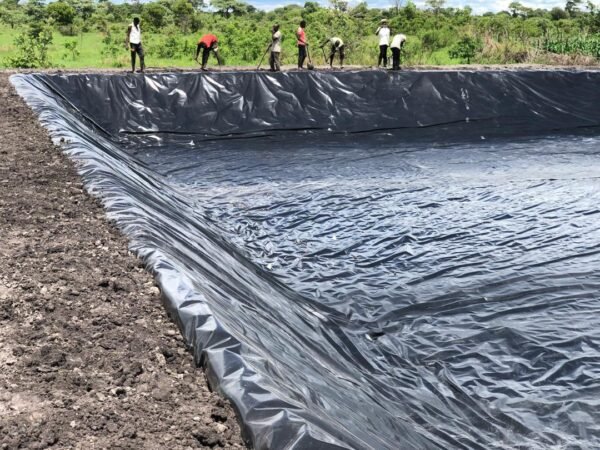
In Chief Mulendema’s area in Zambia, a communal reservoir installed through the Water and Soil Accelerator (WASA) project in partnership with the International Water Management Institute (IWMI) could provide an estimated 1.62 million litres of water every five to six weeks with the current pump installation. It is intended to help 50 households, around 250 people, grow food during dry periods in the Nalusanga Game Management Area.
The reservoir is one example of the kinds of investments at stake in the COP31 discussion. Another community might put its first available funds into seed suited to a shorter growing season or reliable local forecasts before planting. The side event will examine how communities can influence those choices and access the finance to act on them.
“A budget can buy a pump. The people who use it know how long they can go without water if it breaks, what it costs to keep it running and which crops they stand to lose if repairs take too long,” said Dr Jonathan Atkinson, Managing Director of Solidaridad Southern Africa. “That knowledge belongs in the funding decision from the start. If farmers say the pump has to last through the driest weeks of the year, the budget has to account for what it takes to make that happen. That is the difference between paying for a piece of equipment and paying for a reliable water supply.”
Give farmers a say while the budget is still open
Who draws up a proposal can determine what makes it into the budget. A farmer who grows vegetables for both the household and the market may know exactly when water runs short, what it costs to fetch it and which crops she would have to give up first. If she is asked for input after the budget is set, there may be little room to act on what she says.
“At COP31, I want to bring the conversation back to the women who can tell you exactly which weeks they run out of water and what that does to the food they grow and the income they earn,” said Nkomo-Mabobe. “A woman who sells vegetables may already know which beds she will stop watering first and how much income she stands to lose at the market. Ask her what she would fund first, while there is still room to change the budget. Then give her and other farmers a say in what gets built, bought or repaired. Their answers can change where the money goes and how much of a harvest they can bring in.”
Can the money reach a farmers’ group before planting?
The session brings together practitioners, researchers and policy specialists to examine what happens between a funding commitment and a community being able to use it. Eligibility rules, approval timelines and spending conditions can all determine whether a locally identified solution gets off the ground.
“As moderator, I want to explore practical ways that climate finance can support local climate adaptation. There are growing calls for the transformation of climate resilient food, land and water systems that are sustainable, equitable and inclusive. Climate adaptation efforts, however, seldom place local people’s needs, capacities and preferences at the core of climate action. Identifying and implementing climate resilient pathways should be led by communities who are affected and who are best placed to articulate their own priorities and what is relevant within a given context. We need honest discussions about what works and what does not, and how we can best foster partnerships that allow climate-impacted farmers to determine and chart climate adaptation pathways,” says Hellin.
The reservoir in Zambia is one example from Southern Africa of a challenge farmers face across regions. The priorities vary from one community to the next, but the deadline is often set by the season. At COP31, Solidaridad (Southern Africa) will bring that experience into a wider discussion about how farmers can shape adaptation investments and secure the finance to act while there is still time to protect a harvest.
Organisations represented in the side-event correspondence
- Solidaridad
- CGIAR, through the International Rice Research Institute (IRRI), Africa Rice Center (AfricaRice), and the Alliance of Bioversity International and CIAT
- International Institute for Environment and Development (IIED)
- Center for Global Development (CGD)
- LEDARS-Local Environment Development and Agricultural Research Society (Bangladesh)