

A mower that works well on maintained grass may struggle in an orchard with narrow lanes, overgrown field edges or uneven access tracks. The right choice begins with the site and the vegetation, not the engine size or the widest cutting deck in a catalogue.
Start with the job, not the machine
Walk the intended route before comparing equipment. Measure the narrowest spaces between trees, gates and irrigation structures. Note low branches, turning points, soft patches, stones, wire, exposed roots and drop-offs. Record whether the task is routine grass management, seasonal weed control or recovery of neglected ground. A site with short grass and frequent maintenance presents a different workload from one with fibrous weeds and dense, tangled growth.
In orchards, check the distance between the machine and trunks, irrigation lines and protective structures. The ability to enter a row is not sufficient if the mower cannot turn or work without damaging assets. Where vegetation hides hazards, assess the area on foot and remove loose objects before mowing.
Understand the cutting system
Rotary mowers usually suit routine grass cutting where an even, relatively tidy finish is important. Their performance depends on cutting height, vegetation density and the condition of the blades and deck. Heavy, woody or tangled vegetation can produce an entirely different workload.
Flail mowers use multiple cutting elements on a rotating shaft. They may be better suited to rough grass, weeds and mixed vegetation where mulching is more important than a lawn-like finish. However, “flail” does not automatically mean that every machine can safely process thick brush. The permissible material, operating speed and maintenance requirements depend on the individual machine and cutting tools. Operators should never treat a general vegetation description as permission to strike unknown objects.
Match machine size to the site
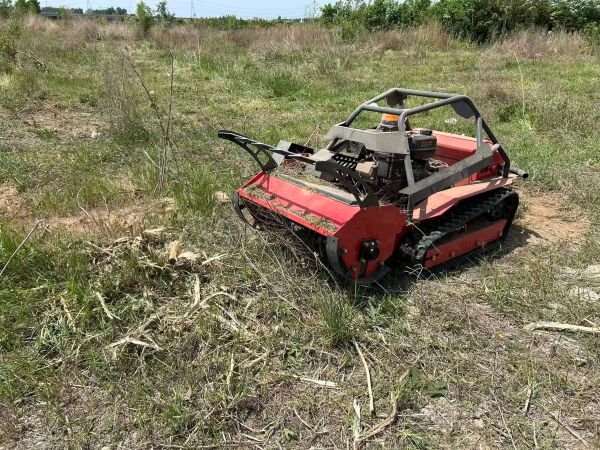
Compact remote-controlled mowers can be useful where orchard spacing, paths or access gates restrict larger equipment. A narrower machine may spend more time cutting the same area, yet save time by avoiding difficult transport or repeated manual finishing. A wider tracked flail may make sense on open margins with heavier vegetation, provided there is enough room to turn, load and transport it.
Compare the overall width and height, not only advertised cutting width. Check loading ramp suitability, transport dimensions and the equipment needed for unloading. On small dispersed jobs, time spent travelling and preparing the machine can matter as much as mowing speed.
Treat slope ratings as limits, not promises
Slope work requires a separate assessment. Measure the gradient, inspect the soil and consider whether the ground is dry, loose, rutted or wet. Traction can change during the day, and an embankment may contain unseen holes or unstable edges. A published maximum slope figure should never replace the manufacturer’s instructions for the specific configuration and actual conditions.
Remote operation can allow the operator to stand away from the machine, but it does not remove hazards from moving blades, thrown material, unexpected movement or restricted visibility. Confirm emergency-stop behaviour, signal-loss response, guarding and safe restart procedures. Set an exclusion area that keeps people and animals away from the cutting zone. Do not rely on remote-control distance as evidence that the whole worksite is safe.
Consider African operating conditions
For a farm or contractor working across several sites, serviceability deserves the same attention as cutting capacity. Ask about replacement blades or flails, belts, filters, bearings and routine inspection points. Confirm the recommended service interval and whether operators can carry out common maintenance with ordinary tools. Verify spare-part availability and realistic delivery arrangements before the machine becomes essential to a weekly schedule.
Dust, heat, seasonal rain and uneven access can affect the daily routine. Plan cleaning, air-filter checks, safe refuelling, transport and secure storage around the actual site. Ask for a demonstration in vegetation resembling the intended work rather than relying solely on a polished promotional video.
Compare the real cost of a job
The lowest purchase price does not necessarily deliver the lowest cost per maintained hectare. Estimate productive working time alongside transport, setup, manual trimming, fuel, wear parts, operator training and downtime. A compact mower may be economical for frequent orchard maintenance; a tracked flail may justify itself on rougher, wider areas. The result depends on local conditions and a realistic trial, not a universal productivity claim.
A buyer’s practical checklist
Before ordering, request the exact machine configuration and operating manual; confirm site access and unloading; establish which vegetation it can handle; review the slope and safety limitations; identify local maintenance responsibilities; and obtain a clear spare-parts plan. Where possible, compare two candidates in a supervised trial on representative ground, recording finish quality, safe access, time and routine service requirements.
The best machine is the one whose cutting system, dimensions, safety controls and support arrangements match the work the operator will actually do.
Contributor bio: Alex Pan works in European business development at GREEN SHINE, a Hong Kong-based supplier of remote-controlled tracked mowing equipment. https://greenshineworld.com/