


By Arvin Ramjee, Account Manager, Pulp and Paper, ABB Sub-Saharan Africa
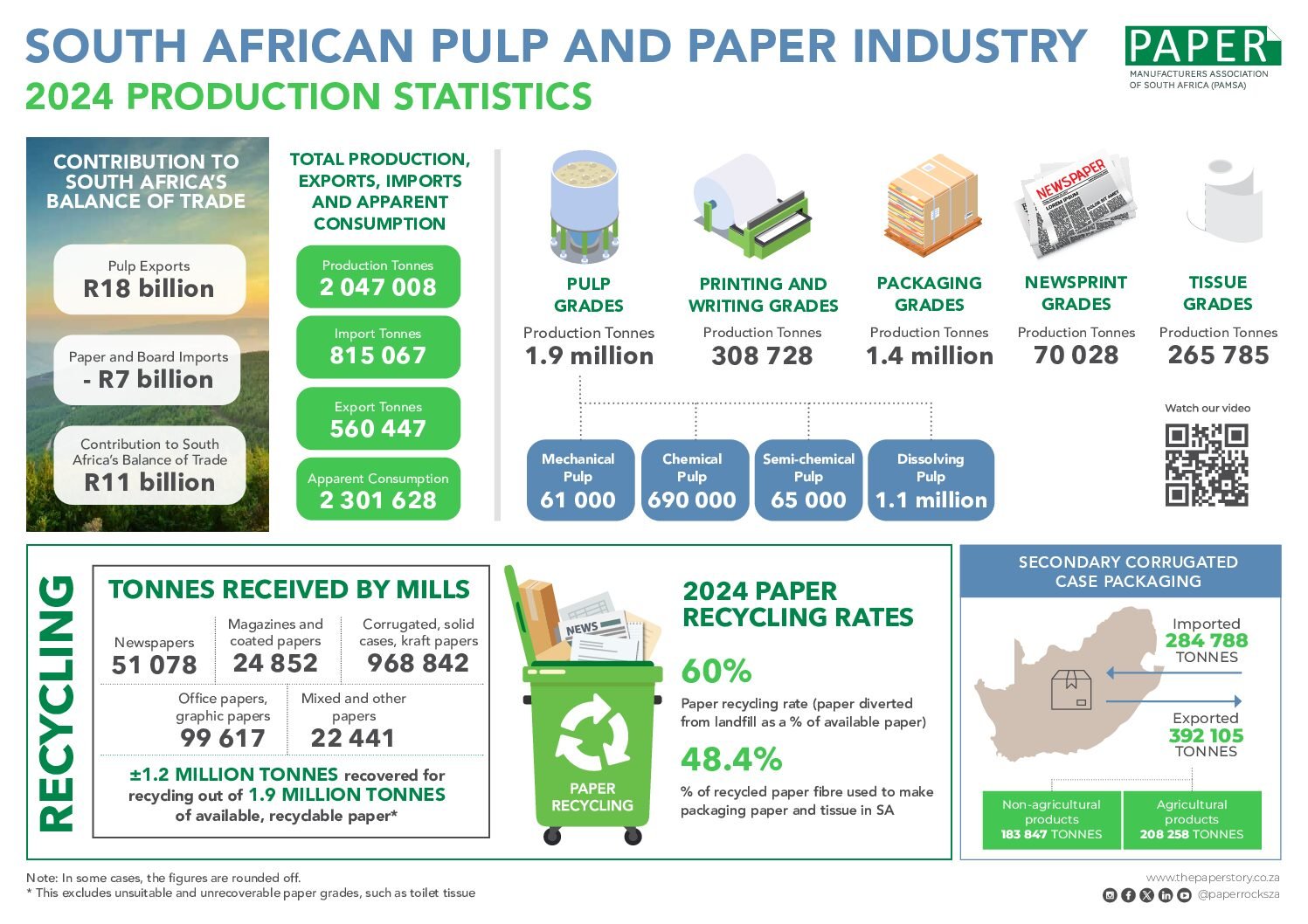
South Africa’s pulp and paper industry is a significant contributor to the economy, producing more than 2 million tonnes of paper in 2024, while pulp exports generated around R18 billion and the industry contributed approximately R11 billion to the country’s balance of trade.
But behind these numbers, mills are operating in an increasingly challenging environment. Rising energy costs, pressure to improve resource efficiency, ageing infrastructure and skills shortages are forcing manufacturers to find new ways to improve productivity while protecting margins. For an energy-intensive, continuous process industry, the question is no longer simply whether mills have invested in automation. It is whether those investments are working together effectively.
The problem is no longer a lack of technology
South Africa’s pulp and paper industry has invested heavily in sophisticated technologies, including process control, drives, electrical infrastructure, instrumentation, quality control and digital applications. The challenge is that many of these systems have been introduced at different stages of a plant’s lifecycle and, in some cases, supplied by different technology providers. The result is an operational environment where highly capable systems can function alongside one another without being fully integrated.
When production is running normally, this fragmentation may be difficult to see. During a power disturbance, equipment failure or process upset, however, the consequences can become much more apparent. In a continuous process environment, even a disruption can affect production, product quality, energy consumption and waste. If information is spread across disconnected systems, operators may spend valuable time establishing what happened, where the problem lies, and how different parts of the operation are affected.
Energy makes integration more important
Energy is central to the economics of pulp and paper manufacturing. In March 2025, NERSA approved an average 12.74% Eskom tariff increase for direct customers for the 2025/26 period, including key industrial tariff categories. South African mills have responded to the country’s energy challenges in several ways, including investing in cogeneration and biomass-based energy generation. PAMSA notes that some mills generate more than half of their energy requirements from biomass-based fuels.
However, producing or sourcing energy more efficiently is only part of the equation. Manufacturers also need greater visibility into where, when and why energy is being consumed. Connecting electrical and process systems can provide a clearer picture of the relationship between energy use and production performance, supporting better decisions around equipment operation, process optimisation and maintenance.
AI cannot fix disconnected industrial data
The industry’s digital transformation is also accelerating, with artificial intelligence, predictive analytics, and industrial software increasingly considered tools to improve manufacturing performance.
But one fundamental issue needs more attention: AI cannot fix poor industrial data. A mill may have sophisticated analytics, but if operational data is incomplete, inconsistent, or trapped within disconnected systems, those tools will have limited value.
Digital transformation therefore needs to start much closer to the plant floor. Electrical systems, drives, process control, instrumentation and production systems need to exchange information consistently and in context. Only then can advanced analytics provide meaningful insight that supports operational decision-making.
Integration is more than putting systems on one screen
There is also an important distinction between visualisation and genuine integration. A manufacturer can bring information from multiple suppliers into a common interface, giving operators a single view of the plant. But the underlying systems may still rely on different communication protocols, engineering environments and diagnostic models.
True integration goes further. It means creating an architecture in which electrical, automation, process control, quality and digital systems can communicate natively. The commercial benefit is greater visibility and better coordination across the operation. It can also provide a stronger foundation for predictive maintenance, advanced process control and future AI applications.
Efficiency extends beyond energy
The industry’s sustainability challenge also extends beyond electricity. South Africa recovered approximately 1.2 million tonnes of paper and paper packaging for recycling in 2024, equivalent to a 60% paper recycling rate based on the available recyclable paper pool. This reinforces the need to look at efficiency across the entire production process. Water, fibre, chemicals, waste and equipment performance all influence both the environmental footprint and cost of production.
Better connected operations can help manufacturers identify these relationships more clearly. Improved process stability can reduce variability and waste, while better asset visibility can support proactive maintenance and more efficient resource use.
The metric that matters is cost per tonne
For all the discussion around digital transformation, AI and Industry 4.0, the commercial question facing South Africa’s pulp and paper producers remains straightforward: Can technology help produce every tonne more efficiently, reliably and sustainably? This requires manufacturers to look beyond individual technology investments and consider the mill as a connected operation. ABB’s approach is based on this principle, bringing electrification, drives, automation, quality control, asset performance and digital technologies together within an integrated industrial architecture.
The objective is not digitalisation for its own sake. It is to improve the operational metrics that determine competitiveness: equipment availability, energy intensity, production efficiency, product quality, resource consumption and ultimately cost per tonne. The next phase of industrial competitiveness will therefore not necessarily be determined by who has the most automation. It may be determined by who can make their automation work together most effectively.
For South Africa’s pulp and paper industry, integration is becoming less of a technology conversation and more of a competitiveness imperative.