


On a small farm, fertilizer is often the largest cash cost of the season, and it is also the input most often applied by guesswork. A bag is opened, a handful or a cup is scattered, and the farmer hopes it is enough. Too little, and the crop never reaches its potential. Too much, and scarce money is washed away in the first heavy rain, while excess nutrients can damage young plants and pollute nearby water.
Accuracy does not require expensive equipment. It requires four simple habits: measuring the field, reading the bag, doing one short calculation, and checking the crop before spending more.
Applying fertilizer by hand along the row: accuracy starts with a measured field and a known rate.
Start with the field, not the bag
Most dosing mistakes begin before any fertilizer is bought. If the field size is guessed, every later number is wrong. A plot described as “about half a hectare” may in fact be 0.3 or 0.7 hectares, and that error alone can mean a 40 percent overdose or underdose.
Measure the length and width with a tape, a marked rope, or careful pacing once the pace length is known, then multiply to get the area. Write the figure down and keep it; it is the basis for every bag and every season that follows.
A soil test, where one is available through an extension service or cooperative, shows what the soil already contains and what it lacks, so fertilizer replaces a real shortage. Where a test is not available, local extension advice for the crop and area is the best substitute. Either way, the dose should follow a recommendation, not the size of the bag.
Read the label as a percentage
A fertilizer bag already carries the information needed for the calculation. The three numbers on the front, such as 15-15-15 or 46-0-0, are percentages by weight of nitrogen (N), phosphorus (P) and potassium (K), in that order.
Urea labelled 46-0-0 therefore contains 46 percent nitrogen: every 100 kilograms of urea supplies 46 kilograms of nitrogen. A compound labelled 15-15-15 contains 15 kilograms of each nutrient in every 100 kilograms of product. Once this is understood, the question changes from “how many bags?” to “how many kilograms of nutrient does my field need, and how much product supplies that?”
The calculation is short:
- Take the recommended nutrient rate per hectare.
- Divide it by the percentage in the bag, expressed as a decimal.
- Multiply by the field area in hectares.
A worked example
Suppose extension advice for a maize field recommends 60 kilograms of nitrogen per hectare, and the farmer has a 0.5-hectare field and a bag of urea (46 percent nitrogen). This is an illustrative example only; the recommended rate should always come from a soil test or local advice for the actual crop, soil and season.
Step 1: divide 60 by 0.46. That gives about 130 kilograms of urea per hectare.
Step 2: multiply by the field area, 0.5 hectares. The field needs about 65 kilograms of urea in total.
Step 3: split the dose if the recommendation says so. Many farmers apply part at planting and the rest as a top dressing when the crop is growing vigorously, rather than putting everything on at once, which reduces losses from rain and leaching.
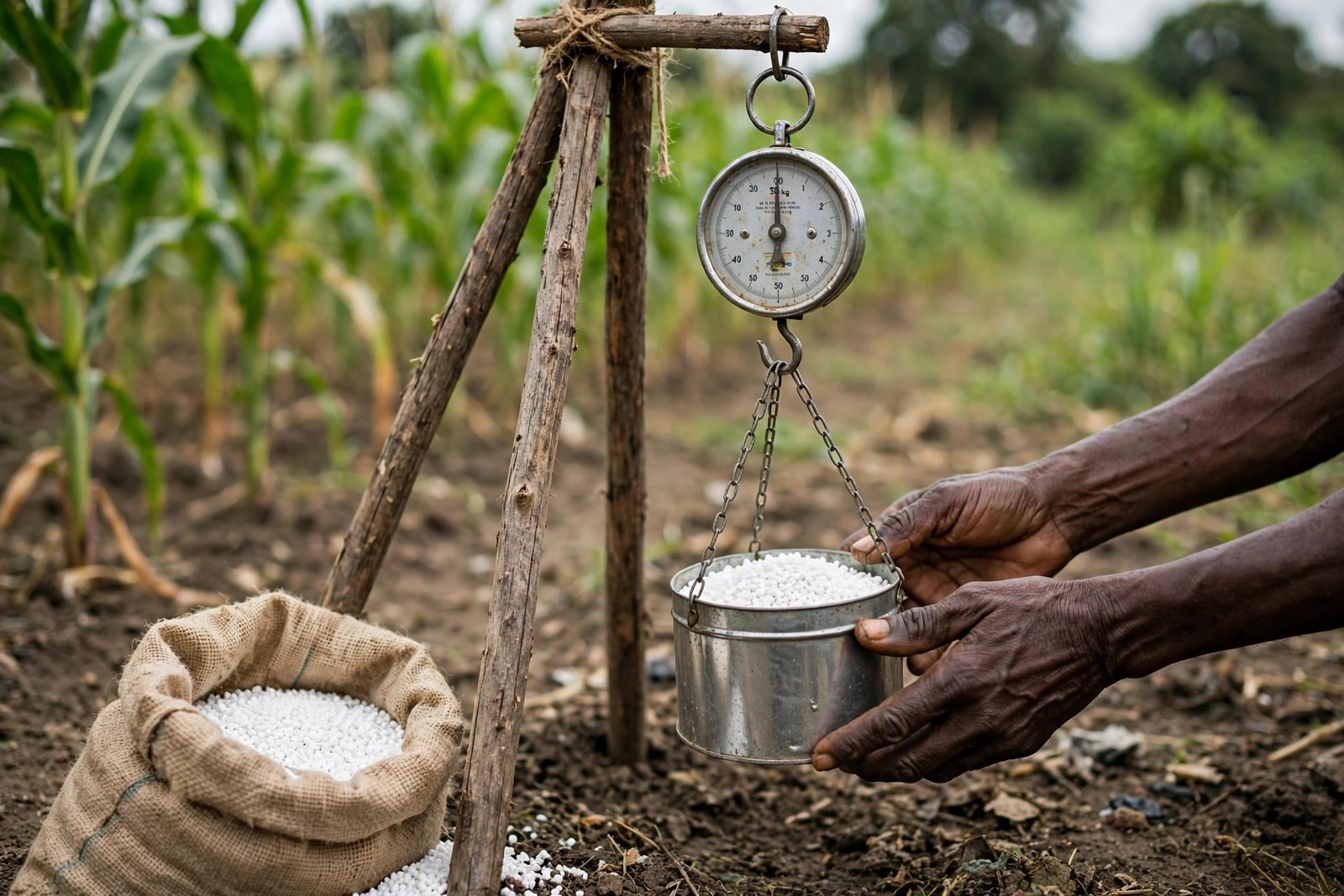
Weighing matters as much as calculating. A tin, cup or scoop should be weighed once, full, so the farmer knows exactly how much it holds. Counting scoops from a calibrated container is far more accurate than estimating by eye, and it makes the same dose repeatable from one row to the next.
Weighing a full scoop once turns guesswork into a repeatable dose.
Check the crop before spending more
A pale or stunted crop is not always short of fertilizer, and adding more without checking can waste money. Yellowing of older leaves, purpling, or poor growth can also be caused by dry soil, waterlogging, pests, disease, or soil acidity that locks nutrients away even when fertilizer has been applied.
Before buying another bag, walk the field: is the problem even or only in patches, has water been short or has the field been waterlogged, and has the same problem appeared before? Visual signs are clues, not a diagnosis on their own. If the pattern is unclear, an extension officer or a soil test will save more money than an extra bag applied blindly.
Timing and placement also protect the investment. Fertilizer spread on dry, windy days, or left on the surface before heavy rain, is easily lost. Applying close to the root zone, at the growth stage the crop can use it, and when some soil moisture is present, gives each kilogram a better chance of reaching the plant.
Walking the field and reading the leaves before buying another bag.
Keep a record, season by season
A notebook entry after each application costs nothing: date, crop, field size, product, kilograms applied, and cost. At harvest, that record shows which fields responded well, and it makes the true cost per hectare visible when comparing products or deciding whether a second application is worth it.
Fertilizer accuracy is not about farming by formula. It is about replacing a guess with a measurement, a label reading, and one short calculation. For a smallholder, where every bag is bought with cash that could have gone elsewhere, that small discipline is often the difference between money spent and money invested.
Team FertDose works on FertDose, a free fertilizer dose calculator used by farmers in 19 countries: fertdose.com