

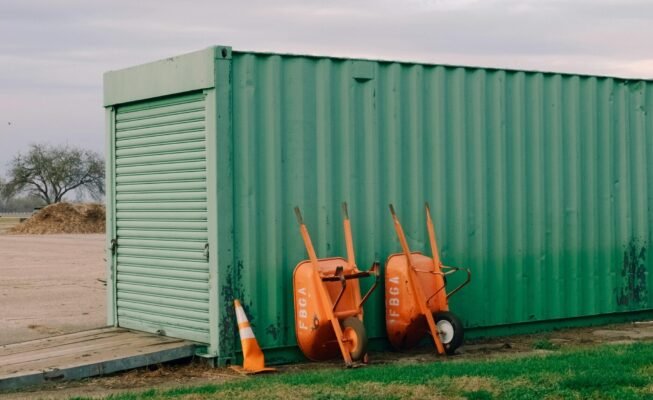
Built for ocean freight, shipping containers are finding a second life as farm warehousing in parts of East Africa. The idea responds to a problem beginning after harvest, when crops wait in conditions able to spoil them before reaching buyers. For farmers far from roads and power lines, a finished steel shell offers a starting point for storage on the farm itself. To make it work, moisture and heat have to be managed carefully.
Post-Harvest Losses and the Warehousing Gap
A study of smallholder bean farmers in Uganda measured losses from handling and storage at about 22% of the harvest. Common storage practices also failed to hold grain at the required moisture level of 13% or lower, with 74% of farmers missing the threshold.
Above the required level, grain can spoil and lose the price premium buyers pay for well-kept beans. Simple steps, such as keeping bags off the floor, could lower grain moisture. The authors still call for wider farmer access to post-harvest technologies.
Dry, cool warehousing is one practical response. Retired shipping containers offer a ready-made shell for it. Several designs now being tested show how far such a shell can be adapted.
Containers as Off-Grid Storage Units
Recently, MIT researchers released an open-source design for a forced-air evaporative cooling chamber built in a used shipping container, according to MIT D-Lab. Inside, fans pull hot, dry air through a wet pad. The cooled, humid air then passes through crates of produce, cooling a harvest straight from the field.
The chamber can run on grid electricity or built-in solar panels. The designers report lower energy use than refrigerated cold rooms. They chose not to patent the design. Any builder can therefore use it. In Kenya, the company Solar Freeze built an off-grid, solar-powered chamber at a produce market between Nairobi and Mombasa for $15,000, as reported in the same article. The cost and performance figures come from the developers and pilot partners rather than independent testing. They are better read as early indicators.
Remote sites pose their own building challenges. A finished steel enclosure can reduce the materials and labor needed on location. With solar power, a grid connection is unnecessary where electricity is unreliable. Even transport shapes who can use the approach, because access roads and unloading space decide whether a container can reach the farm.
Insulating Containers Against Heat and Condensation
Metal enclosures call for moisture planning. In metal buildings, condensation forms when warm moist air meets cold surfaces such as framing and windows. In a container, the same conditions can develop along the steel walls wherever hot days give way to cool nights. Having a facing with a low perm rating — meaning it allows very little water vapor to pass through — helps control moisture migration.
A single layer of fiberglass insulation between structural members, with the facing toward the interior, is a common approach. Even inside the insulation, condensation can form if moisture passes the vapor retarder. Further, insulation helps control indoor temperature and lower energy use.
Stored grain adds a further consideration. A simulation study modeled condensation in ship cargo holds and found that condensation risk persists where grain touches the inner shipside. Meanwhile, moisture moves toward the cooler surface as nearby grain cools. For farm warehousing, the lesson is to insulate the shell and keep stored grain from touching the walls. On pallets or racks, sacks stay clear of the floor and the walls, serving the same purpose. Both steps protect the moisture level that the Ugandan bean farmers struggled to hold.
Costs, Training and Local Markets
A study of tomato farmers in Kilolo district, Tanzania, examined barriers to solar cold storage built as walk-in rooms or used shipping containers with rooftop panels and batteries. Limited awareness, high investment costs and low farmer purchasing power constrained adoption.
Most of the farmers surveyed had never received post-harvest management training. The study also mentions Kenya and Rwanda as recent adopters of these systems. A container may lower the cost of the shell. Even so, cooling equipment and maintenance still need funding. For adoption, financing and training matter as much as the structure itself.
Local markets can help justify the investment. Organic vegetable farms, for example, can sell locally to cut input costs and support rural economies. Organic methods centered on building healthy soil and conserving water add a sustainability case. On-farm warehousing gives growers more control over when produce reaches nearby buyers. Fewer losses after harvest also mean the water and labor already invested in a crop reach a plate more often.
Practical Considerations Before Converting a Container
Early attention to delivery logistics pays off because a truck and lifting equipment, or a ramp, must be able to reach the chosen spot. If a base is level and well-drained, it can keep water away from the floor. Where possible, shade from trees or a simple roof frame over the container may reduce the heat reaching the steel, though local conditions should guide the choice.
On the interior side of the steel shell, insulation with a vapor retarder belongs in a continuous layer. Proper vents are needed to let moist air escape. Before loading, a handheld moisture meter lets farmers check grain against the target level. Regular moisture checks give early warning of trouble before a lot is damaged. Recorded readings reveal patterns across seasons. Internal temperature belongs in the same log.
In groups, farmers can share the cost of a unit and the training accompanying it. Local welders and fabricators can cut door and vent openings and reinforce the frame, keeping more of the project’s spending in the community. A pilot with one crop shows how the container performs through a full season before more money is committed.
Storage Built Around Local Conditions
The approach is still fairly young. Results will vary by crop and site. In practice, warehousing in a container works well when the design fits the crop, the climate and the site. Evaporative cooling and careful insulation each answer a different local constraint. With moisture monitoring and shared training added, farmers can turn an unused steel box into storage, protecting more of the harvest.

Jane is an agriculture and environmental journalist and the founder and editor-in-chief of Environment.co, where she covers sustainability and eco-friendly living.