

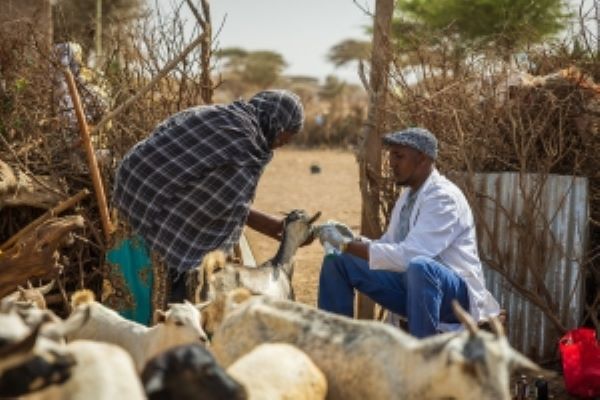
A nationwide livestock vaccination campaign targeting 9.8 million animals is expected to help protect the livelihoods of 1.2 million livestock-owning households in Sudan as conflict, displacement and a deepening food crisis continue to threaten rural communities.
The campaign which was launched late last month will run through the 2026–2027 period, building on the previous year’s efforts to safeguard animal health, strengthen food security and support the recovery of rural communities across the country’s 18 states.
The initiative comes as Sudan’s livestock sector, estimated at 115.4 million animals in 2025, remains a critical source of income and nutrition for millions of agro-pastoral families. Livestock provide milk, food and income, particularly for internally displaced households struggling to meet their basic needs.
“One thing is clear – Sudan’s farmers, herders and fishers are resilient. I have met people determined to rebuild their lives despite the challenges they continue to face.
For many, livestock are their most valuable asset. For families in need of humanitarian assistance, livestock are also a vital source of nutritious milk,” said Rein Paulsen, Director of the Office of Emergencies and Resilience at the Food and Agriculture Organization of the United Nations (FAO).
Paulsen made the remarks during a visit to Sudan, where he travelled across Khartoum, White Nile and Sinnar states, meeting government officials, farmers, pastoralists, fishers, technical experts, women and young people to assess the challenges facing communities.
The conflict that began in April 2023 has severely disrupted veterinary services, damaged infrastructure and weakened disease surveillance and vaccination systems. FAO estimates that livestock-related losses have reached nearly $3 billion.
The destruction of the Central Veterinary Research Laboratory in Soba, Sudan’s national veterinary reference laboratory and the country’s sole producer of veterinary vaccines for more than five decades, has further weakened the country’s capacity to diagnose and respond to animal diseases. Before the conflict, the facility produced up to 35 million vaccine doses annually.
To address the shortages, FAO supported the importation of approximately 23 million vaccine doses in 2025, alongside cold-chain management, transportation and distribution to livestock-producing areas, including hard-to-reach communities in Darfur and Kordofan.
Between October 2025 and July 2026, the agency vaccinated 8.4 million animals, benefiting an estimated 537,000 households, or 2.7 million people. For the first time, vaccines were delivered through a cross-border supply corridor from Chad into Darfur.
The new campaign will target common livestock diseases and include vouchers for concentrated animal feed and mineral salt licks for eligible livestock owners. The support is intended to improve animal nutrition, maintain productivity and help conflict-affected households preserve their productive assets.
“Preventing the outbreak and spread of animal diseases is one of the most cost-effective investments we can make. Protecting an animal today costs far less than replacing one tomorrow,” Paulsen said.
“In the context of the humanitarian response, healthy animals mean food on the table, milk for a child, and a vital source of income for vulnerable households.”
Beyond livestock, FAO is supporting crop production and fisheries as part of a broader emergency response. Conflict, displacement, disrupted markets and rising production and transport costs continue to undermine food security, with national cereal production remaining 22–25 percent below average over the past three years.
Climate risks could further worsen the situation, with forecasts indicating a rainfall deficit of 30–40 percent associated with what is predicted to be the most significant El Niño event on record. Access to drought-tolerant seeds and other agricultural inputs is therefore considered critical to sustaining production.
During the 2024–2025 season, FAO reached more than 832,000 farming households across 15 states with over 8,000 tonnes of crop seeds, contributing to total grain production of 6.6 million tonnes.
However, humanitarian needs continue to exceed available funding. FAO’s emergency and resilience portfolio in Sudan stands at $44.1 million against an appeal of $193 million under its 2026–2028 Emergency Response Plan.
Only 11 percent of emergency agriculture requirements under Sudan’s 2026 Humanitarian Needs and Response Plan have been funded.
The agency is calling for increased support for animal health services, feed, seeds, cash and vouchers, irrigation rehabilitation and anticipatory action to help farmers and pastoralists sustain food production and withstand conflict and climate-related shocks.