


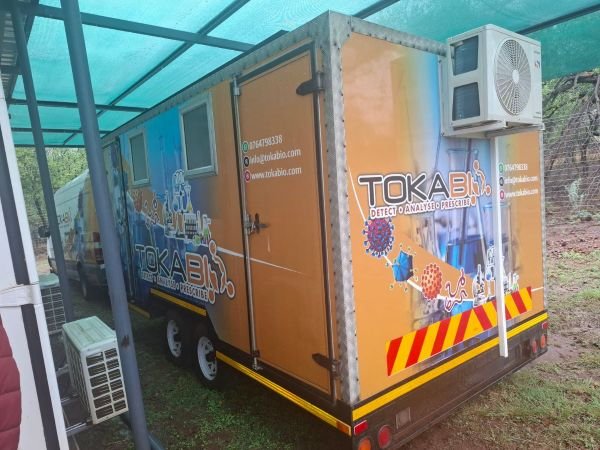
The Technology Innovation Agency (TIA), an entity of the Department of Science, Technology and Innovation (DSTI), has invested R14 million in TokaBio to support the development of its Molecular Rapid Response and Bio-surveillance Programme.
The programme enhances South Africa’s capacity to identify and address livestock diseases, including Foot-and-Mouth Disease and Avian Influenza, which pose risks to the nation’s agricultural sector and commodity exports.
TokaBio has established a Fourth Industrial Revolution (4IR) driven mobile laboratory in Modimolle, Limpopo, focused on Avian Influenza surveillance within the ostrich industry. The entity also has a laboratory in KZN, commissioned to support nationwide Foot-and-Mouth Disease surveillance.
“South Africa’s economy cannot sustain the repeated loss of foreign markets from the recurring disruptions caused by livestock disease outbreaks. Securing our nation’s agricultural sector, preserving jobs, and maintaining our edge in global trade depends heavily on accelerating innovation, “said Dr Titus Mathe, CEO of TIA.
“TIA’s investment in TokaBio exemplifies how government funding for technology can extend beyond research and development to enable practical solutions that can be implemented in real-world settings. Swift and precise livestock disease detection is essential to safeguarding farmers, enhancing biosecurity, and maintaining the competitiveness of South African agricultural products in global markets,” said Mathe.
Protecting the livestock economy and export potential
Livestock products plays a significant role in South Africa’s economy, contributing to employment, food security, rural livelihoods, and economic activity throughout the agricultural value chain.
However, livestock disease outbreaks can have consequences extending well beyond individual farms. They can disrupt production, restrict animal movement, and result in temporary or prolonged restrictions on the export of livestock and animal-derived commodities.
The Molecular Rapid Response and Bio-surveillance Programme aims to address this challenge by enhancing the nation’s capacity to perform swift, precise, and geographically targeted disease surveillance.
The programme aims to protect beef trade by improving Foot-and-Mouth Disease surveillance in affected areas. It also supports frameworks like compartmentalisation to keep trade moving safely.
For the ostrich industry, TokaBio has already begun implementing an Avian Influenza bio-surveillance programme, establishing a potential template for broader livestock disease surveillance and rapid-response services.
From public-funded research to commercial technology
“TIA’s investment in TokaBio forms part of our mandate to support the development, demonstration, and commercialisation of technology innovations that address national priorities,” said Loyiso Tyira, Chairperson of the Board, TIA.
“As the implementing agency supporting the DSTI’s Bio-Economy Strategy, TIA invests in technologies that harness South Africa’s biological resources to address challenges in areas such as food security, agriculture, health and economic development,” said Tyira.
“The Molecular Rapid Response and Bio-surveillance Programme investment demonstrates how funding can help move biotechnology innovations from development towards commercial deployment and practical impact in the agricultural sector.”
Supporting South Africa’s position in global livestock markets
The global demand for meat and other livestock-derived commodities offers African countries an opportunity to expand their participation in international agricultural markets.
“Maintaining access to lucrative export markets is especially important to South Africa for the sustainability of commercial farming, rural economies, and the broader agricultural value chain,” said Dr Phiyani Lebea, Chief Scientific Officer at TokaBio.
“The Molecular Rapid Response and Bio-surveillance programme seeks to ensure that disease outbreaks do not automatically lead to prolonged loss of market access by strengthening the country’s ability to detect, contain, monitor, and demonstrate control of livestock diseases,” said Lebea.
TIA believes that the commercialisation and diffusion of technologies such as TokaBio’s Molecular Rapid Response Programme can strengthen the agricultural sector’s resilience while positioning South Africa as a leader in biotechnology-driven livestock disease management on the African continent.