

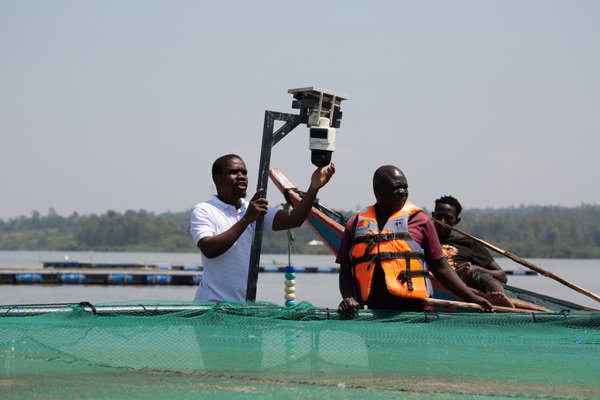
Vincent Oduor (left), CEO of Aquaculture Barn Limited, shows a Chinese-made Hikvision CCTV camera installed above a fish cage at Paga Beach on Lake Victoria, Kisumu County, Kenya. PHOTO BY VICTOR RABALLA / CHINA DAILY
Chinese aquaculture technology and innovative community financing are helping reshape livelihoods around Lake Victoria in western Kenya, increasing fish production while creating new economic opportunities for women and young people.
According to a report by China Daily, modern cage farming is emerging as an important response to declining wild fish stocks, rising demand for tilapia and the social challenges that have affected fishing communities for years.
Floating cages made from high-density polyethylene (HDPE), most of them manufactured in China, are now positioned between 100 metres and 1 kilometre offshore. The cages provide suitable conditions for tilapia while reducing pressure on the lake’s shoreline ecosystems.
The development comes after years of overfishing, environmental degradation and climate pressures reduced catches and intensified competition among fishing communities.
The shortage contributed to the “sex-for-fish” practice, locally known as Jaboya, in which some women traders have been coerced into exchanging sex for access to fish.
China Daily reports that the expansion of aquaculture, combined with local entrepreneurship and community ownership, is helping women gain alternative sources of income and reducing their dependence on traditional fish traders.
At Nyachebe Beach in Homa Bay County, Global Tilapia, a Chinese-invested company, operates 72 HDPE cages covering nearly 90,000 square metres of water. The farm produces between 4,000 and 5,000 metric tons of tilapia annually for markets in Nairobi, Mombasa and Kisumu.
Company manager Li Zepeng said he identified the opportunity after observing Kenya’s dependence on imported fish.
“I realized Lake Victoria had excellent water conditions for raising tilapia,” Li said.
The farm uses modern production techniques to achieve two production cycles annually. Fish weighing about 3 grams can reach an average market weight of 700 grams within six to seven months.
The company also has a strong focus on employment for women. Li said nearly half of the workforce is made up of women working in harvesting, sorting, processing and packaging, adding that the company wants more women to benefit as it expands.
Further south, Aquaculture Barn Limited is using Chinese technology alongside an innovative financing model to bring commercial fish farming within reach of low-income communities.
Its CEO, Vincent Oduor, developed a “lease-to-own” programme after travelling to China under the Global South Rural Entrepreneurship Program.
He said visits to Chinese universities and rural communities demonstrated how productive assets could be made accessible through appropriate financing and government-supported mechanisation.
“It showed us that expensive productive assets can still be made accessible if you have the right model.”
Oduor currently works with four youth groups of about 15 members each, predominantly women aged 18 to 35. His enterprise provides cages, fingerlings, feed and technical expertise, while participants repay the investment from their harvest income and eventually take ownership of the cages.
One participant, 22-year-old Roseline Okanda, said the programme could provide young women with reliable income and reduce their dependence on the sex-for-fish trade by allowing them to participate directly in fish production.
Technology is also being used to protect the farms. Chinese-made Hikvision CCTV cameras powered by solar energy allow operators to monitor cages around the clock and deter theft.
At Takawiri Island, Chinese solar-powered ice-making technology is addressing another challenge: post-harvest losses.
The facility uses 72 solar panels and can produce up to 120 kilograms of ice per hour, helping fishermen preserve their catch despite unreliable electricity supplies.
Plant operator Jacob Ochieng said the unreliable grid remains a major challenge, but noted that the area has abundant sunlight.
“One thing we never run out of is sunshine,” Ochieng said.
The scale of the opportunity is significant. A 2025 Kenya Fisheries Service report cited by China Daily said Kenya produces about 161,000 metric tons of fish annually, compared with estimated demand of 510,000 tons.
Farming accounted for an estimated 76 percent of national aquaculture production in 2024, with Lake Victoria having 5,975 operational cages managed by 634 farmers.
With the Food and Agriculture Organization calling for a major increase in Africa’s aquatic food production by 2050, the developments around Lake Victoria demonstrate how technology, investment and community participation could help close Kenya’s fish supply gap while strengthening livelihoods and women’s economic independence.