



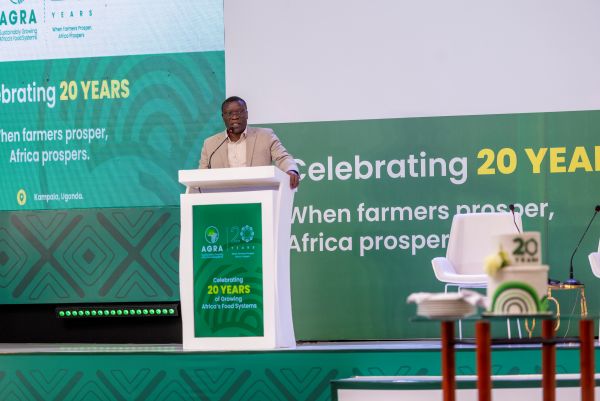
National dialogue calls for stronger agricultural extension, competitive markets, value addition and coordinated investment to turn Uganda’s production potential into farmer incomes, jobs and regional trade.
Uganda must accelerate the movement of agricultural innovations from research institutions to farmers, strengthen extension services and expand value addition if the country is to convert its agricultural potential into higher incomes, jobs and food security, leaders said at a national dialogue marking AGRA’s 20th anniversary.
The AGRA@20 Uganda Country Celebration, held at Kampala Serena Hotel, brought together government officials, agricultural researchers, farmers’ organisations, private-sector leaders and development partners to assess two decades of progress and identify priorities for the next phase of Uganda’s agrifood transformation.
Opening the dialogue, AGRA Country Director, Mr David Wozemba said the organisation’s experience over the past two decades had reinforced that Africa’s agricultural transformation must be driven by African institutions, science and solutions designed for the continent’s conditions. He said stronger links among research, public policy, markets and investment would be essential to make food systems more productive, inclusive and resilient.
Dr. Patience Rwamigisa, Commissioner for Extension Coordination, Ministry of Agriculture, Animal Industry and Fisheries (MAAIF) said Uganda should increase investment in agricultural extension and build stronger partnerships among universities, research institutions, government agencies and other organisations so that knowledge and proven technologies reach farming communities.
He also called for better coordination of public and development-partner investments to reduce duplication and address neglected priorities.
He pointed to the Parish Development Model, through which approximately UGX 1.3 trillion is flowing directly to communities, as an opportunity to organise production and strengthen agriculture at parish level. He also urged sustained investment in soil health, sustainable land management and climate-smart agriculture.
“We have a strong agricultural research system. However, how do we move those technologies beyond research institutions and into farmers’ fields?” Dr Patience Rwamigisa, Commissioner for Extension Coordination, MAAIF
Two decades of measurable results
AGRA began working in Uganda in 2006, initially supporting the development of national research capacity. Over the past 20 years, it has funded 49 master’s and 20 doctoral students in plant breeding and soil science. Their work contributed to the release of 59 crop varieties, 56 of which were commercialised.
AGRA’s programmes have reached 427,806 farmers with information on value chains, mechanised services, crop insurance and market prices. The organisation supported the launch of seven seed companies, helped expand national seed inspection and certification capacity, and worked with partners to strengthen access to quality seed and crop-specific fertiliser blends.
In markets and finance, AGRA supported the construction or rehabilitation of 440 aggregation centres and helped small and medium-sized agribusinesses generate US$21.1 million in regional grain trade over three years. Its interventions leveraged US$62.8 million investment for agribusiness SMEs, while credit-guarantee schemes unlocked US$25 million in lending and reached more than 50,000 farmers.
Next phase: markets, resilience and jobs
Under its Uganda Strategic Plan 2024–2028, AGRA is prioritising inclusive and competitive markets, quality seed systems, sustainable farming, and stronger policy and state capability. The strategy seeks to improve the competitiveness of maize, beans and rice while supporting value addition and trade across other priority crops, including soybeans, cassava, sorghum and groundnuts.
The approach is aligned with Uganda’s ambition to build an agribusiness economy that advances food security, export growth, import substitution and job creation. It also builds on Uganda’s ability to produce tradeable food surpluses for regional markets in East Africa.
The anniversary dialogue examined three priorities: raising agricultural production and productivity; using inclusive markets and trade to stimulate value addition and farmer incomes; and strengthening policy and state capability as anchors of resilient agrifood systems. Participants also discussed the partnerships Uganda will need over the next 20 years to position itself as a major food producer for Africa.
AGRA continues to work with the Government of Uganda on national and continental priorities, including implementation of the Comprehensive Africa Agriculture Development Programme Strategy and Action Plan 2026–2035, seed-system strengthening and climate resilience. Emerging partnerships include the Agrifood System Transformation for Youth Employment programme with Mastercard Foundation and collaboration with the World Bank on agricultural trade and data systems.




[…] Credit: Source link […]
Comments are closed.