

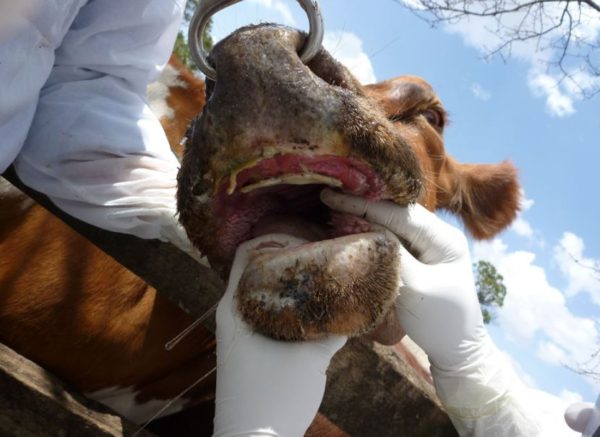
On 25 May 2026, the North Gauteng High Court ruled that farmers may source Foot-and-Mouth Disease (FMD) vaccines directly from accredited importers, manufacturers, or their agents, and administer them without a government veterinarian present.
The state vaccination programme remains fully intact, and farmers may now choose to work through state or private veterinary channels. For those who choose to vaccinate independently, the ruling changes more than procurement. It transfers responsibility for the vaccine cold chain directly onto the farm.
That includes how vaccines are stored, monitored, transported, and handled from the moment they arrive to the moment they are administered.
The compliance baseline
Vaccinating independently is not an informal arrangement. Farmers choosing to source and administer FMD vaccines privately now take on responsibilities previously handled within the state-controlled system.
At least five days before vaccination, the provincial director of veterinary services must be notified in writing, including details of how vaccines will be stored, transported, and administered. Within 14 days after vaccination, an affidavit confirming compliance with animal disease regulations must be submitted to the state veterinarian.
In other words: if you vaccinate independently, the cold chain becomes your responsibility, and you may need to prove that you managed it correctly.
The most common mistake
When farmers need to store vaccines on-site for the first time, the instinct is often to use whatever refrigeration is readily available: a domestic fridge, an old bar fridge, or a beverage cooler from a shop or storeroom.
These are common perceived solutions… and the wrong ones.
Vaccines are biological products, not canned goods. They require a tightly controlled cold storage environment that most domestic or commercial refrigeration cannot reliably provide.
FMD vaccines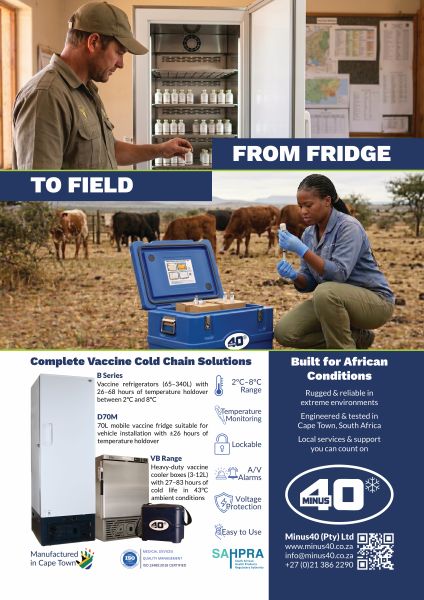 must remain consistently between 2°C and 8°C. But domestic fridges are designed to keep food cold in relatively stable indoor conditions, not to protect pharmaceutical products in fluctuating environments.
On a hot afternoon, temperatures drift upward. On a cold night, they can fall below freezing. A domestic fridge in a hot Karoo storeroom during midsummer may spend hours outside the required temperature range without anyone noticing. The damage is silent.
Heat slowly reduces vaccine potency over time. Freezing can be even more destructive. Both Bioaftogen from Biogénesis Bagó and Aftodoll Oil from Dollvet are oil-based formulations, and both manufacturers explicitly state: do not freeze. A single freeze event can permanently damage the vaccine emulsion, rendering the dose ineffective even if the vial later returns to the correct temperature.
Light exposure creates an additional problem. Vaccines are sensitive to prolonged UV and visible light exposure, particularly when stored in clear-fronted beverage coolers or repeatedly handled in direct sunlight.
And that is the risk: the vaccine that looks completely normal may already have lost efficacy long before it reaches the animal.
The infrastructure problem
Power outages are a fact of life on Southern African farms, whether from load-shedding, storm damage, or a tripped breaker that goes unnoticed overnight. By the time power returns, stock may already have spent hours outside the required temperature range.
That is why vaccine refrigeration cannot rely on electricity alone. Purpose-built vaccine fridges use holdover technology designed to maintain stable temperatures during outages, helping preserve the cold chain even when power is unavailable for longer than a day.
In Southern Africa, that is not a luxury feature but part of maintaining compliance.
From fridge to field
A vaccine that leaves a compliant fridge in a non-compliant container can still be ruined before it reaches the animal.
Once vaccines move into the field, they remain vulnerable to heat, freezing, and direct sunlight. Improvised transport using cooler bags or loose ice packs can expose doses to the same temperature risks the vaccine fridge was designed to prevent.
Purpose-built vaccine transport equipment helps maintain stable temperatures during transport while preventing accidental freezing during field administration. The goal is not simply to keep vaccines cold. It is to keep them stable from storage to administration.
Building a compliant cold chain
Official guidelines for vaccine storage require proper refrigeration and consistent temperature monitoring. That standard is significantly higher than what most repurposed domestic refrigeration can reliably provide.
Before purchasing any vaccine storage equipment, confirm that it is specifically designed to maintain a stable 2°C to 8°C range under real operating conditions, not simply to “keep things cold.”
If your current setup relies on a repurposed household fridge, a bar fridge, or a beverage cooler, it is worth reassessing it before your first order of FMD vaccine arrives.
The court order requires farmers to declare their cold chain protocols in writing before vaccination takes place. That means refrigeration and transport systems need to be documented, consistent, and defensible.
The responsibility now sits with the farm management.
Minus40 manufactures vaccine refrigeration and cold chain equipment in Cape Town. Visit www.minus40.co.za or contact info@minus40.co.za.