

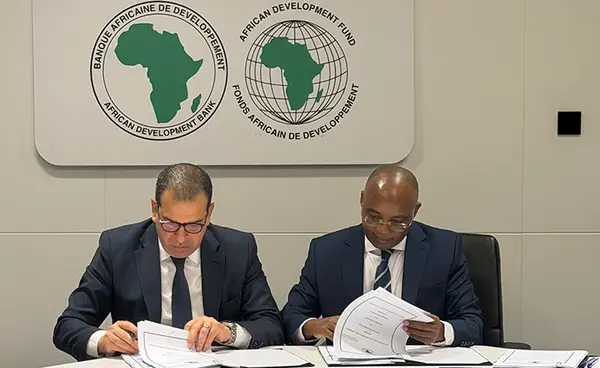
Abdallah Alwardat, WFP Sudan Country Director (L), and David Muthusi Mutuku, AfDB Sudan Country Manager (R), officially launch the BOOST Sudan project during a signing ceremony. Photo: AfDB.
The African Development Bank Group (AfDB) and the United Nations World Food Programme (WFP) have launched an $87 million initiative aimed at strengthening Sudan’s food systems and supporting farmers in key agricultural regions as the country grapples with a deepening hunger crisis.
The four-year project, known as the Boosting Agrifood Systems Resilience in Sudan Project (BOOST), was officially launched on May 22 during a ceremony at the Bank’s East Africa Regional Office in Nairobi. The initiative comes at a critical time, with more than 19 million people in Sudan facing crisis levels of hunger or worse.
BOOST is a collaborative effort between the African Development Bank Group, WFP and other partners to help farming communities restore agricultural production, reduce post-harvest losses, improve household incomes and strengthen access to local markets.
The project will focus on four locations in the rainfed farming areas of Sennar and Blue Nile states, regions that have traditionally served as major crop-producing zones. However, years of conflict and reliance on rudimentary farming practices have undermined productivity, forcing many farmers into subsistence agriculture.
“During recent field visits across the country, farmers who already work with WFP in our resilience activities told me that they did not require food assistance even during the war,” said Abdallah Alwardat, WFP Sudan Country Director.
“On the contrary, farmers supported by WFP have been able to preserve their agricultural schemes and even improve their yields of wheat and sorghum,” he added.
The initiative is expected to benefit more than 230,000 farming households and support the production of nearly one million metric tons of cereals and pulses over the life of the project. According to project estimates, this output would be sufficient to meet the annual cereal consumption needs of almost nine million people and pulse requirements for more than 15 million people.
David Muthusi Mutuku, AfDB Country Manager for Sudan, said the investment underscores the importance of agriculture in the country’s recovery efforts.
“Investing in Sudan’s farmers is investing in the country’s recovery and long-term resilience,” Mutuku said.
“Through this partnership, the African Development Bank is supporting practical solutions that can contribute at scale to staple food production, strengthen rural economies and help communities withstand future shocks.”
Beyond increasing production, BOOST will organize farmer groups for training and agribusiness development, while leveraging the expertise of UN agencies and agricultural research institutions. The project will be implemented by WFP under the Bank Group’s third-party implementation arrangements.
BOOST builds on the success of the ongoing Sudan Emergency Wheat Production Project, also implemented by WFP. Together, these initiatives seek to shift support from short-term humanitarian assistance toward strengthening local food production under emergency conditions.
Since 2023, the African Development Bank Group and WFP have partnered on resilience-building activities in Sudan, with nearly $267 million invested in Bank-financed, WFP-implemented programmes aimed at supporting agricultural recovery and long-term food security.