

As winter approaches in Zambia, gardeners and small-scale farmers are turning their attention to one of horticulture’s most important seasonal practices: pruning. Often misunderstood as simple trimming, pruning is in fact a precise combination of art and science that can transform struggling plants into thriving ones. It is typically done in late August or early September, while many plants are still dormant. Rather than simply cutting back growth, pruning redirects a plant’s energy toward healthier, stronger development.
“Pruning is less about taking away and more about helping plants reach their full potential,” explains Brad Barthorpe, Sales Manager – Distributors Africa for Husqvarna South Africa. “Done right, every cut directs the plant’s energy toward healthier, stronger growth and the change from bare to blooming is truly remarkable.”
Benefits of Pruning
“Pruning delivers other advantages that go well beyond what meets the eye,” adds Barthorpe. He highlights some of the key benefits:
- Encourages better growth: Selective cutting triggers a natural growth response that shifts energy from weak or crowded branches to stronger new growth.
- Reduces disease risk: Thinning dense foliage improves air circulation, making it harder for fungal diseases to thrive.
- Boosts yield and blooms: For fruit trees commonly grown in Zambia, this results in better-quality fruit and improved harvests. For flowering plants, it leads to more blooms and stronger stems.
- Shapes growth: Cutting just above a node helps direct new growth and avoids branch dieback.
- Strengthens structure: Targeted pruning supports healthy, stable plant structure.
- Improves light penetration: More light reaches inner branches, reducing weak, leggy growth.
Seasonal Pruning Techniques
“Pruning is not limited to winter, though,” Barthorpe adds. “Different plants require different methods, depending on the season, dormancy, and when they flower.
- Winter: Ideal for pruning deciduous trees and structural work, as dormant plants handle cuts with minimal stress.
- Spring: Once the risk of frost is over, prune spring-flowering shrubs (after they bloom), evergreen hedges, and frost-damaged perennials to encourage new growth.
- Summer: Focus on controlling growth, deadheading, and shaping, but avoid heavy cutting during peak heat.
- Autumn: Limit pruning, as it can trigger frost-sensitive growth. Stick to light clean-up of spent or diseased growth.
Tips and Safety Practices
For Barthorpe, safety is paramount – starting with PPE, supported by reliable, professional-grade tools such as those of Husqvarna, and guided by the right technique.
He also emphasises the need for sharp, clean tools to create smoother cuts that heal faster and are less likely to attract pests or disease than the rough tears caused by dull blades. He shares some additional tips:
- Taper hedges so they’re wider at the base. Hedge trimmers are the ideal tool for achieving a clean, even shape that allows light to reach lower branches, helping to prevent sparse growth.
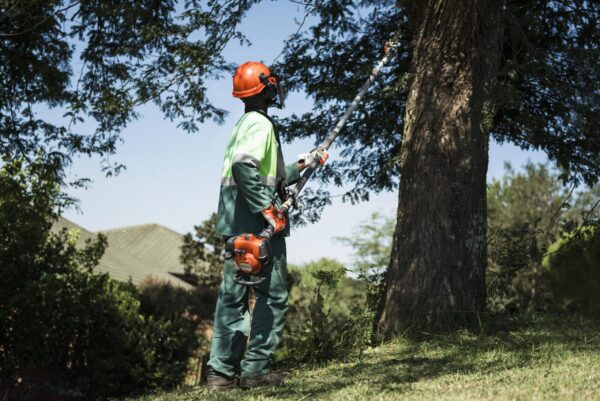
- Use a pole saw to reach high branches safely. Start low, work up, use smooth motions, and cut in stages to avoid bark tearing.
- Trim small flowering shrubs from the bottom up, maintaining proper cutting angles that slope away from buds to shed water effectively.
- For large limbs on mature trees, use the three-cut method: undercut, top cut, then final stub removal to prevent bark damage.
Common Pruning Mistakes
Knowing what not to do is as important as mastering proper pruning methods. Barthorpe highlights what to avoid:
- “Topping” (random cutting of main branches back to stubs) destroys natural plant shape, promotes weak sucker growth, and creates long-term health problems.
- Cutting too close to or far from nodes either damages growing points or leaves vulnerable stubs, which invite disease.
- Removing more than one-third of the oldest, thickest stems annually shocks plants into survival mode rather than promoting thriving growth.
- Using dirty or poorly maintained tools spreads disease-causing organisms between plants, while torn bark from dull blades creates entry points for pests and structural weakness.
- Pruning spring-flowering shrubs in late winter inadvertently removes flower buds and sacrifices the entire season’s blooms.
Mastering the art of pruning is about knowing what to cut, when to cut, and where to cut,” concludes Barthorpe. “Once you can put this into practice, you’ll be able to achieve healthier, better-shaped plants, improved yields, and gardens that truly thrive.”
Visit www.husqvarna.com/zm to browse the full range of Husqvarna pruning equipment.