

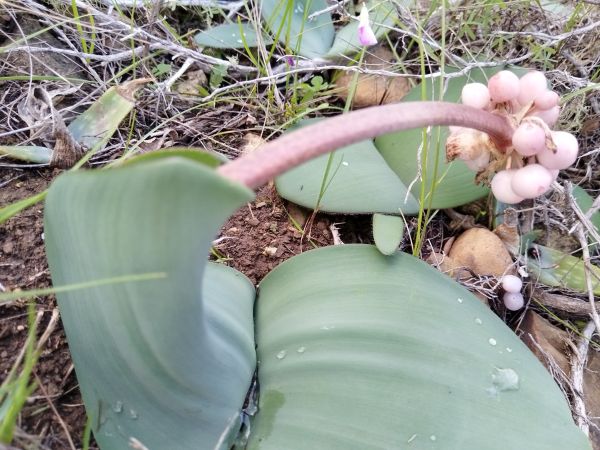
From 24-27 April the annual City Nature Challenge [CNC] by iNaturalist offered international participants a four-day BioBlitz event, using the app to snap photos of fauna and flora in their regions to help track and conserve global biodiversity.
The Wild Rescue nature reserve near Riversdale in the Western Cape hosted free iNaturalist tutorials and guided nature walks on their fynbos trails for the CNC – led by itinerant wildlife expert Shaun Swanepoel, and Claude Schippers from the Gouritz Cluster Biosphere Reserve [GCBR]. Members of the public joined each day to workshop around the online tools, ask questions and train in the field.
iNaturalist (or “iNat” for aficionados) is a world-leading platform revolutionizing our understanding of global biodiversity. Participants use a mobile app or desktop browser to contribute their own nature observations, anywhere, which is then identified and verified by the community. Whether you’re in a national park, out on a hike or merely in your own back yard – iNaturalist is the go-to resource to ID that mystery plant, bird, insect, fungi or just about any other living organism you’re curious about. Metadata such as a GPS location is added to enrich each entry, pinning the finding to a mapped repository which anyone can see. All the data gathered is essential to the detection and understanding of global biodiversity; including the discovery of new species, tracking endangered species numbers and losses, monitoring invasives, the impacts of climate change, and even migratory patterns.
This crowdsourced natural surveyance is part of a broader mission of iNaturalist to help engage people in nature conservation while expanding the data availability for scientists and researchers – useful to anyone from botanists to ecologists to zoologists, to those involved in anti-poaching efforts. Vitally, an observation is deemed research grade when it has two or more positive identifications, with an agreed-upon taxonomy and species verdict. This is when it becomes especially useful for organisations such as the South African National Biodiversity Institute [SANBI], the GCBR or any equivalent international environmental agency, and academia at large. Your observations on iNaturalist may even be featured or referenced in a scientific publication.
However, even if an observation is not identifiable to the species level, an expert identification to family or genus, coupled with teaching the observer what to look for and capture next time is often useful for improving data quality in the future. They’ll make a scientist out of anyone. Usable observations should include at least three photos (or sound recordings for bird calls) showcasing – for example, in the case of plants – the overall profile, above and below leaves, seeds and blossoms (if any) with some close-ups. Blurry photos or photos that have been weirdly cropped or that are all too zoomed-in may cause some difficulties in identification. Notes may also be added in the app by users to flesh out the context and specificity. Was the observation made on a mountain, in a forest, near a body of water or in a desert? For insects, birds and other animals; what kind of plants they were around or perhaps seen to be feeding on? Every remark and detail is valuable. Common mistakes also include having multiple species in one observation or grouping multiple observations on the same species together. For improved GPS tracking users can set their in-app accuracy to an exact location, though it can also be left to a wider area radius. Making connections and friends with other iNaturalist users can be helpful in speeding along the identification of an unknown species, and it’s important to check one’s comments or messages periodically for additional queries.
“iNaturalist as a citizen science programme is specifically designed to help the average person identify and better appreciate nature, to assist people in learning and potentially discover new species. It’s primarily for wildlife, but you can use it literally anywhere, even in your home garden. When taking photos it’s important to make it as clear as possible and don’t be scared to take too many shots. To help with identification, if for example you know it’s a plant then label it as a plant. Don’t leave it as unlabeled and never be scared to enter a basic ID,” said Shaun Swanepoel.
A BioBlitz is an event that focuses on finding and identifying as many species as possible in a specific area and / or over a set period of time. Scientists, volunteers and members of the public collaborate to identify living organisms en masse such as plants, fungi, mammals, reptiles, birds, fish, insects and amphibians – be it in their wild habitats, parks, or closer to the concrete jungle. BioBlitzes are effective at bringing people and organizations together to build collaborative communities of professionals and amateur nature enthusiasts – contributing a huge number of wildlife sightings to aid in nature conservation and serve as a trigger for further outdoor exploration. Apart from official bioblitz events such as the City Nature Challenge, community members can also organise their own at any time.
South African nature-lovers have been industrious in their adoption of the platform as the 5th country to reach 1 million iNaturalist observations, currently with almost 6,800,000 observations to date by over 50,000 people. Key successes in the country include discovery of four new iris flower species in the Western Cape, the rediscovery of a rare South African moth, a rare Red Sundew species, and a Karoo flower which was last seen nearly 200 years ago. Cape Town consistently ranks among the top cities globally for observations and the city offered free access to its nature reserves over the long weekend for the CNC. Significant contributions have been made by the Custodians of Rare and Endangered Wildflowers [CREW] using iNaturalist to survey and protect threatened species, and over 400 invasive species have been mapped nationally.
iNaturalist is a totally free system for citizen scientists. As a non-profit organisation it is financed through sponsorships, donors and universities. For advanced users, developers on open source platform GitHub have created a number of special free utilities for iNaturalist – including a personal dashboard, milestone and achievement tracking, personal field guides, a taxonomy completion checklist and tools to see whether you were the first to identify or observe any species. There are also various active South Africa-focused community projects for those who would like to connect their observations to larger endeavours. Using the tools somewhat in reverse; anyone with green thumbs can utilise iNaturalist to explore a localised inventory of indigenous plants to add to their own gardens. Bird watchers or other wildlife enthusiasts can plan their tourism around where sought-after species have been spotted.
Says Gill Simpson, Executive Director of Wild Rescue nature reserve, “Conservation starts with each person on an individual level and we believe iNaturalist is an important tool that allows anyone to contribute to studying and protecting the wonderful biodiversity of our planet. We hosted iNaturalist workshops for each day of the City Nature Challenge to empower people to use the App. We all need to be citizen scientists to appreciate, and notice, the magical world that is in our very own gardens and living in the Cape Floristic Kingdom. We have such rich biodiversity in South Africa that we perhaps take for granted, but conservation starts with awareness and every human can make a positive difference.”
Noteworthy discoveries for this BioBlitz event are listed on the City Nature Challenge 2026’s Journal and the City Nature Challenge live results page tracks a leaderboard for observation metrics by city. The Garden Route, eThekwini and Overstrand municipality also featured prominently in this year’s BioBlitz. .