

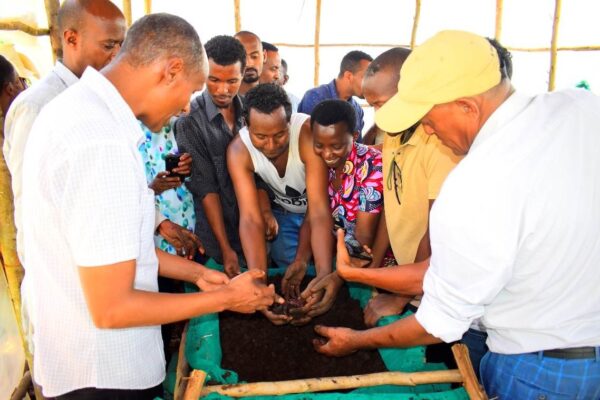
Training of trainers approach supports access to affordable fertilizer solutions for farmers in Ethiopia and Rwanda
The Food and Agriculture Organization of the United Nations (FAO) Subregional Office for Eastern Africa, in collaboration with Facilitators for Change, organized a regional training and study tour on composting practices for farmers and agricultural experts from Ethiopia and Rwanda.
Conducted from 23 to 27 March 2026, the programme brought together farmers, extension officers, researchers and development partners to strengthen practical knowledge and skills in producing organic fertilizers using locally available materials. The training was designed as training of trainers (ToT), enabling participants, particularly lead farmers and extension agents, to cascade the knowledge and skills to other farmers in their communities.
The initiative responds to increasing pressure on fertilizer access and affordability. Strengthening local capacity to produce alternative fertilizers at household and farm level is an important step toward more resilient and self-reliant farming systems. Composting is a practical and low-cost method of converting organic materials, including household and farm waste, into nutrient-rich fertilizer. It provides farmers with an accessible option to improve soil health and crop productivity while reducing dependence on external inputs.
The training and study tour combined classroom-based learning with field-based practical sessions. Technical sessions introduced key concepts and approaches to compost preparation and use, followed by field visits to demonstration sites in selected woredas (districts) in the Jimma zone. Participants observed composting practices in real conditions and engaged directly with local farmers and experts as a way of sharing experiences.
Practical sessions focused on the preparation and management of composting processes and their integration into farming systems. Interactive discussions and group reflection sessions created space for experience sharing and peer learning, helping participants to relate the practices to their own contexts. The programme also contributed to strengthening linkages among farmers, extension services, researchers, private sector actors and development partners working on sustainable soil fertility management.
In addition to building technical capacity, the training fostered collaboration between Ethiopian and Rwandan participants. At the end of the programme, participants developed action plans to support the cascading and scaling up of composting practices in their respective areas.
Promoting sustainable soil fertility through composting
FAO promotes composting as a sustainable approach to managing organic waste and improving soil fertility across Africa. By transforming organic materials into nutrient-rich humus, composting improves soil structure, enhances water retention and supports resilience to climate variability.
Composting using locally available materials provides a cost-effective alternative to chemical fertilizers. It supports the build-up of organic matter, improves soil quality and contributes to more sustainable agricultural production systems.
Proper composting practices also play an important role in reducing pest risks in farming systems. In Rwanda, for example, poorly decomposed organic matter has been associated with increased millipede infestations, which can affect germinating crops. Ensuring proper composting through adequate decomposition, appropriate layering, moisture control and aeration helps fully break down organic materials and reduces conditions that allow pests to thrive.
Well-managed compost therefore not only improves soil fertility but also supports healthier crop establishment by minimizing pest-related risks during early growth stages. Together, these practices contribute to restoring degraded soils, improving crop productivity and strengthening the resilience of farming systems across Eastern Africa.
Related Links : Benefits of using compost