

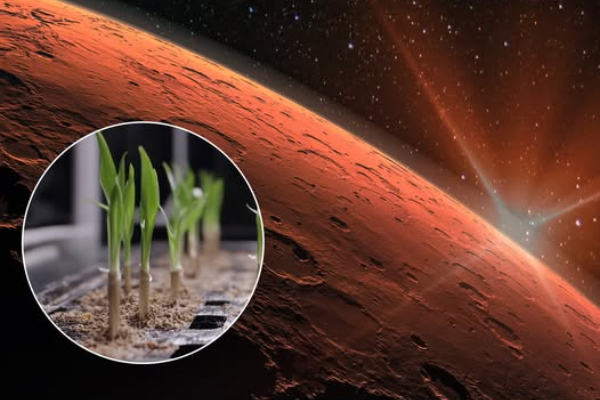
Agricultural innovation is set to reach new frontiers—literally—as Pannar Seed announces plans to test its latest climate-resilient hybrid crop on Mars by 2027.
The initiative marks a groundbreaking collaboration between agricultural scientists, aerospace partners, and global researchers seeking to unlock sustainable food production beyond Earth.
Dubbed PAN Terra-X, the hybrid seed represents decades of research into yield improvement, drought tolerance, and environmental adaptability.
Now, the company says it is ready to subject its innovation to one of the harshest environments imaginable—extraterrestrial conditions characterized by thin atmosphere, extreme temperature fluctuations, and unfamiliar soil composition.
“This mission is about pushing the boundaries of agriculture as we know it,” the company said in a statement. “If humanity is to establish a long-term presence beyond Earth, reliable food systems will be essential.”
From Earth’s fields to Martian soil
Pannar Seed’s confidence in Terra-X stems from extensive trials conducted under simulated Martian conditions. Scientists have tested the hybrid in artificial soils designed to mimic Martian regolith, as well as in low-pressure greenhouse environments that replicate the Red Planet’s atmosphere.
According to the company, germination rates in these controlled experiments have exceeded expectations, suggesting that the hybrid has the resilience required for extraterrestrial cultivation.
Researchers attribute this success to the seed’s genetic traits, which enhance its ability to withstand stress factors such as low moisture availability and temperature variability.
The Terra-X hybrid builds on decades of agricultural research aimed at addressing climate change challenges on Earth. By selecting for traits that enable crops to survive drought, poor soils, and unpredictable weather, scientists may have inadvertently created a candidate suited for space agriculture.
Partnerships powering the mission
The Mars initiative is not a solo effort as Pannar Seed is working alongside leading aerospace firms and research institutions to integrate agricultural science into broader space exploration goals.
These partnerships are expected to play a critical role in transporting, testing, and monitoring the seeds in controlled Martian habitats.
Experts say such collaborations reflect a growing convergence between agriculture and space technology. As plans for human missions and potential colonization efforts accelerate, the need for sustainable, locally produced food is becoming increasingly urgent.
“Food production is one of the biggest challenges for long-duration space missions,” said one researcher involved in the project. “Transporting supplies from Earth is costly and impractical in the long term. Growing crops on-site is the only viable solution.”
Challenges beyond the horizon
Despite promising early results, significant hurdles remain. Mars presents a uniquely hostile environment, and even the most resilient crops may struggle to adapt fully.
Among the uncertainties researchers are investigating are the effects of Martian dust storms on plant development and pollination, as well as how reduced atmospheric pressure could impact growth cycles.
Logistical questions also persist. While partly lighthearted, the company acknowledged the unknown cost of operational inputs in space—joking that even diesel prices on Mars remain to be determined.
More seriously, energy supply, water availability, and habitat design will all play crucial roles in determining the success of any agricultural system beyond Earth.