

Ethiopia has launched an ambitious National Agroecology Strategy for Food System Transformation (2026–2040), marking a significant step toward building sustainable, climate-resilient agricultural systems in one of Africa’s most climate-vulnerable nations.
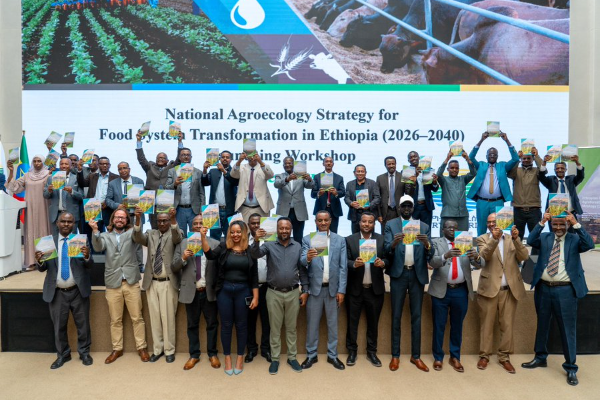
The strategy, unveiled at a national event convened with support from the Center for International Forestry Research and World Agroforestry (CIFOR-ICRAF) and Bioversity International–CIAT, provides a long-term roadmap to promote farming practices that restore ecosystems while improving productivity and livelihoods.
It is being implemented alongside the National Agroforestry Development Strategy (2026–2035), which focuses on integrating trees into farming systems to enhance biodiversity and soil health.
Agriculture remains the backbone of Ethiopia’s economy, employing more than 80% of the population. Smallholder farmers contribute approximately 95% of the country’s agricultural output, making them central to any transformation agenda.
Experts note that increasing climate shocks, land degradation and declining soil fertility have heightened the urgency for more resilient production systems.
The new strategy prioritizes agroecological approaches such as diversified farming, improved soil management, water conservation and the use of indigenous knowledge. These practices are expected to reduce reliance on external inputs while strengthening farmers’ capacity to adapt to climate change.
Developed through a multi-stakeholder process led by the Ministry of Agriculture, the initiative brings together a wide range of international partners. These include the European Union, International Fund for Agricultural Development, Irish Aid, GIZ and the Liechtenstein Development Service. Their involvement reflects growing global interest in agroecology as a pathway to sustainable food systems.
According to information from the launch event, the strategy is designed to align with Ethiopia’s broader development goals, including food security, environmental sustainability and economic growth. It also supports global commitments such as climate adaptation and biodiversity conservation.
Officials highlighted that the roadmap will focus on scaling up proven agroecological practices, strengthening research and extension services, and improving policy coordination.
Capacity building for farmers, extension workers and institutions is also a key component, ensuring that knowledge and innovation reach rural communities effectively.
The complementary agroforestry strategy is expected to play a crucial role by promoting tree-based solutions that enhance carbon sequestration, improve soil fertility and provide additional income streams for farmers through products such as fruits, timber and fodder.
Stakeholders at the launch emphasized that transforming Ethiopia’s food systems will require sustained investment, strong partnerships and inclusive approaches that place smallholder farmers at the center.
By integrating agroecology into national policy, the country aims to reduce vulnerability to climate shocks while improving food security and nutrition outcomes.
The launch positions Ethiopia among a growing number of countries adopting agroecology as a national strategy to address interconnected challenges of climate change, land degradation and food insecurity.
Observers say successful implementation could serve as a model for other nations seeking sustainable pathways to agricultural transformation.