

Rwanda has launched a soil- and crop-specific fertiliser recommendations system designed to transform agricultural productivity across the country’s diverse agro-ecological zones.
According to a recent report for the International Potato Centre-Rwanda by Bester Tawona Mudereri, this shift away from one-size-fits-all fertiliser advice stems from years of scientific research, digital innovation, and multi-stakeholder collaboration that culminated in the establishment of site-specific fertiliser recommendations grounded in robust soil data.
For decades, farmers in Rwanda relied on uniform fertiliser recommendations that did not account for the country’s varied soils, which range from volcanic highlands to sandy plains and clay-rich wetlands, leading to inefficient nutrient use and suppressed crop yields.
The new system is built on the Rwanda Soil Information System (RwaSIS), a national digital platform that captures, analyses, and visualises detailed soil data, including nutrient profiles and erosion patterns, to inform tailored agronomic advice.
RwaSIS integrates advanced tools such as the CGIAR AgWISE decision support system to generate recommendations that match fertiliser types and quantities to specific soils and crop requirements, enabling a scientific approach to nutrient management.
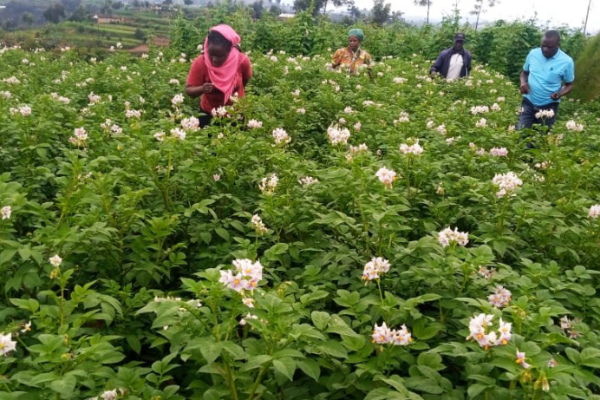
Extensive fertiliser response trials conducted across Rwanda have produced evidence showing potential yield increases of up to 20 per cent for potatoes and stable production for rice, maize, and wheat with reduced fertiliser use, strengthening the case for site-specific nutrient guidance.
To ensure the recommendations are practical and adoptable, over 1,000 validation trials were carried out under semi-controlled conditions, followed by large-scale piloting with more than 8,000 farmers in real farming environments.
A telephone survey of 1,200 farmers captured crucial feedback on adoption behaviour and perceived yield gains, which has been used to refine the recommendations and ensure they are responsive to farmers’ needs.
Delivery of these tailored recommendations at scale has been enabled through integration with Rwanda’s Smart Nkunganire System (SNS), the digital platform used for managing agricultural input subsidies, which now provides parcel-level fertiliser guidance to farmers and extension agents.
The SNS platform has been strengthened through Innovation Packaging and Scaling Readiness (IPSR) processes that identified bottlenecks across the supply chain, improved platform usability, and facilitated large-scale training of master trainers and extension workers.
In parallel, the fertiliser market in Rwanda has opened to private sector participation, inviting qualified suppliers to use the national recommendations to develop crop- and soil-specific blends that meet local needs.
The Rwanda Fertiliser Company (RFC), a joint venture between the Government of Rwanda and OCP Africa, has already responded by launching three locally blended fertiliser products—Twihaze, Ongera and Ongera+—based on the RwaSIS recommendations.
These “Made-in-Rwanda” fertilisers incorporate key nutrients tailored to specific soil constraints and crop demands, helping to address widespread soil acidity and micronutrient deficiencies that have historically limited crop performance.
Government officials at the launch of the new blends noted that this approach ushers in a new era of precision agriculture, with customised solutions expected to increase yields, improve soil health, and enhance resilience against climate variability.
Farmers have welcomed the innovations, with early adopters reporting improved crop responses and expressing optimism that site-specific fertiliser use will boost food security and farm profitability nationwide.
Agriculture stakeholders see Rwanda’s integrated system of soil intelligence, digital delivery, and locally produced fertiliser blends as a model for other African countries seeking to harness data-driven solutions to uplift agricultural productivity and sustainability.