

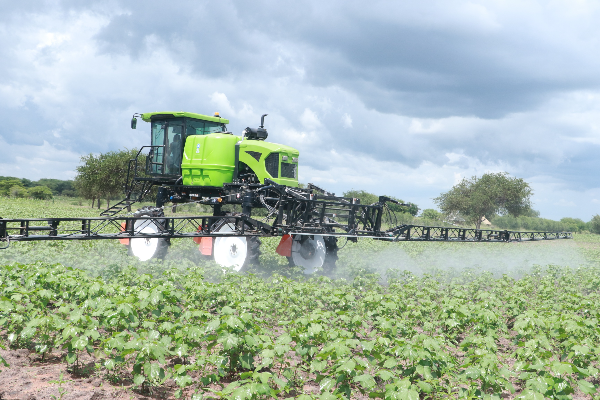
In a major push to modernise cotton farming, the Government of Tanzania, through the Tanzania Cotton Board, has purchased and deployed 16 modern self-propelled boom sprayers across key cotton-producing districts as part of its 2024/2025 financial year agricultural strategy.
The high-tech sprayers have been distributed to five of the eight strategic cotton-producing districts — Meatu, Maswa, Kishapu, Igunga, and Bariadi — where they are expected to significantly improve pest management, cut production costs, and save time for farmers with large farms.
Speaking about the project, Ndinda Anthony, the Board’s Agricultural Officer in Bariadi District, said the machines are targeted at farmers operating on larger acreages who adopt recommended cotton farming practices.
“The Government has purchased and distributed these machines to strategic cotton-producing districts, targeting farmers with large farms. These machines serve farmers who follow proper cotton farming practices, including planting in rows, since the machine operates by moving through the field while efficiently spraying pesticides.”
Anthony stressed that while the machinery is powerful, its benefits depend on farmers adhering to good agricultural practices to boost productivity and ensure correct chemical application.
The initiative marks a clear shift from traditional pest control methods that have long challenged cotton farmers, who typically relied on manual knapsack sprayers that are labour-intensive, slow, and physically demanding.
During a field visit to Kasoli Village in Bariadi District, farmers welcomed the new technology, praising its impact on their daily work. Marco Kayanhale, a farmer and resident of Mwamlapa Village, said the machines have alleviated the strain of spraying duties.
“In previous years, we used knapsack sprayers. On this farm, I used to spend four days spraying and would get very exhausted. Now the Government has brought us a spraying machine — we have seen that it has made the work much easier. I will reduce labour costs and the amount of time spent in the field,” he said.
Kayanhale noted that the new sprayers not only save time but also reduce fatigue that farmers endure while manually operating backpack equipment.
Similarly, Marco Kubagwa, a farmer from Nyanguge Village, said the machines have revolutionised spraying on larger plots. “These machines make spraying much easier for farmers with large farms. In the past, we used knapsack sprayers that caused fatigue and body pains, but now large farms can be sprayed in a short time.”
Echoing these views, Chongela Selemani, an Agricultural Officer under the Building a Better Tomorrow (BBT) programme in Mwamlapa Village, highlighted the efficiency gains. “These machines have greatly simplified the work. Previously, farmers used to spend two to three days to complete spraying one acre of land.”
Selemani added that despite the clear advantages of the modern sprayers, some farmers still need guidance on proper agronomic techniques, especially planting in rows. Extension officers continue to use demonstration plots to educate farmers so they can fully benefit from the technology.
The purchase and distribution of these sprayers form part of broader government efforts to strengthen cotton production, increase farmer productivity, and promote modern, technology-driven agriculture nationwide — a move that aligns with national agricultural transformation agendas.