

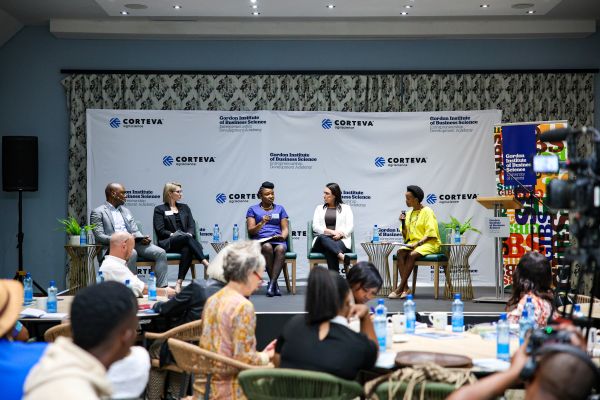
During a recent SoilSistas Round Table discussion held at the Gordon Institute of Business Science (GIBS) in Johannesburg, discussions centred on how women led agripreneurship and technology adoption are shaping profitability, agricultural resilience and food security.
“The SoilSistas initiative, launched by Corteva Agriscience in partnership with the GIBS Development Academy, empowers women in agriculture by addressing systemic barriers. Combining academic learning with practical training in modern farming, finance, marketing and sustainability, the programme aims to position women farmers as business leaders shaping the future of our food system,” said Lerato Luzipo, Communications Manager at Corteva Agriscience.
In her opening remarks, the Programme Manager at GIBS, Mirriam Mashego, highlighted the evolving demands placed on women in agriculture. As a business expands, so too does the complexity, and she emphasised that the SoilSistas initiative aims to equip farmers for what lies ahead.
During the panel discussion, Simóhn Engelbrecht, Head of Trade and Relations at AgriSA, emphasised the importance of prioritising local markets before pursuing exports, noting that credibility and consistency are essential for growth. “The biggest opportunity is not export first, but building a strong and reliable presence in the local market before scaling towards export,” she said.
Addressing market access challenges, Engelbrecht highlighted coordination across the value chain as a key constraint, explaining that traceability, scalability and consistency must be managed together, as buyers do not buy potential but reliability and consistency.
Acting Chief Executive Officer (CEO) of the Land Bank, Jabu Mphambo, reflected on the realities facing emerging farmers seeking funding. From a regulatory perspective, Mphambo emphasised that the Land Bank must comply with strict legal and financial requirements when approving funding. He acknowledged frustrations around access to finance but noted that progress has been made through blended finance schemes.
“We have approved approximately four billion rand in funding across more than 500 farmers. Many of these beneficiaries faced similar challenges to other applicants but were able to meet the requirements. The process can be demanding as farmers also have a responsibility to be prepared and compliant in order to access the funding available.
Offering a farmer’s perspective, Kabelo Puling, CEO of Pula Nala Bataung, an award winning farming enterprise, spoke candidly about the realities on the ground. She described farming as a demanding and capital intensive enterprise, particularly in rural areas, where limited infrastructure and high input costs place additional strain on operations, making long term sustainability difficult to achieve. “Serious consideration needs to be given to the broader role of agriculture in addressing socio economic challenges. We need to use the land we have to create jobs, improve food security and expand the economy especially in rural areas,” she said.
Adding an academic and supply chain perspective, Dr Carla Schutte, a Senior Lecturer and Researcher at the University of Pretoria (TUKS), emphasised the increasing impact of climate related disruptions on agriculture. “We can no longer treat climate events as isolated incidents. We must build systems that are flexible, resilient and prepared, and ensure that digital tools and skills are adopted purposefully, aligned with the readiness and needs of farmers so they can respond effectively and strengthen the resilience of their farming operations,” she explained.
She highlighted the importance of resilience, adaptability and integrated planning, noting that climate events can no longer be treated as isolated incidents. According to Dr Schutte, agricultural systems must be designed to be flexible, resilient and prepared, with digital tools and skills adopted purposefully and aligned with the readiness and needs of farmers to enable more efficient, responsive and sustainable farming operations.
In closing the Round Table, the 2026 cohort of the SoilSistas Women Agripreneur Programme participated in the establishment of a Spekboom garden on the GIBS grounds, honouring women who work the land, create opportunities and strengthen communities.