

In Auckland, GEA experts will discuss technologies for resource-efficient milking, inline quality monitoring, hygienic product distribution, energy-efficient spray drying and aseptic transport.
Dairies face growing pressure to provide more nutrition while using less energy, water and raw material. Yet many plants still optimize individual machines rather than the process as a whole. At the IDF World Dairy Summit 2026 in Auckland, New Zealand (November 15–20, 2026), GEA will show how technologies from dairy farming to aseptic transport can work together along the Better Dairy Journey (booth 11–12). At a technical symposium, Dr. Riccardo Bergamini will outline how dairies can prioritize investments to reduce plant emissions.
Why the dryer matters in New Zealand
RaboResearch identifies New Zealand as the world’s largest single-country dairy exporter, with an estimated 22% share of global dairy exports in 2025 and 53% of global whole milk powder exports. USDA analysis indicates that the country’s product mix is gradually shifting toward cheese, milk fats, infant formula and specialty protein ingredients. For processors, more product variants can mean additional changeovers, cleaning cycles and quality checks. Spray drying also remains one of the most energy-intensive stages of milk powder production.
The losses happen at the interfaces
Plants lose energy as unrecovered heat, product through deviations from specification and production time when residues remain after cleaning. GEA therefore considers the chain as a whole, from milking on the farm through milk reception and processing to drying, packaging, utilities and service.
“Many plants measure efficiency machine by machine. But the losses happen in between: between farm and factory, between the dryer and the energy supply,” says Thorsten Heidack, Senior Vice President Nutrition Plant Engineering Execution APAC at GEA. “If you plan the dryer, heat recovery and cleaning together from day one, you find savings that no single machine would show you.”
“Digital tools help us close these gaps while the plant is running,” Heidack adds. “With GEA OptiPartner®, we actively control the plant and bring in our process know-how. When raw materials or ambient conditions change, the software adjusts the setpoints – on the spray dryer as well as on the chillers and heat pumps that supply cooling and heat. That way, we increase output and reduce energy consumption at the same time.”
Technologies along the Better Dairy Journey
The journey begins on the farm, continues through processing and drying, and extends beyond the factory through aseptic transport.
Resource-efficient milking on the farm: Resource efficiency starts before the milk reaches the dairy. The GEA DairyRobot R9500 milking robot was among the first solutions to receive GEA’s TÜV-validated Add Better label, based on its electricity savings. In independent testing, it used up to a third less electricity and around 13% less water than its predecessor. Because the robot milks each quarter individually, it also reduces milk losses: if one quarter shows elevated conductivity, only that quarter’s milk is diverted, while the milk from the other three still goes into the vat. The Coubrough family in Tīrau, New Zealand, benefits from this on its pasture-based farm, where two DairyRobot R9500 units milk the herd.
Quality control during processing: The GEA OptiPartner® NiSoMate® Quality Analyzer monitors liquids directly at the homogenizer. Without touching the product, an ultrasound sensor measures density, consistency and dilution inline. Operators can detect deviations immediately and adjust settings such as homogenizing pressure. This helps avoid product losses and unnecessarily high homogenizing pressure. NiSoMate® fits all GEA homogenizers and can be retrofitted to existing plants. Leonardo Maggi will demonstrate it at the Speakers’ Corner.
Hygienic product distribution: The CONTA® dual block valve system addresses a hygiene risk in spray drying. Valve blocks distribute liquid feed to the atomizer nozzles, but product can pool in areas that cleaning-in-place (CIP) struggles to reach. The patented design reduces these areas by about 96% compared with its predecessor. Each valve weighs about half as much as a conventional valve, allowing operators to remove and inspect it by hand. In many compatible dryers, the system can directly replace the existing valve block.
Energy-efficient drying: GEA SANICIP® II removes residual powder from the exhaust air of food and dairy spray dryers. Its redesigned dedusting system and patented inlet keep pressure loss low and stable. This reduces compressed-air consumption and cuts electricity use by up to 57% compared with the previous generation. The result earned SANICIP® II the Add Better label, validated independently by TÜV Rheinland. Stable pressure also extends the time between cleaning cycles. The new, shorter filter bags last up to 50% longer and are easier to change. Barry Cole will explain the results in a poster presentation.
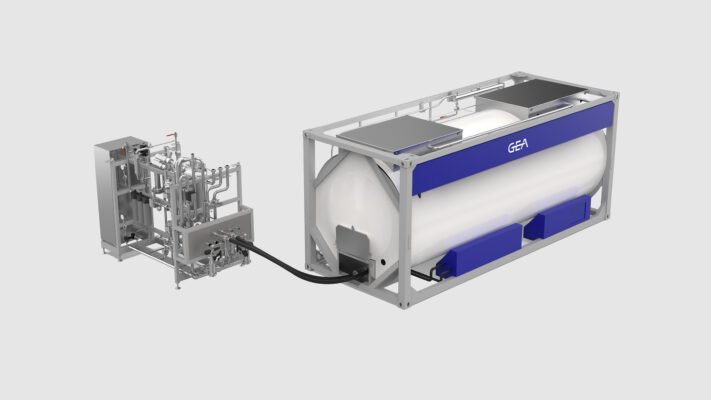
Aseptic transport beyond the factory: The GEA Mobile Aseptic Solution, developed with Singapore-based Oriental Tanks, transports milk, dairy ingredients and plant-based beverages over long distances in liquid form. Producers can thus avoid drying them into powder or filling them into single-use aseptic packaging.
A filling and emptying station connects to a reusable ISO tank container holding up to 20,000 liters. The container can travel by road, rail and sea and serve as temporary storage. A patented concept maintains overpressure with sterile gas throughout the journey to help prevent recontamination. In a full-scale trial, UHT milk traveled from Japan to Singapore.
RaboResearch reports that New Zealand has been China’s leading supplier of imported liquid milk and cream since 2024. For export-oriented producers, the system could help manage seasonal peaks, reach distant markets or supply contract manufacturers.
The DLG (German Agricultural Society) awarded two of its five International FoodTec Award 2027 gold medals to GEA technologies: the Mobile Aseptic Solution and GEA AddCool®. AddCool® integrates a high-temperature heat pump into spray dryers, recovers process waste heat and feeds it back into the dryer at up to 130 °C while also providing ice-water-grade cooling. At Arla Foods’ site in Svenstrup, Denmark, the system cuts natural gas consumption for heating the main drying air by 59%. The jury cited an annual CO₂ reduction of around 1,500 metric tons, depending on the share of renewable electricity. The GEA Ariete Homogenizer 2.0, which combines energy-saving homogenizing valves with the NiSoMate® analyzer, received a silver medal. The award ceremony takes place on February 23, 2027, at Anuga FoodTec in Cologne.
GEA experts in the summit program
The summit takes place at the New Zealand International Convention Centre in Auckland. It brings together dairy farmers, processors, scientists, policymakers and suppliers. Visitors can meet GEA at booth 11–12.
- GEA Technical Symposium: “Engineering for a better world – towards carbon neutrality in dairy plants”
- Dr. Riccardo Bergamini, Global Technical Sustainability Manager at GEA, will explain how dairies can identify the right investments and integrate process steps with energy utilities.
- Tuesday, November 17, 2026, 7:00–8:00 AM NZDT (local time)
- Speakers’ Corner: “From Insight to Impact: NiSoMate® in Action”
- Speaker: Leonardo Maggi, Digital Products Manager at GEA
- Tuesday, November 17, 2026, 1:15–1:30 PM NZDT (local time)
- Poster: Phase inversion of high fat cream to butter oil – Development of a method for quantifying phase inversion in Anhydrous Milk Fat (AMF) and for determining the influence of processing parameters
- Dairy Science & Technology category
- Presenter: Tim Cooper, Business Development Dairy Separation, GEA
- November 16–18, 2026
- Poster: Eliminating a well-known bottleneck in dairy powder production – SANICIP®II
- Dairy Science & Technology category
- Presenter: Barry Cole, Director Application Management Nutritional Formula, GEA
- November 16–18, 2026
- Poster: Utilizing machine vision to reduce labor by automating teat spraying on pastoral farms
- Animal Health & Farm Management category
- Presenter: Ben Morris, Product Manager Pasture, Sheep & Goat, GEA
- November 16–18, 2026